
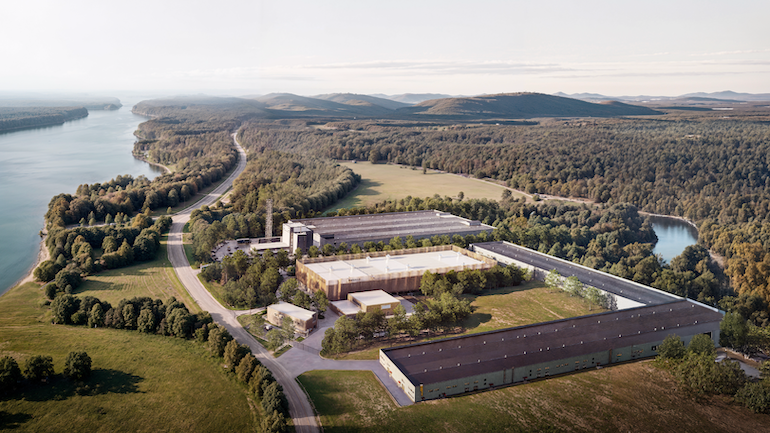
Swedish nuclear energy company Blykalla is proceeding with the next phase of planning for a small modular reactor (SMR) park in Norrsundet, Gävle. The company aims to initiate the permitting process, following initial assessments confirming that the site offers suitable conditions for fossil-free energy production.
The proposed park is envisioned to consist of six of Blykalla’s lead-cooled SEALER reactors, with a total capacity of approximately 300 MW. The project is expected to generate 300-400 direct jobs, as well as several thousand indirect employment opportunities in the region.
Blykalla founded in 2013, is a spin-off from the KTH Royal Institute of Technology in Stockholm. Its SMR prototype SEALER (Swedish Advanced Lead-cooled Reactor) design is a fast compact reactor with passive safety. Each reactor will have a 55 MWe capacity, which can be increased by installing multiple units at the same location. The reactor is designed with the smallest possible core that can achieve criticality in a fast spectrum using 19.9% enriched nitride fuel. It broke ground in February 2025 for the construction of an electrical small modular reactor pilot facility near Oskarshamn to test proof of concept of its SEALER technology.
“The decision to move forward in Norrsundet is based both on the site’s favourable conditions and the growing need for stable, fossil-free electricity to enable industrial development,” said Jakob Stedman, CEO of Blykalla. “Gävle is a strategically important location where new power generation can support long-term growth and strengthen competitiveness.”
The project is subject to approvals from several authorities, including the Swedish Radiation Safety Authority, the Land and Environment Court, the Swedish Government, and Gävle Municipality. Subject to the necessary permits and final investment decisions, the facility could become operational in the first half of the 2030s.
Blykalla will now continue site investigations and detailed studies, alongside maintaining an open and ongoing dialogue with local stakeholders as the project progresses.
Earlier in March, Blykalla signed a Joint Development Agreement (JDA) with fabrication technology company ESAB AB The agreement formalises an industrial partnership to develop and industrialise Blykalla’s proprietary Alumina Forming Steels (AFS) for the SEALER. The companies will together industrialise proprietary alumina-forming alloys that are critical for the corrosion protection of reactor internals operating in high-temperature molten lead process conditions. The companies will carry out dedicated project plans for Blykalla’s AFS. Blykalla will define application requirements and contribute the base materials, while ESAB will lead the formulation, production, and optimisation of alloy-matched filler metals and welding parameters. The work encompasses materials characterization, weldability studies, and mechanical and corrosion testing to establish qualified, production-ready joining solutions.
Blykalla is also collaborating with NEEXT, an engineering firm based in Belfort, France, to optimise the performance of the conventional island for SEALER. NEEXT is contributing its expertise in engineering, design, and advanced modelling to support this development. NEEXT has provided the analytical tools and technical support necessary to evaluate and select the optimal cold source configurations for prospective sites, including both single-reactor and multi-reactor setups. Ongoing efforts are focused on designing a fully integrated power plant.
Meanwhile, Blykalla has opened an office in New York marking “a decisive step in our mission to bring Swedish lead-cooled reactor technology to the North American market”. By establishing a permanent presence in the United States, “we are accelerating the deployment of the SEALER reactor as a primary energy solution for the rapidly growing AI and industrial sectors”. Blykalla said the US “currently offers a uniquely favourable policy environment for advanced nuclear innovation”.
Blykalla has an ambitious timeline, aiming to begin serial production of its commercial SEALER-55 units in the early 2030s. Construction of an electrical (non-nuclear) prototype began in 2024 at Oskarshamn, Sweden, to test the lead-cooled systems. A pilot nuclear plant, SEALER-One, is planned to achieve criticality by 2029. A letter of intent is in place with Studsvik to build this at the Nyköping site.
Blykalla’s technology is built on proprietary assets that aim to address the traditional challenges of lead-cooled fast reactors. A key challenge for lead cooling is its tendency to corrode stainless steel. Blykalla uses a patented aluminium-alloyed steel that forms a self-healing protective layer of alumina on its surface, allowing for long-term commercial operation. The reactor uses 19.9% enriched nitride fuel. This fuel has a 40% higher uranium density than standard fuels, enabling it to last for up to 25 years without replacement or refuelling.
While technical corrosion hurdles are being overcome with the new alloys, the Blykalla’s timeline could be at risk because of the need to obtain regulatory approvals from the Swedish Radiation Safety Authority and the non-availability of high-assay low-enriched uranium (HALEU) fuel, which is the raw material for the nitride fuel.
Western regulators are mostly set up to oversee proven water-cooled technology. A startup needs to teach the regulator how their new technology works, which is a costly process. Quite apart from supply problems with HALEU fuel, because nitride fuel is not currently used in commercial reactors, current efforts are focused on establishing fabrication techniques and securing the necessary isotope enrichment.
Blykalla has scheduled the transition from laboratory R&D to kilogram-scale fuel fabrication in 2026. This is a critical step toward validating the industrial processes needed to produce the dense fuel pellets for the first SEALER-One core. However, nitride fuel needs to use enriched Nitrogen-15, and the only possible supplier is the Aria Project in Sardinia slated for commissioning in 2026. As yet there is no official public contract yet between Blykalla and the Aria project.
There is currently no commercial-scale factory for uranium nitride fuel and Blykalla needs to prove they can manufacture uranium nitride pellets consistently at scale without the fuel crumbling or reacting poorly with lead. They, transitioning from “kilogram-scale” lab tests to the “tonne-scale” needed for a reactor core involves complex chemical engineering that hasn’t been done at scale since the 1960s (and then, only for experimental space reactors). Blykalla has no such infrastructure. And assuming the reactor is built, the problem then arises of dealing with used nitride fuel. All current facilities for processing used fuel are set up for oxide fuels.
While Blykalla’s website has details of the overall design, fuel and the safety features for SEALER, there are no details about the fast reactor technology. This is currently only operational in Russia, where the world’s first ever lead-cooled fast reactor is now nearing completion after decades of government supported research and development on a site that already has a nitride fuel manufacturing facility, with a used fuel recycling facility under construction.


