
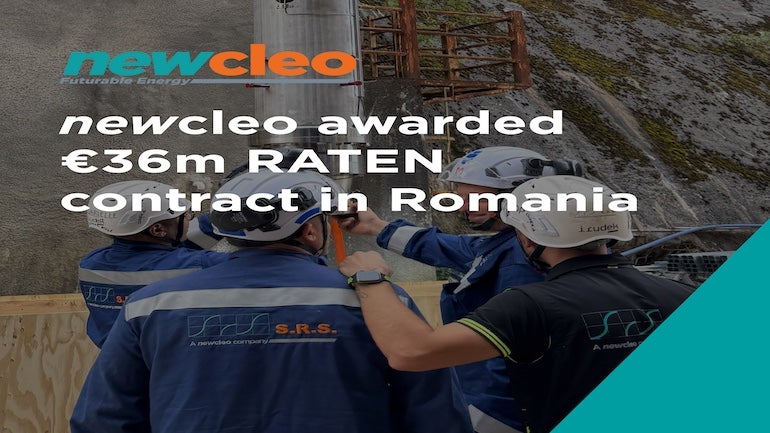
Servizi di Ricerche e Sviluppo (SRS), a subsidiary of France-based nuclear start-up newcleo, has been awarded a €36m ($41.7m) contract for the “Research Activities and Experimental Infrastructure for the Lead Fast Reactors Technology Demonstration” (4ALFRED) European Union funded project. The project is being led by Romania’s state-owned nuclear energy company RATEN and forms part of the broader effort to advance the lead-cooled fast reactor demonstrator ALFRED.
In line with the contract, SRS will design, supply and commission a liquid lead loop-type facility (Helena-2), a liquid lead pool-type facility (ELF) and confined modules to study the interactions between liquid lead and irradiated and non-irradiated fuels during accidents (Meltin’Pot). Building on successful past collaborations, SRS will benefit from the expertise of ENEA (Italian National Agency for new Technologies, Energy and Sustainable Economic Development), which is involved as nominated subcontractor. SRS will deliver the work by the end of 2028.
These facilities will be owned and used by RATEN to investigate thermal-hydraulic behaviour, materials performance and component qualification in liquid lead systems. The infrastructure, to be built at RATEN’s Mioveni site in Romania, is intended to support its roadmap toward deploying lead-cooled fast reactor technology and to strengthen Romania’s participation in next-generation nuclear systems.
To support newcleo’s R&D programme, SRS has recently completed the installation of Othello, a 2 MW loop-type lead test facility for qualifying components and materials in lead-cooled environments. SRS is currently working on the installation of Precursor, a 10 MW pool-type non-nuclear test system scheduled for completion in 2026 at the ENEA Brasimone Research Centre, near Bologna, Italy.
ALFRED (Advanced Lead-cooled Fast Reactor European Demonstrator) is a centerpiece of the European effort to deploy Generation IV nuclear technology. It is a 300 MWth (thermal) reactor designed to generate approximately 125 MWe of electricity, serving as a primary technology demonstrator for future industrial-scale Lead-cooled Fast Reactors (LFR). The reactor is designed to prove that liquid lead technology is safe, sustainable, and economically viable for commercial power generation. The project is managed by the FALCON (Fostering ALfred CONstruction) consortium, led by Italy’s Ansaldo Nucleare, ENEA, and Romania’s RATEN. While originally targeting earlier dates, the focus as of 2026 is on completing the 4ALFRED research infrastructure to provide the safety data necessary for a future construction permit.
The 4ALFRED project involves the construction and operation of six specialised experimental facilities on the Mioveni nuclear platform in Romania. These include: Athena – a large pool-type facility for testing full-scale components and thermal-hydraulic regimes; Helena-2 – a lead loop designed for thermal-hydraulic testing of fuel assemblies and control rods; ELF – focused on the endurance and reliability of primary system components under long-term operation; Meltin’Pot – investigating severe accident scenarios, including fuel-coolant interaction and fission product retention; ChemLab – a specialised laboratory for lead and cover gas chemistry control; and HandsOn – a pool-type facility for testing and qualifying fuel handling machines and procedures.
Newcleo completed 100% acquisition of SRS in October 2023. The agreement to purchase the firm, along with its sister company Fucina Italia, was first announced in June 2023. Before the acquisition, SRS operated as an independent private company within the broader Italian-based SRS Group, which included several engineering and research-focused subsidiaries such as SRS Engineering Design and SRS Energy Solutions. Over its 40 years of independence, it established itself as a leader in nuclear engineering, decommissioning, and liquid lead technology. Its activities focused on translating decades of Research & Development into tangible experimental infrastructure and plant components.
SRS specialised in creating “loop-type” and “pool-type” experimental systems to test how liquid lead behaves as a coolant. The company designed systems such as OTHELLO (a 2 MW lead test facility) to qualify nuclear materials and components for endurance in corrosive lead environments. Before the acquisition, it had already been involved in 24 Lead-cooled Fast Reactor (LFR) projects.
Its customer base included Westinghouse which was developing several lead-cooled experimental systems as part of its Lead-cooled Fast Reactor (LFR) programme. The programme is underpinned by test rigs being developed at its Springfields site in the UK and its Churchill site in the US. Westinghouse is currently using the data from these rigs to finalise the design of a reduced-scale LFR demonstration plant, with construction planned for the 2025–2026 timeframe for global commercialisation of a full-sized plant by approximately 2030.
However, the Westinghouse Lead-cooled Fast Reactor (LFR) is still in the pre-licensing and conceptual design phase and the LFR design has not yet formally entered the UK Generic Design Assessment (GDA) process. Regulatory engagement is currently limited to the Springfields site, where eight test rigs have been operating since 2023 to provide the safety data required for future licensing. A standard UK GDA takes 4-5 years to complete. Even if Westinghouse started the LFR GDA today, it could not receive a Design Acceptance Confirmation until 2030 or 2031. In the US, the LFR is in the pre-application engagement phase with the Nuclear Regulatory Commission (NRC). The IAEA lists the Westinghouse LFR as being in the conceptual design stage as of late 2025.
Another SRS client was ENEA with work involving collaboration on R&D for next-generation reactors, including work at the Brasimone Research Centre. SRS has also designed experimental facilities for the Chinese Academy of Sciences Institute of Nuclear Energy Safety Technology (INEST), which specialises in the development of advanced nuclear energy systems, particularly LFR and Accelerator Driven Systems (ADS).
SRS worked closely with its sister company Fucina Italia, where SRS provided the engineering and design while Fucina handled the physical manufacturing of the liquid lead systems, making them a prime target for newcleo’s ambitious integration strategy.
Stefano Buono, CEO & Founder of newcleo, said: “The vertical integration of key suppliers of the nuclear industry sets newcleo apart from the competition. newcleo isn’t simply designing reactors on paper, we are building real infrastructure that generates value for our customers and investors. This contract underscores our ability to generate revenues in the short term while we continue to deliver on our long-term reactor and fuel projects.”
Newcleo’s key projects are its lead-cooled fast reactors and a planned facility to produce mixed uranium plutonium oxide (MOX) fuel in France targeted for 2030 – both still in the basic design stage, although pre-licensing processes are underway with French regulators. Newcleo has an ambitious timeline:
- 2024–2026: Test the mechanical systems (PRECURSOR);
- 2026–2028: Finalise the “Standard Design” and get the construction permit;
- 2028–2031: Rapid assembly (using modular components built in their own factories);
- 2032: First criticality.
Newcleo has explicitly told regulators that their 30 MWe reactor and the MOX plant are “interdependent projects”. If one fails to get licensed, the other cannot function.
Since its launch in 2021, newcleo has been very active in fundraising and signing partnership and collaboration agreements. Its business now counts over 90 partnerships, with more than 1,000 employees based in 19 locations across France, Italy, the UK, Switzerland, and Slovakia, including three manufacturing facilities. In February it embarked on co-operation with the European EAGLES consortium for development of the LEANDREA (Lead-cooled European Advanced Nuclear DEmonstrator for Research and Applications) project being developed in Belgium. Newcleo’s extensive network involving organisations and companies throughout Europe could potentially complicate co-operation and co-ordination, impacting negatively on its timeline.


