
SMRs hold the promise of mitigating what has historically been one of the most significant delivery risks associated with conventional nuclear projects: delays and additional costs attributable to the licensing process. For the time being, however, as SMRs remain first-of-a-kind deployments, licensing continues to represent a substantial legal and commercial risk. Whether SMRs can fully deliver on the promise of mitigating licensing risk will depend in large part on how the risk is managed in the jurisdictions in which SMRs are deployed. The trilateral cooperation between the United States Nuclear Regulatory Commission (NRC), the Canadian Nuclear Safety Commission (CNSC) and the United Kingdom’s Office for Nuclear Regulation (ONR) could prove to be a significant development and model for reducing licensing risk both in the next generation of SMR projects, and for future conventional large-scale reactor projects.
Trilateral cooperation
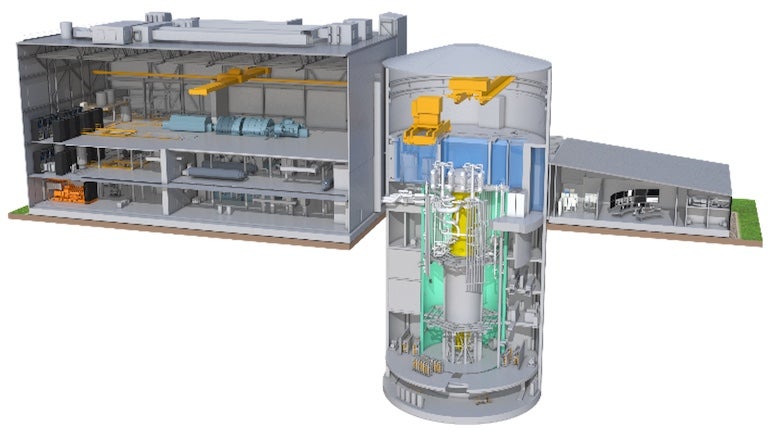
Cooperation between the three nuclear safety authorities builds on the initial cooperation between the NRC and CNSC that has been ongoing for several years. In 2019, the NRC and the CNSC signed a Memorandum of Cooperation intended to facilitate regulatory reviews of advanced reactors and SMRs. Building on this momentum, in March 2024, the NRC, CNSC and the ONR signed a trilateral Memorandum of Cooperation (MoC) designed to enable the exchange of technical assessments, regulatory experience and safety reviews for advanced reactor and SMR technologies. GE Vernova Hitachi’s BWRX-300, a 300MWe boiling water reactor SMR, has become one of the first SMR designs to undergo parallel regulatory review in several major Western jurisdictions. In part due to this cooperation, the licensing of the BWRX-300 has reached significant milestones in all three jurisdictions:
Canada: In April 2025, the CNSC granted Ontario Power Generation a construction licence for the first BWRX-300 reactor at Darlington. Construction is now underway, with commercial operation expected by the end of 2030. As the first commercial deployment of the design, Canada’s regulatory findings have provided valuable experience for subsequent reviews in the UK and US.
United Kingdom: In December 2025, the ONR completed for the BWRX-300 the two-step Generic Design Assessment (GDA), that takes place prior to the detailed proposals for a specific site, enabling regulators to assess new nuclear designs at an early stage. The BWRX-300 completed the GDA process faster than any previous to date. The ONR attributed this quick progression partly to its active collaboration with regulators in the United States and Canada.
United States: On 15 July 2026, NRC staff formally recommended that the NRC issue the construction permit to the Tennessee Valley Authority for its proposed site at Clinch River in Oak Ridge, Tennessee. A mandatory public hearing took place on 13 August 2026, following which the NRC is expected to grant the construction permit in the autumn of 2026.
A broader shift towards cooperation
The NRC/CNSC/ONR collaboration sits within a broader trend of increasing international cooperation on nuclear deployment. In September 2025, building upon the existing trilateral regulatory cooperation, the US and UK announced the Atlantic Partnership for Advanced Nuclear Energy, aimed at reducing duplication in reactor design reviews and increasing acceptance of assessments performed by another regulator. The Partnership aims at a two-year timeline for reactor design approvals and one year for site licensing. The agreement also addresses fusion energy. Other initiatives point in the same direction. In July 2026, the US, Japan and South Korea signed an MoC to support trilateral cooperation on accelerating SMR deployments in third countries, with an initial focus on the Indo-Pacific region. These developments suggest that regulatory cooperation in SMR licensing is gaining momentum.
Practical implications for future nuclear
The practical significance of the trilateral cooperation lies in its potential to reshape how licensing risk is managed in future. Historically, vendors have had to repeat substantial parts of the licensing process across multiple jurisdictions. If the cooperation around the BWRX-300 proves successful, it could provide an example to materially reduce licensing risk for multi-country deployment of technology and enable regulators to draw more readily on the technical work, experiences and lessons learned of their counterparts in other jurisdictions.


