
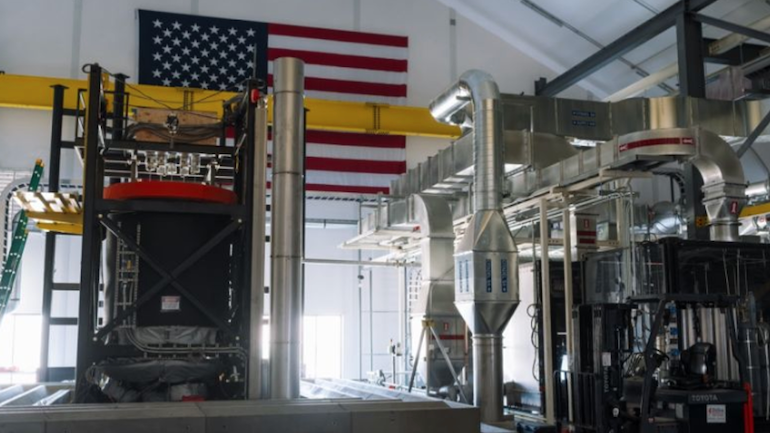
California-based nuclear start-up Valar Atomics achieved a major milestone when its Ward 250 microreactor completed its zero-power fueled criticality demonstration. The experiment took place at the Utah San Rafael Energy Laboratory (USREL) in Emery County, Utah. This marked the first time a Department of Energy (DOE) authorised reactor was built and operated entirely outside of a national laboratory.
The project was executed under DOE’s Reactor Pilot Program. It is the second advanced reactor to hit criticality under President Trump’s May 2025 Executive Order 14301, Reforming Nuclear Reactor Testing at the Department of Energy. Antares Nuclear’s Mark-0 reactor achieved criticality at the Idaho National Laboratory earlier in June.
Zero-power criticality (cold criticality) is a self-sustaining chain reaction of uranium-235 within a nuclear core, but without reaching full operating temperatures or actively removing heat with a working fluid. It makes it possible to better understand the neutronic characteristics of the core and verify assumptions about fuel, moderators, active reactivity control, and burnable poisons. This is the necessary final physics validation before a reactor can begin ramping up its power levels to generate actual electricity.
Ward 250 is a 100 kWt high temperature gas-cooled reactor (HTGR) design that uses TRISO (Tristructural Isotropic) fuel, helium coolant and graphite moderators. When fully operational, it is designed to scale up to 5 megawatts of electricity (MWe). Valar aims to build America’s first nuclear gigasites – clusters of thousands of HTGRs designed to produce industrial power and carbon-based fuels cheaper than oil.
The components of the Ward 250 reactor were manufactured and constructed by Valar Atomics in Southern California, primarily out of their corporate headquarters in El Segundo and their research and development facility in Hawthorne.
El Segundo handled the high-level aerospace-style structural design, integration planning, and overall digital modelling of the Ward 250 platform. It served as the hub for navigating the DOE’s Reactor Pilot Program and managing the rigorous Documented Safety Analysis (DSA) approvals required. The Hawthorne Facility is the hands-on hardware development site. Hawthorne teams built the physical mechanical structures, advanced graphite moderators, and the microreactor shell. Engineers designed the high-temperature automation systems, control room interfaces, and telemetry configurations needed to safely run the reactor remotely from a minivan-sized shipping envelope.
In February, the unfuelled modular components of the Ward250 were transported to March Air Reserve Base near Riverside, California, where they were loaded onto three US Air Force C-17 Globemaster III aircraft to be airlifted to Utah for final assembly and testing.
In September 2025, Valar began ground-breaking for the reactor at USREL, part of the Utah Office of Energy Development (OED). Over 4,000 cubic yards of concrete were poured for the foundations of the Ward250 reactor and the on-site TRISO fuel fabrication facility, which is being built alongside the reactor.
Additionally, Valar developed a “NOVA Core” (a subset of the Ward250 design) for cold criticality testing at Los Alamos National Laboratory (LANL) to validate the physics of the Ward250 before its full operation. In December 2025, the NOVA Core achieved zero-power criticality at LANL’s National Criticality Experiments Research Center (NCERC) at DOE’s Nevada National Security Site (NNSS).
Commenting on the Ward250 criticality, Energy Secretary Chris Wright noted: “From the first-ever airlift of a small reactor aboard a U.S. military C-17 to successful zero-power criticality testing, Valar Atomics is delivering achievements that mark a revolutionary moment for advanced nuclear in this country.”
“Nine months ago, this was an empty site. Today, there’s a critical reactor on it, built and operated by the Valar team,” said Isaiah Taylor, Founder & CEO of Valar Atomics. “We met the milestone the executive order set. This reactor was built to make power, and that’s exactly where we’re headed.”
Valar Atomics was founded in 2023 and emerged from stealth in February 2025. It was one of 11 companies selected in June 2025 by DOE for its Reactor Pilot Program and was also one of four companies selected by DOE in September 2025 to take part in its Fuel Line Pilot Program.
Using DOE authorisation, Valar has completed bypassed the Nuclear Regulatory Commission, against which it took legal action in April 2025. Valar Atomics joined a high-stakes, multi-party federal lawsuit challenging NRC’s regulatory framework. The legal coalition includes several pro-nuclear states (Texas, Utah, Louisiana, Florida, and Arizona) along with advanced reactor startups such as Last Energy and Deep Fission
The lawsuit aims to strip NRC of its monopoly over small-scale designs. Valar explicitly argued that NRC’s rigid and slow processes create “hurdles” that actively stifle domestic innovation, threatening to force American startups to deploy their initial commercial projects overseas.
Under the 1954 Atomic Energy Act, DOE has the independent statutory authority to review, approve, and operate nuclear reactors for research and development purposes parallel to, and independent of, NRC. The Reactor Pilot Program explicitly eliminated the need for NRC expert design reviews for specific advanced test reactors.
However, while Valar bypassed NRC to build and test Ward250 this is not a permanent free pass for commercial sales, which still require NRC authorisation. Valar’s current legal action is an attempt to turn this temporary “testing bypass” into a permanent “commercial bypass”. If the lawsuit succeeds, it could strip NRC of its exclusive commercial monopoly and hand permanent licensing power over to individual states for small-scale reactors.
To date, Valar Atomics has raised a total of approximately $580m in several funding rounds resulting in a $2bn valuation as of April. The company’s rapid financial scaling is heavily tied to the defence-tech establishment, and the energy demands of AI data centres.
Notable Investors include Palmer Luckey (founder of Anduril Industries and Oculus Rift), Shyam Sankar (Chief Technology Officer of Palantir Technologies), Snowpoint Ventures (led by Doug Philippone, former head of global defence at Palantir, who also sits on Valar’s board of directors), John Donovan (former CEO of AT&T and current Lockheed Martin board member).


