
Mitsubishi Heavy Industries (MHI) has secured Japanese government backing for three key projects aimed at pioneering next-generation nuclear reactor technologies. This initiative is funded under the Ministry of Economy, Trade & Industry’s (METI’s) supplementary budget programme to advance domestic energy security and carbon-neutrality goals.
This funding functions alongside Japan’s broader Green Transformation programme, an ongoing state fund supporting development of test fast reactors and high-temperature gas reactors. METI has structured the subsidies to target three separate vulnerabilities in Japan’s nuclear architecture:
- Advanced light water reactors: The funding covers the engineering of enhanced localised safety mechanisms and a standardised commercial design. Standardisation is intended to significantly lower the financial barrier and setup costs for domestic utilities.
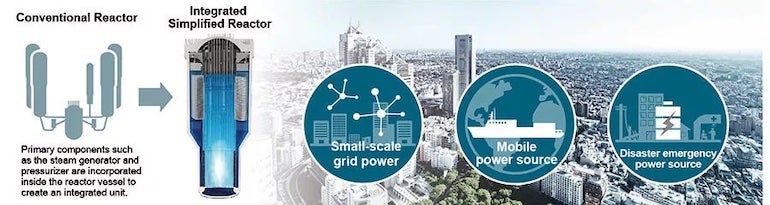
- Small modular reactors (SMRs): This segment finances design and core component technologies to build a domestically engineered SMR. The government’s specific mandate for this project is to tailor the compact reactor’s physical foundation to withstand Japan’s unique seismic and tsunami conditions.
- Supply chain reinforcement: Recognising that Japan’s domestic manufacturing capacity has degraded since 2011, this project funds the development of specialised domestic suppliers, human resources, and high-integrity equipment production networks to ensure the country is not entirely reliant on foreign components.
The state support follows an official declaration in the national nuclear policy guidelines, which legally upgraded advanced light water reactors and SMRs from the “experimental/research” phase to the status of practical deployment. The subsidies are legally anchored to Japan’s Basic Energy Plan. This tasks MHI and partnering utilities with building operational replacement reactors to phase out up to five retiring plants by the 2040s and up to 14 by the 2050s.
MHI is leveraging this support to fast-track its SRZ-1200 advanced light water reactor for early commercial roll-out in Japan. The funding will also assist MHI in engineering a specialised, domestic SMR tailored to Japan’s seismic and tsunami conditions.
The SRZ-1200 is a 1,200 MWe Generation 3+ advanced pressurised water reactor (PWR) engineered specifically to meet Japan’s ultra-strict post-Fukushima regulatory standards. It combines optimised baseload thermal efficiency with advanced passive safety systems.
The underlying power generation mechanics rely on a standard PWR cycle, but with significant mechanical modifications to eliminate historical vulnerabilities. Conventional reactors place measurement sensors at the bottom of the reactor pressure vessel. The SRZ-1200 moves these to a top-mounted in-core instrumentation system, reducing the risk of bottom-localised coolant leaks.
The system features a redesigned pressuriser with a lowered centre of gravity and a high-capacity heater. This slashes the total number of required heaters by half while maximising seismic resistance. Advanced Steam Generators: The loop uses optimised three-quarter-inch heat transfer tubes paired with compact primary and secondary separators to improve thermal efficiency and better resist flow-induced vibrations.
In the event of a severe accident or total station blackout, the SRZ-1200 deploys a series of independent physical barriers designed to restrict radioactive materials entirely within the plant site. The passive system relies on pressurised nitrogen gas to automatically inject massive volumes of emergency cooling water directly into the reactor core the moment system pressure drops.
If a complete core meltdown occurs, water is directed from an elevated refuelling water storage pit using pure gravity injection. In the highly improbable event that fuel melts through the reactor vessel, an integrated core catcher structure catches the molten corium in a dedicated, permanently cooled holding area to prevent it from escaping the containment shell. An advanced containment filtration system scrubs and holds radioactive particles, neutralising pressure buildup without venting toxic material into the environment.
Unlike older nuclear power plants designed strictly for static baseload generation, the SRZ-1200 is built to integrate with a modern grid reliant on renewable energy. Advanced control systems allow the reactor to adjust its power output up or down rapidly to stabilise the grid when solar or wind energy fluctuates. When electricity demand is low, but reactor output is high, the excess thermal and electrical energy can be dynamically routed to integrated hydrogen production facilities.
Japan’s revised nuclear energy guidelines explicitly frame the development of next-generation reactors around a mid-century energy transition. The deployment timeline is split into three phases: immediate engineering validation, targeted reconstruction in the 2040s, and complete structural replacement by the 2050s.
MHI almost completed the basic design for the SRZ-1200 under its Basic Design Phase 2 for Next-Generation Light Water Reactors framework between 2022 and 2024. The current focus is shifting to late-stage component testing and regulatory verification. Before physical construction can start, candidate sites must be locked in. Initial baseline surveys are underway. Once a site is finalised and clears the Nuclear Regulation Authority (NRA) reviews, MHI expects that it will take approximately 10 years to physically construct and commission the first SRZ-1200 reactor.
MHI is developing the SRZ-1200 reactor in close partnership with a core consortium of four major Japanese electric utility companies. These already own and operate existing MHI-built pressurised water reactors (PWRs) and are the primary candidates to deploy the next-generation units.
Kansai Electric Power Co, Japan’s largest operator of PWRs, is busy planning next-generation rebuilds within its existing sites. Kyushu Electric Power Co is positioned to benefit directly from government replacement policies. Hokkaido Electric Power Co collaborates heavily on basic engineering design phases to secure energy stability for northern Japan. Shikoku Electric Power Co works alongside MHI on advanced design verification tests to guarantee compliance with regional seismic criteria.
All four utilities collaborated directly on MHI’s Basic Design Phase 2 for Next-Generation Light Water Reactors to ensure the SRZ-1200 fits practical operator requirements. These utilities provide the physical infrastructure needed for future deployment, aiming to replace retiring reactors seamlessly. The consortium pools technical feedback to streamline safety reviews with NRA.
Government guidelines targeting 2-5 reactors by the 2040s are designed to counteract a drop in supply as early generation reactors hit their maximum 60-year operational limits. The roadmap expands significantly in mid-century, targeting the replacement of 11-14 ageing reactors by the 2050s. During this window, MHI’s operational roadmap transitions from large advanced light water reactors to include its alternative next-generation portfolio, specifically commercial SMRs, high-temperature gas reactors, and fast test reactors.


