
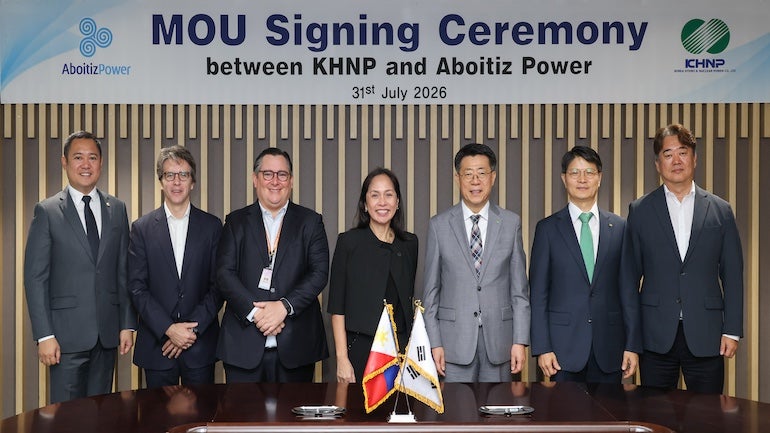
Korea Hydro & Nuclear Power (KHNP) and Philippines energy company AboitizPower have signed a memorandum of understanding (MOU) to explore nuclear energy cooperation in the Philippines. Under the MOU, the two companies agreed to pursue joint pre-feasibility studies, information sharing, and capacity-building activities related to nuclear technologies. The agreement is exploratory and non-exclusive and creates no binding obligations for either party.
AboitizPower Chief Corporate Services Officer Carlos Ramon Aboitiz and KHNP Senior Executive Vice President for the Business Development and Management Division Il-kyung Choi signed the MOU for their respective companies. Also present were AboitizPower President & CEO Danel Aboitiz, Philippines Department of Energy (DoE) Secretary Sharon Garin, and National Power Corporation (Napocor) President & CEO Jericho Jonas Nograles as well as KNHP EVP for the Construction Project Division Seung-oh Hong, and KNHP VP for the Overseas NPP Project Office Geun Park.
Currently, the Philippines is pursuing nuclear energy projects to respond to rapidly increasing electricity demand and enhance energy security, and is laying the foundation for nuclear power projects, including joint surveys of nuclear power plant candidate sites by the government and private power companies.
“This MOU marks a meaningful step in AboitizPower’s efforts to understand nuclear energy’s potential contribution to the Philippines’ energy security and reliable baseload capacity,” said Carlos Ramon Aboitiz. “Nuclear energy is complex and highly regulated, and any future role for it must be grounded in rigorous technical assessment and strong regulatory oversight. We see significant value in learning from KHNP’s decades of experience and we look forward to working alongside the Department of Energy to responsibly assess nuclear energy’s role in the country’s energy future.”
DoE Secretary Sharon Garin underscored the importance of the collaboration in advancing the energy transition in the Philippines, saying the MOU marked a significant milestone. “The transition toward a secure, clean, and reliable energy future cannot be achieved by government alone. It requires strong public-private coordination and the exchange of best practices across borders with experienced industry leaders such as KHNP.”
The interaction between the Philippines and Korea Hydro & Nuclear Power (KHNP) is a decades-long relationship that evolved from exploratory asset assessments to comprehensive governmental pacts and private-sector partnerships. The company has long been the primary technical partner for Filipino nuclear ambitions.
KHNP operates South Korea’s Kori NPP, which features a design identical to the mothballed Bataan NPP (BNPP) built by Westinghouse in the Philippines, which was completed in 1984 but never fuelled in face of environmental concerns, excessive costs and allegations of corruption. The historical foundation of the relationship centres around this facility, the fate of which is still disputed.
In 2008, “Team Korea”, comprising KHNP, KEPCO KPS (Korea Electric Power Corporation Plant Service & Engineering Co) and Doosan, conducted its first preliminary study to determine if BNPP could physically be revived. In 2017, KHNP returned to perform an updated structural assessment. These early studies kept the lines of communication open, although they lacked the binding political and financial frameworks necessary to launch a true rehabilitation effort.
Following former Philippine President Rodrigo Duterte’s 2022 executive order including nuclear energy into the national power mix, interactions shifted toward preparing local workforces. In July 2023, the Philippine Ambassador to South Korea met with KHNP executives to address the country’s severe shortage of domestic nuclear professionals. The following September, KHNP invited Philippine energy journalists and officials to the Kori NPP. KHNP formally offered the Philippines the same institutional training blueprint it had used to construct the Barakah NPP in the United Arab Emirates.
The partnership transitioned from theoretical to operational during a state visit by South Korean President Yoon Suk Yeol to Manila in October 2024 during which the Philippines DoE signed a memorandum of understanding (MOU) with KHNP. Under the agreement, KHNP committed to fully fund a two-phase feasibility study to evaluate the economic and safety viability of reviving BNPP, starting in January 2025. If rehabilitation is ruled out, the MOU permits KHNP to suggest alternative small modular reactor (SMR) options.
In October 2025, DoE and KHNP concluded the 2024/25 Nuclear Power Knowledge Sharing Program (KSP), which had kicked off the previous February. The programme brought DoE together with a consortium of leading South Korean energy and academic institutions, including KHNP, the Korea Energy Economics Institute (KEEI), and the Asia Economic Development Committee (AEDC). Over its eight-month duration, the KSP transferred critical institutional capacity to Filipino regulators through technical site visits to advanced South Korean nuclear facilities, standardising technical pathways and regulatory criteria for future cooperation.
In 2026, interaction expanded beyond state agencies to include the Philippines leading private power conglomerates. During a follow-up state visit by South Korean President Lee Jae Myung in March, a three-way MOU was signed between KHNP, Korea Eximbank, and Meralco, the Philippines’ largest power distributor. This established a blueprint combining Korean technical operating knowledge with local market power distribution infrastructure. The agreement with AboitizPower followed.
KHNP is primarily pitching its next-generation i-SMR (Innovative Small Modular Reactor) design to Philippine distribution utilities such as Meralco and AboitizPower. The i-SMR is a next-generation, integrated pressurised water reactor (PWR) designed by KHNP specifically for export markets requiring flexible grid integration. While the i-SMR undergoes final licensing, KHNP maintains its upgraded SMART reactor design as a commercially ready alternative. Because the original version achieved standard design approval from South Korean regulators in 2012, its regulatory pathway is much more mature than standard SMR concepts.
While KHNP is moving forward with its private sector MOUs, local utilities are not exclusive to South Korean technology. For instance, Meralco is simultaneously utilising a $2.7m grant from the US Trade and Development Agency (USTDA) to review competing American-made SMR designs (such as NuScale or Westinghouse). However, KHNP’s advantage is its ability to bundle its SMR technology with direct sovereign financing options through Korea Eximbank.
The Export-Import Bank of Korea acts as a state-backed financial engine to de-risk and fund the Philippines’ nuclear transition. By shifting from a simple lender to a strategic co-developer, the bank provides the financial architecture needed to make capital-intensive nuclear builds viable for private utilities like Meralco and AboitizPower.
The financial backing is structured around four primary mechanisms. Before major construction begins, Korea Eximbank completely funds early-stage technical and economic feasibility studies. This includes covering the ongoing dual-phase valuation of the BNPP rehabilitation potential SMR grids.
Barakah NPP in UAE, Korea Eximbank launched a specialised K-Finance Package. For the Philippines, this means providing customised sovereign loan structures with extended repayment grace periods to match the lengthy construction timelines of nuclear plants. It also includes offering low-interest project financing directly to Filipino utility consortia if they choose South Korean technology.
Through a landmark tripartite agreement signed with KHNP and Meralco in March, Korea Eximbank provides bilateral credit lines and loan guarantees. ensures that if a local utility signs a contract for a Korean reactor, Eximbank steps in to cover the high upfront capital expenditure (CapEx), drastically reducing the debt-to-equity pressure on the local utility’s balance sheet.
Korea Eximbank is not a new player in the Philippine market. The state lender holds deep institutional credibility in Manila, having previously acted as the primary project financier for major conventional energy milestones in the country, including the Ilijan and Cebu power plants. Local conglomerates view this existing relationship as a safety net against project delays or capital shortfalls.


