
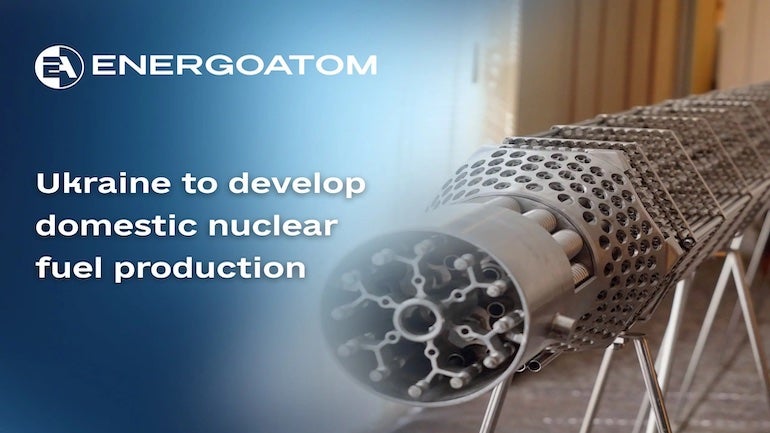
Ukraine’s Cabinet of Ministers has approved the construction of a modern technological complex for the manufacture of fuel assemblies for Ukrainian NPPs within the Pivdennoukrainsk municipal territorial community. The corresponding order has been published on the Government website.
This strategic project, implemented by Energoatom aims to establish a domestic production cycle for nuclear fuel assemblies, primarily for VVER-1000 reactors, which make up the majority of Ukraine’s nuclear fleet, apart from two VVER-440 units at the Rivne NPP.
The planned facility will utilise technology from Westinghouse, which has already certified Energoatom’s production lines for fuel components. Practical implementation follows local community approval granted in September 2025. Energoatom says the first Ukrainian-made fuel assembly is expected to be loaded into a reactor as early as 2027.
Ukraine aims to achieve energy independence by localising approximately 50% of its nuclear fuel needs, with the remaining half supplied through its partnership with Westinghouse. The plant will be located in the Voznesensk district of the Mykolaiv region, near the existing South Ukraine NPP.
According to Energoatom, environmental impact assessments and feasibility studies have already passed state review. The project is now moving into development of detailed project documentation; a comprehensive state examination; and the beginning of physical construction.
Ukraine’s attempts to build a domestic nuclear fuel fabrication plant span over 30 years, transitioning from early post-Soviet partnerships with Russia to the current alliance with the US.
Shortly after independence in 1991, Ukraine attempted to establish a full fuel cycle, including assembly manufacturing, but the project stalled due to a lack of capital and shifting government priorities. A tender was held in 1996 for the construction of a fuel plant which was won by Russia’s TVEL with Westinghouse placed second.
In 2010, the Ministry of Fuel and Energy selected TVEL for a 50-50 joint venture to build a facility in Smolino, Kirovograd region to produce 400–800 fuel assemblies a year for VVER-1000 reactors. Construction began in 2012 but was suspended in 2014 following the annexation of Crimea. The agreement was officially terminated by Ukraine in 2015.
Ukraine then accelerated its “Nuclear Fuel Qualification Project” to integrate Westinghouse fuel into its Soviet-designed reactors, moving away from dependence on Russia. In 2019, plans for a fabrication plant near the South Ukraine NPP were first formally discussed in as a way to localise production of Westinghouse-designed fuel components. A memorandum between Energoatom and Westinghouse in 2021 included provisions for building a fuel fabrication facility in Ukraine, potentially at the Skhidniy Mining and Processing Plant.
Following the start of the conflict in Ukraine, Energoatom ceased importing Russian nuclear fuel. An agreement was signed for Westinghouse to supply 100% of the fuel for the Ukrainian fleet.
Westinghouse has already certified specific structural components of the fuel assembly for production in Ukraine. The primary components that have been qualified for domestic manufacture under Westinghouse’s licence include top nozzles (heads) – the upper structural parts of the fuel assembly; bottom nozzles (shanks – the lower structural parts of the assembly; and expansion shanks – specific sub-components that have been part of the qualification process with Westinghouse since 2018.
These components are manufactured by Atomenergomash, a specialised subdivision of Energoatom. In May 2025, Westinghouse officially recognized this unit as a qualified and approved supplier of these nuclear fuel components. The production typically occurs at the Atomenergomash machine building and repairs plant (RMZ), which is conveniently located in Pivdennoukrainsk.
Ukraine is currently working toward full certification to become an integrated part of Westinghouse’s global supply chain. Currently, the heads and shanks produced in Ukraine are shipped to Westinghouse’s fuel fabrication facility in Västerås, Sweden where they are combined with other elements (such as fuel rods and spacer grids) to create the final “cartridges” for use in VVER-1000 reactors.
The newly approved complex in Pivdennoukrainsk aims to eventually bring this final assembly process entirely within Ukraine. The financing for the construction of the nuclear fuel assembly complex in Pivdennoukrainsk involves a combination of Energoatom’s own funds and international financial support. As the state-owned operator, Energoatom is responsible for the direct implementation, design, and construction of the facility using its internal budget and revenue from electricity sales.
Energoatom has engaged with the Export-Import Bank of the United States to secure loans for nuclear infrastructure projects involving Westinghouse technology. The UK government has previously provided significant loan specifically to support Ukraine’s nuclear fuel independence and procurement from Western partners.
Although Energoatom was transformed into a joint-stock company in January 2024 to improve accountability and align with European governance norms, confidence was shaken in 2025 following “Operation Midas,” the corruption scandal involving a $100m kickback scheme at Energoatom. Investigators from National Anti-Corruption Bureau of Ukraine (NABU) uncovered a system where contractors were forced to pay 10–15% kickbacks to avoid having their payments blocked or losing their supplier status.
Seven individuals were indicted, including former high-ranking officials from Energoatom and the Ministry of Energy. Former Energy Minister German Galushchenko was also charged in February 2026 for his alleged role in the money-laundering operations.
To restore international confidence and safeguard future funding, a new supervisory board was appointed for Energoatom in late 2025, including international experts such as former Westinghouse CEO Patrick Fragman and Canadian nuclear regulator Rumina Velshi.
However, given the previous history of fuel fabrication plans and the recent corruption revelations, it seems unlikely that the 2027 target for producing the first Ukrainian fuel assemblies will be met.


