
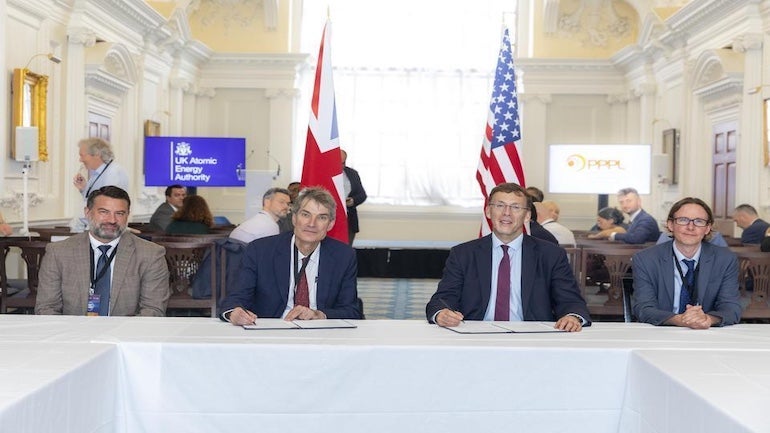
The UK Atomic Energy Authority (UKAEA) and the US Department of Energy’s (DOE’s) Princeton Plasma Physics Laboratory (PPPL) have signed a Joint Declaration of Intent to form the Sunrise–Stellar-AI Federation. This partnership aims to directly tackle the immense computational and data-sharing bottlenecks involved in commercialising nuclear fusion energy. The Sunrise–Stellar-AI Federation builds on a memorandum of understanding signed between UKAEA and PPPL in June, which set out a framework for joint work.
The initiative bridges two newly developed, multi-million-dollar platforms dedicated specifically to fusion and plasma physics. Sunrise (UK) is a £45m ($60m) mission-focused AI supercomputer located at the Culham Campus in Oxfordshire. Stellar-AI (US) is a $13m high-performance computing and AI platform operated by PPPL with support from Princeton University.
By linking these architectures, researchers aim to seamlessly transfer models and experiments between both systems. AI requires massive datasets to make accurate predictions. The federation allows scientists to train a single foundational AI model on experimental data pooled from two distinct, world-leading spherical tokamaks – the UK’s MAST Upgrade and the US’s NSTX-U. Both MAST Upgrade and NSTX-U are well suited for joint AI training. Models built using data from a single machine can struggle to make accurate predictions that apply across different machines.
The supercomputers will be used to build precise, virtual copies (digital twins) of operational fusion reactors. This lets engineers safely simulate how plasma behaves and test reactor modifications in software before executing them on multi-million-dollar physical hardware. Because the two supercomputers use different underlying hardware architectures, a core focus of the federation is enabling computing jobs to move freely so scientists can run simulations on whichever system is best suited for that specific task.
By combining supercomputing power and expertise, the federation aims to shorten the design cycle for future fusion power plants, make better use of existing experiments, and give the next generation of fusion scientists on both sides of the Atlantic a shared platform to build on.
“Fusion is one of the great scientific and engineering challenges of our time. To solve these challenges, fusion needs partnerships,” said Joe Milnes, Executive Director for Engineering and Computing at UKAEA. “The US and UK are two global leaders in fusion research, and the federation of Sunrise and Stellar-AI would build on a long history of transatlantic cooperation to further advance fusion development.
Jonathan Menard, Chief Scientist at PPPL, noted: “A fusion power plant is one of the most complex machines humanity has ever tried to build and no single laboratory or nation will design it alone. By federating the Sunrise and Stellar-AI computer platforms, we can train AI on data from two leading fusion facilities, test ideas across two of the most capable computing systems in the world that are designed for fusion research, and accelerate the path to a compact fusion power plant.”
When different facilities are combined, researchers can develop more powerful machine-learning models that better capture the underlying physics and help accelerate future fusion projects, including the UK’s Spherical Tokamak for Energy Production (STEP Fusion) and US concepts such as PPPL’s Spherical Tokamak Advanced Reactor (STAR). The federation wants to also develop the next generation of fusion and AI experts through training, workshops, research opportunities and other international collaborations.
“UKAEA and PPPL would draw on experimental data from two world-leading fusion machines, using simulation to fill the gaps and extend those datasets into regimes we have yet to explore,” said Rob Akers, Director of Computing Programmes and Senior Fellow at UKAEA. “Together, we can develop digital twins of both machines to support the design of future fusion power plants, creating models of spherical tokamaks that are more predictive, more actionable and ultimately more useful to fusion engineers. The real power will come from working as one team. Together, we can learn faster and learn more, extracting maximum insight. The computing and international collaboration will help us accelerate the journey from today’s experiments to tomorrow’s fusion power plants.”


