
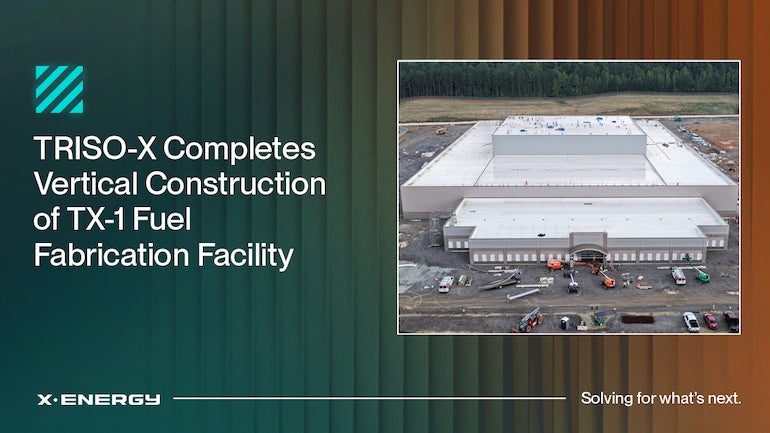
TRISO-X, a wholly-owned subsidiary of X-energy, has completed vertical construction at TX-1, its advanced nuclear fuel fabrication facility in Oak Ridge, Tennessee. This completes the primary building structure of the 214,000-square-foot facility and enables the project to advance fully into its next phase of construction, including interior buildout, installation of fuel fabrication equipment and continued construction of supporting facilities.
“We are moving from constructing the core and shell of the facility to building out the interior utilities, installing manufacturing equipment, and constructing key support capabilities,” said Joel Duling, President of TRISO-X. “Every milestone brings us closer to establishing a new domestic source of advanced nuclear fuel and supporting the deployment of the next generation of American nuclear reactors.”
Vertical construction refers to the phase of a building project where structures are built above ground level, focusing on the upwards assembly of the building’s skeleton and exterior shell. This includes: erecting the structural steel, reinforced concrete columns, or timber beams that form the skeleton of the building; building the concrete elevator shafts, stairwells, structural walls, and laying down the concrete floor slabs for each level; and installing the roof, exterior walls, windows, and “curtain walls” to make the building completely weather-tight.
Clark Construction Group continues to serve as construction contractor, leading interior buildout of the facility’s process equipment and administration building, installation of fuel fabrication equipment, and construction of an adjacent graphite matrix powder building.
Once operational, TX-1 is expected to produce approximately 700,000 TRISO (TRI-ISOtropic) fuel pebbles annually, equivalent to 5 tonnes of uranium, with capacity to provide fuel for up to 11 of X-energy’s planned Xe-100 reactors. TX-1 is being developed initially to support X-energy’s proposed deployment of its Xe-100 advanced small modular reactor at Dow’s UCC Seadrift Operations manufacturing site in Texas through the Department of Energy’s (DOE’s) Advanced Reactor Demonstration Program. X-energy is also advancing additional Xe-100 projects in partnership with Energy Northwest, Amazon, and Centrica as demand grows for secure, reliable, and scalable nuclear energy.
In February, the Nuclear Regulatory Commission (NRC) granted TRISO-X a 40-year Special Nuclear Material Licence for the facility, the first-ever NRC Category II fuel fabrication licence issued for the processing of high-assay low-enriched uranium (HALEU). TX-1 is expected to be the first new commercial-scale advanced US nuclear fuel fabrication facility built in more than 50 years.
In recent months, TRIDO-X has expanded its nuclear fuel campus by approximately 70 acres; extended its cooperative research and development relationship with Oak Ridge National Laboratory (ORNL); initiated construction of TX-L, a dedicated research and development facility; and received economic development support from the State of Tennessee for continued expansion.
The next steps in the TX-1 buildout include:
- Interior utility routing: installing the massive, redundant electrical grids, specialised HVAC air-filtration systems (critical for nuclear material containment), and process piping required to run a Category 2 nuclear facility.
- Building out supporting facilities: constructing adjacent, specialised support structures on the campus, most notably the graphite matrix powder building.
- Administration and laboratory spaces: completing the office infrastructure and the specialised TX-L fuel fabrication laboratory, which will be dedicated to testing, fuel innovation, and manufacturing process optimisation.
- Systems commissioning: transitioning individual rooms into clean-room environments suitable for handling nuclear materials before equipment testing begins.
Fabricating TRISO-X fuel is a highly sophisticated chemistry and material science process. The interior buildout involves installing custom, automated equipment designed to handle HALEU. This includes chemical processing equipment to handle the initial uranium kernels – the tiny fuel centres about the size of a ballpoint pen tip.
These undergo six distinct chemical refining and shaping processes before coating. Massive Chemical Vapour Deposition (CVD) machines will then precisely apply three micro-layered coatings (carbon and ceramic layers) over each kernel. This requires highly controlled gas fractions, precise flow rates, and extreme temperatures to ensure the protective shell is structurally perfect.
Specialised industrial machinery will then mix graphite matrix powder and press roughly 18,000 of the coated kernels together into the final billiard-ball-sized fuel pebbles. Industrial-scale furnaces will cure and harden the graphite fuel pebbles, ensuring they can withstand reactor temperatures exceeding 1,450°C without melting. Advanced robotic scanners, radiological monitors, and precision imaging tools will inspect every pebble for microscopic defects before they are approved for deployment.
The interior buildout, equipment installation, and commissioning phase at the TX-1 facility is expected to take approximately 15 to 18 months, with commercial fuel production optimistically projected to begin in early 2028.
Because the TX-1 plant is a highly sensitive Category II nuclear facility, the regulatory milestones during the interior phase shift from “paper reviews” to physical verification, safety validation, and operational inspections. Although the NRC Special Nuclear Material Licence permits the facility to possess and process HALEUTRISO-X must clear several strict regulatory and operational milestones before any uranium can enter the building.
Because HALEU is highly enriched compared to traditional reactor fuel, the facility must prove it can track every gram of uranium down to microscopic precision. Regulators will audit the digital tracking databases, weight sensors, and automated scanning infrastructure installed during the interior buildout. Investigators will run “dry” commissioning tests in which technicians must prove they can run the lines exactly according to protocol. Engineers must physically verify that the layout of the interior machinery makes accidental criticality impossible. NRC will conduct comprehensive inspections before approving receipt of the first physical shipments of HALEU to begin commercial manufacturing.
Securing the HALEU supply chain is a significant hurdle for next-generation nuclear power. Historically, the global market relied almost exclusively on Russia for commercial HALEU. To break this bottleneck and fuel the TX-1 plant, a domestic supply chain is being secured through a combination of multibillion-dollar federal interventions, strategic private partnerships, and interim stockpiles.
Earlier this year, X-energy solidified its primary supply line by signing a definitive contract with Centrus Energy Corp. X-energy is providing financial prepayments to Centrus to back its commercial expansion. In return, Centrus will supply the necessary HALEU and low-enriched uranium (LEU) to power X-energy’s initial Xe-100 reactor deployments. The uranium will be enriched at Centrus’s American Centrifuge Plant in Piketon, Ohio.
However, Centrus’s centrifuges in Ohio produce uranium hexafluoride (UF6) a gaseous chemical. The TX-1 fabrication facility cannot use gas – its manufacturing equipment requires a solid material, specifically uranium oxide (UO₂) or uranium metal. To provide this, an extra deconversion phase is required. In late 2024, the DOE awarded up to $800m in contracts to companies such as BWXT, Framatome, and Westinghouse to establish robust domestic deconversion lines.
Until the long-term goal of an on-site, co-located deconversion plant is built in Ohio, the material cannot travel directly between Centrus and X-energy. In March, Centrus announced a planned joint venture with advanced reactor developer Oklo to build a dedicated deconversion facility directly on-site at the Piketon, Ohio enrichment campus.
The first commercial-scale US HALEU deconversion operations are expected to begin coming online in 2027-2028. Framatome (at its Richland, Washington site) is modifying existing licensed fuel facilities. which are slated to begin producing tonne quantities of fuel in 2027. Under DOE HALEU Availability Program, a pool of six selected contractors (including BWXT, Orano, and Westinghouse) are designing dedicated commercial deconversion lines. These are being timed to support the broader surge of domestic HALEU enrichment capacity, which is projected to scale up by 2029–2030.
So while X-energy remains on track to finish the physical TX-1 facility buildout in the first half of 2028, having the entire domestic, commercial supply chain synchronised by then is a major hurdle. Because of this timeline squeeze, the industry expects a phased approach rather than a perfectly completed commercial pipeline by early 2028. Centrus Energy Corp is currently producing HALEU at a demonstration scale and has multi-million-dollar DOE backing to expand, its large-scale commercial output from new centrifuge cascades is not projected to fully hit its stride until 2029. Furthermore, industrial-scale deconversion is still being built out
X-energy will therefore likely have to rely heavily on the DOE HALEU Availability Program. With the government releasing portions of its own domestic stockpiles to act as a bridge, giving TX-1 the solid uranium it needs to begin test-runs and early fabrication before the commercial loop from Ohio is fully established.
Because the domestic fuel supply chain is so tight, downstream partners are building flexibility into their timelines. Dow has secured environmental clearances for X-energy’s primary deployment at its Seadrift, Texas manufacturing site. However, citing the complexities of the emerging technology and supply chains, Dow does not expect to make a Final Investment Decision (FID) on constructing the reactors before 2028.
In short: X-energy’s building will be ready to make fuel in 2028, but it will likely start by using temporary government-backed fuel reserves while the broader, commercial enrichment and deconversion pipeline catches up.


