
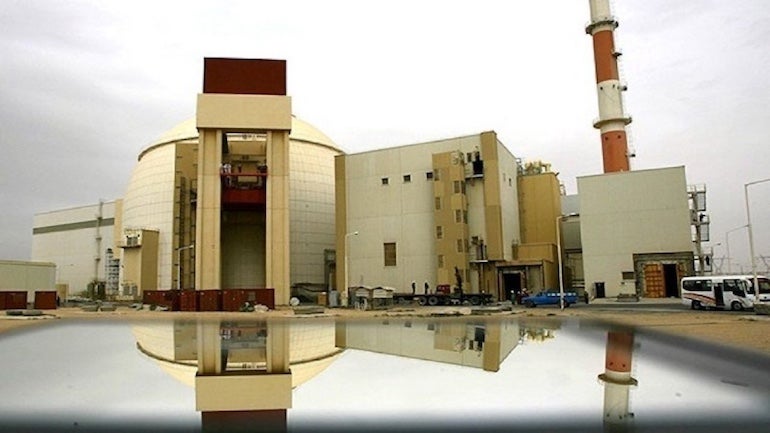
The Atomic Energy Organisation of Iran (AEOI) said the Bushehr NPP has been struck by a projectile, marking the third attack on the facility within 10 days. AEOI said the projectile hit the plant but that the incident caused no human, financial, or technical damage. “Preliminary assessments indicate that, despite the projectile hitting the plant’s premises, no sections of the facility were harmed,” it said in a statement.
The plant is fully operational and contains significant quantities of radioactive materials, the statement noted, warning that “such actions create serious risks to regional security and safety”.
According to Iranian authorities, the operating reactor was not damaged, no radiation release was reported, and the facility remains in normal condition.
Following the second strike, on 24 March, AEOI said in a statement that the US and Israel had targeted the Bushehr NPP again and that “a projectile hit inside the enclosure of the Bushehr power plant”. It added: “Initial reports indicate this incident did not cause any financial or technical damage, or human casualty, and the various areas of the power plant are unharmed.”
The International Atomic Energy Agency (IAEA) in a post on X said it had been informed of the strike noting that Director General Rafael Grossi “reiterates call for maximum restraint to avoid nuclear safety risks”. The first attack on 17 March damaged an area adjacent to the metrological service building. The IAEA reported that the structure, located 350 metres from the plant’s reactor, had been hit by a shell and destroyed.
Following the second attack, Rosatom Director General Alexey Likhachev said the projectile in the latest attack landed in the area of the pumping station. “And this is very worrying, because the pumping station is an element of the security infrastructure. There are no serious violations or damage, but this is a signal that the red lines are being crossed. We understand that the station’s infrastructure, a significant part of security, is not the red line for the parties to the conflict, ” he told reporters.
Russia is assisting with the construction of units 2&3 at the Bushehr NPP, where the first unit with a 915 MWe VVER reactor has been in operation since 2011. Construction of the Bushehr NPP began in 1975 with a West German company but stopped in 1979 after the start of the Islamic revolution. In 1992, Russia and Iran signed an agreement to continue construction of the station using Russian VVER-1000 technology. Unit 1 was officially transferred to Iran in September 2013. First concrete for unit 2 was poured in 2019 and the core catcher was installed in 2024.
Since the recent conflict began, Rosatom has evacuated 250 people from the facility leaving 480 people on site. The day after the second attack, another group of 163 Russian specialists working at the plant set off by car towards the Iranian-Armenian border for further evacuation to Russia. Likhachev said the evacuation of two more groups was planned.
“We are temporarily reducing the number of our specialists on the site to a minimum until the situation normalises,” he said. “The health and lives of our employees are the highest priority for everyone.” He added that only a few dozen personnel would remain on the site.
He also said the evacuation routes have been communicated to the parties involved in the conflict. “First, the Iranian side is providing full support, and second, the routes have been communicated to the Israeli and US leadership through the intelligence agencies. We very much hope that the necessary support will be provided,” he noted. He added that the Russian Foreign Ministry, Ministry of Defence, and Foreign Intelligence Service were also involved in ensuring maximum security for the evacuated citizens. “We are acting as a united front. Everyone is involved, and everyone is working to ensure the safety of people as much as possible.”
Following the third attack on Bushehr, AEOI also reported that the Shahid Khondab Heavy Water Complex in Arak and the Ardakan yellowcake production plant in Yazd Province had been targeted. The strikes did not cause any casualties and there was no risk of contamination, it said.
Countries attacking peaceful nuclear facilities in Iran are undermining the Treaty on the Non-Proliferation of Nuclear Weapons (NPT) and IAEA verification mechanisms, Russian Foreign Ministry spokeswoman Maria Zakharova said.
“The drama of the situation is aggravated by the fact that countries attacking peaceful nuclear facilities in Iran are effectively undermining the NPT, the IAEA’s verification mechanisms, nuclear and physical security conventions, as well as the agency’s relevant regulations,” she said in a statement on the Ministry’s website.
“Carefully crafted and internationally agreed solutions are not taken seriously by these states and can be discarded at any moment in favour of their selfish interests and geopolitical considerations,” she added.
The attacks on the complex in Khondab, the factory in Ardakan, and the shelling near the Bushehr nuclear power plant deserve strong condemnation from the international community, Zakharova stated.”The aggressors continue to raise the stakes in their war in the Middle East, ignoring all associated risks, including the danger of widespread radioactive contamination.”
She added that the IAEA must speak more clearly about the seriousness of threats due to attacks on Iran’s nuclear facilities.”The leadership of the IAEA is obliged to speak more clearly about the seriousness of the threat that Iran’s opponents are trying to ignore, or even deny.”


