
Russia’s Central Design & Technology Institute (TsPTI -Tsentralnii Proektno-Tekhnologicheskii Institut), part of Rosaotm’s Fuel Division, TVEL, has received approval from the Tajikistan state supervisory authorities for design documentation for the rehabilitation of two uranium legacy sites – tailings ponds in Adarasman and industrial complex workshops at the № 3 site in Taboshar in the Sughd region.
Rosatom leads systematic work on the rehabilitation of Soviet mining dump lands period in neighbouring countries (Tajikistan and Kyrgyzstan). Central Asia was an important source of uranium in the former Soviet Union. A large amount of radioactively contaminated material was placed in mining waste dumps and tailing sites and now poses a threat to the environment and the health of the population. All the facilities are now being brought into line with international radiation standards and IAEA safety norms using the best Russian practices.
The CIS [Commonwealth of Independent States] Interstate Target Program (MTsP – Mezhgosudarstvennoi Tselevoi Programmi), Reclamation of territories of states exposed to uranium mining,has already reclaimed tailings ponds in the villages of Min‑Kush and Kadzhi‑Say in Kyrgyzstan), as well as the dump of an ore factory and four industrial site tailings ponds in Taboshar in Tajikistan. Work is continuing under new intergovernmental agreements. In Kyrgyzstan work is underway on the dumps of Too‑Moyun, Kyzyl‑Zhar and in Kadzhi‑Sai (planned to be completed by 2030). Rehabilitation of tailings dam in Adrasman and workshop dumps in Taboshar are planned for Tajikistan.
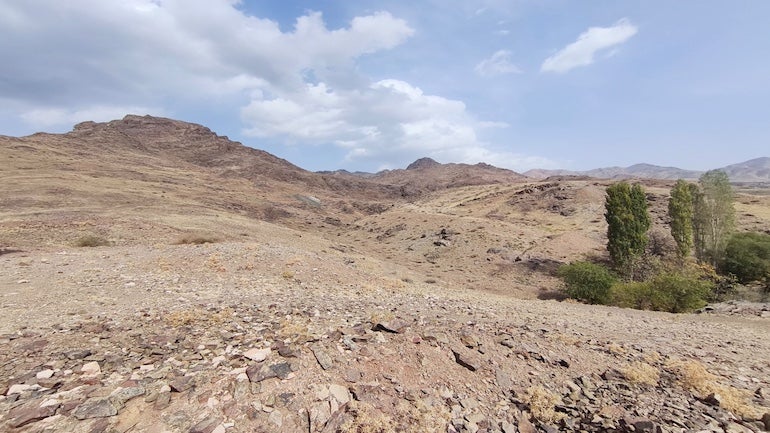
The tailings pond at Adrasman is located in a mountainous area covering an area of 3.45 hectares It is 22–25 metres high with a total volume of accumulated waste 0f 400,000 tonnes. The dump at workshop № 3 occupies about 3 hectares and includes contaminated structures of former industrial buildings.
“The main task of our designers was to develop a design solution to isolate contaminated sites from the effects of natural and anthropogenic factors to improve the environmental and radiation situation in Sughd,” said TsPTI Director General Yakov Nikonov. “Now our specialists have begun preparing working documentation for two objects. I would like to point out that the positive conclusions received from the government agencies of the Republic of Tajikistan confirm the competencies of the TsPTI team as a responsible and trustworthy performer at the international level.”
The project for the tailings dump at Adarasman involves dismantling buildings, installation of a protective screen made of sand and gravel mixture using geosynthetic materials to isolate the outlet of radioactive gas radon from waste ore into the atmosphere. Also, construction of two mudflow channels is required to protect the screen from erosion precipitation and mudflows. When constructing the protective wall, excavation and reverse high-quality backfilling of 9,000 cubic metres of soil will be needed.
Similar activities are planned on the workshop site № 3, where a mudflow channel will be built, combining two streams: Sai Archasoy and Sai Utkem Suu. Its purpose is to protect the insulating screen from debris flows (a mixture of water, mud, large rocks and tree debris), which can form in the mountainous regions of the Sughd region. Work will also entail moving more than 65,000 cubic metres of contaminated soil.
Since 2019, TVEL has been an industry integrator for the business area dealing with nuclear and radiation hazardous facilities and radioactive waste. In 2021, the CIS Economic Council appointed TVEL as the basic organisation for used fuel, radwaste and decommissioning of nuclear and radiation hazardous facilities. The basic organisation provides assistance to CIS member states within the framework multilateral and bilateral cooperation with a view to providing comprehensive solutions the field of handling used nuclear fuel, radioactive waste and nuclear weapons and the implementation of specific projects at nuclear and radiation hazardous sites.
TsPTI specialises in object design and manufacture of equipment for nuclear facilities involved with energy, science and nuclear medicine. Directions of the company’s activities also include decommissioning of nuclear and radiation hazardous facilities and reclamation of radiation-contaminated areas.


