
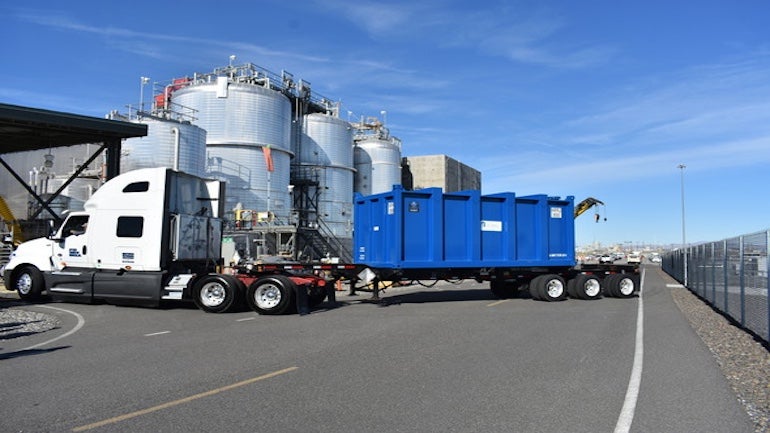
The US Department of Energy’s (DOE’s) Hanford Site in Washington state has begun its first transfer of Effluent Management Facility (EMF) concentrate to a local offsite facility for grouting. This milestone transitions a portion of secondary liquid byproduct, originally destined for vitrification (glass stabilisation), into a more efficient, cost-effective treatment method.
Liquid byproducts from the Hanford Waste Treatment Plant are concentrated at the EMF, mixed with grout locally, and then shipped out of Washington state for permanent commercial disposal. This development directly reduces operational costs, frees up storage capacity to enable continued tank waste retrievals, and expedites the overall cleanup mission. This process serves as a proof of concept for a broader “glass-plus-grout” dual strategy. It allows established grouting methods to safely run alongside the primary vitrification operations that began processing low-activity waste.
With the necessary regulatory permit now in place, the Hanford Site is moving forward with this improvement that will reduce costs, enable continued tank retrievals and expedite the Hanford tank waste mission. The Hanford site was used to produce plutonium over a 40-year period during WWII and the Cold War resulting in 56m gallons of radioactive and chemical wastes, which are now stored in 158 underground tanks.
“This new strategy reflects our commitment to expediting the Hanford cleanup mission in an innovative, efficient and safe manner,” said Ray Geimer, Hanford Field Office Manager for DOE. “By removing the need to reprocess EMF concentrate back through WTP, we can maximise Plant efficiency and treat up to 20% more tank waste.”
The successful use of grouting for EMF concentrate marks an important step in the tank waste mission for Hanford – proving that grout can safely and effectively support waste treatment operations while helping manage byproducts more efficiently. This progress also helps lay the foundation for a broader science-backed dual glass-plus-grout strategy, in which grout works alongside glass operations as a proven and practical tool for accelerating cleanup and delivering better value to taxpayers.
“This isn’t an either-or-situation,” said Geimer. “The people of Washington deserve an all-of-the above approach that includes grout solutions that have been safely and successfully used for decades across DOE and around the globe.”


