
Sweden’s Studsvik has applied to the Swedish Government to establish new nuclear power capacity of 600-1,400 MWe near its existing nuclear site in Nyköping Municipality. Subject to permits, the company is aiming for commercial operation of the first reactors in the 2030s.
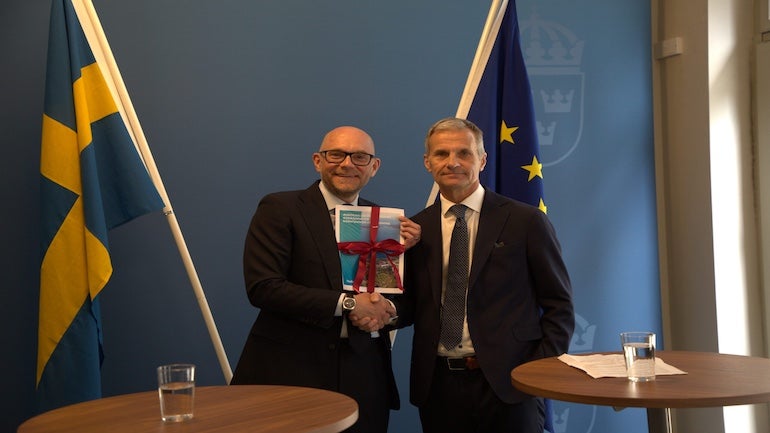
The application was handed to Johan Britz, Minister for Employment and acting Minister for Climate and the Environment, by Studsvik’s President and CEO Karl Thedéen and Christian Sjölander, Head of New-Build Projects. It is the second application submitted to the Government from within the Studsvik Group, following Kärnfull Next’s submission for 1,200–1,600 MWe of SMR capacity at Valdemarsvik in March. Studvik acquired Kärnfull Next earlier this year.
Studvik said further applications may follow as the group’s project portfolio matures. The Nyköping project is part of Studsvik’s ReFirm programme, which came into the group with the acquisition of Kärnfull Next. ReFirm is also pursuing projects at Valdemarsvik, Motala and Karlshamn.
Nyköping sits in the SE3 bidding zone, the same price area as Stockholm, where demand is concentrated and the supply gap is increasingly acute. The Studsvik site is close to the E4 motorway, major energy consumers, Stockholm Skavsta airport and the regional grid, and is already one of Sweden’s most established nuclear environments hosting decades of reactor physics, fuel and materials research and services to operators worldwide.
“Sweden has decided to build new nuclear power, and the country needs new firm, fossil-free capacity on a scale not seen in a generation,” said Karl Thedéen. “Few sites in the country are as ready to contribute as Nyköping. Studsvik combines an active nuclear site and decades of technical expertise with one of Sweden’s most experienced new-build development teams. Our intention is to turn that into real capacity for the Swedish grid.”
“The application is the start of a permitting process,” said Christian Sjölander. “Our task now is to do the technical, environmental and community work needed to build confidence among the municipality, the authorities and our neighbours that this is a project worth backing — and to keep that dialogue going at every stage.”
The Government review is the first stage of an extensive permitting process that will also involve the municipality, the Land and Environment Court and the Swedish Radiation Safety Authority. Any future establishment would require further reviews, permits and approvals under Swedish nuclear, environmental and planning legislation, alongside continued local engagement.
Nyköping Municipality said the issue will be examined within the framework of the formal permit process that applies to nuclear facilities in Sweden. “According to the legislation, the municipality has a so-called veto right and can say ‘yes’ or ‘no’ to the establishment. In order for the establishment to be carried out, the municipality must say ‘yes’. The issue is decided by the municipal council and handled at an early stage of the process.”
Sweden’s updated energy roadmap aims to build the equivalent of 10 new full-scale reactors by 2045 to replace its ageing fleet and meet soaring electricity demand from industrial electrification. Sweden’s parliament in May 2025 approved government proposals for providing state aid to companies seeking to invest in new nuclear. The support will be limited to the equivalent of four large-scale reactors (about 5,000 MWe). The new reactors must be sited at the same location and have a total installed output of at least 300 MWe.
The government’s intervention is designed to “de-risk” nuclear development, as private investors have been hesitant due to massive cost overruns seen in recent European projects. The state plans an initial capital injection of SEK1.8bn ($195m) during 2026–2027 to secure the 60% stake. Beyond the initial purchase, the government is seeking parliamentary authority for up to SEK 34.3bn in construction-period funding. A final decision on technology is expected later in 2026.
In February, the Swedish government announced several proposed measures to make it easier to establish new nuclear power in the country. The new legislation introduced an early-stage government approval process designed to improve predictability and accelerate the deployment of new nuclear capacity.
The following month, Kärnfull Next became the first application under the new Act on Government Approval of Nuclear Facilities. It was the first application for the establishment of new nuclear power in Sweden in 50 years.
“Developments for a new start of Swedish nuclear power and an effective climate transition are now proceeding rapidly,” said Acting Minister of Climate and Environment Johan Britz. “The fact that the government has now received another application for new nuclear power clearly shows that the legislative changes that the government has implemented create the right conditions for companies to want to invest in new nuclear power.”


