
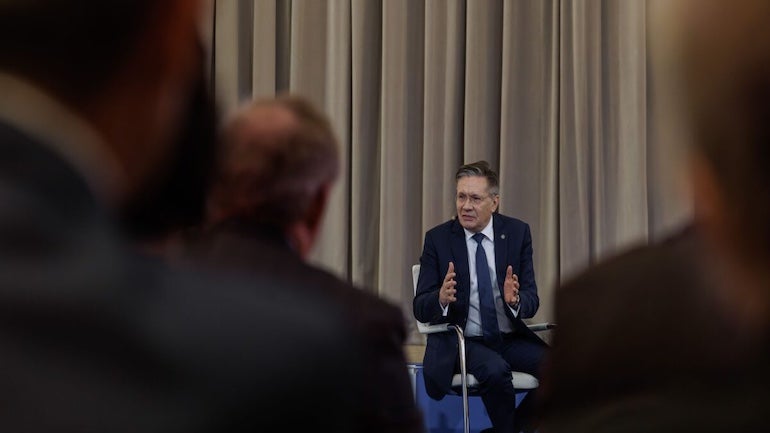
Rosatom’s interim financial results highlight a trajectory of strong economic growth, with 2026 open-part consolidated revenue on track to reach approximately RUB3,400bn ($43.4bn). This outlook, shared by Director General Alexey Likhachev during Director’s Day for central office employees, follows a strong baseline from 2025, where open-part revenue reached RUB3,330bn.
“We are increasing revenue from new products. We expect RUB1,600bn by the end of the year. At the same time, foreign revenue is higher than the target values for this year. In 2028 we are aiming for RUB4,000bn, Likhachev noted. Rosatom plans to grow its “new products” portfolio 1.5 times by 2028, targeting RUB2,200bn in revenue from these technological sovereignty projects. This goal shifts the state corporation’s reliance away from traditional nuclear power, positioning the company as a key driver of domestic tech self-sufficiency
Likhachev emphasised the need to increase efficiency both in operating activities and in the implementation of investment projects. He said Rosatom has created an efficiency committee, developed industry cost optimisation programmes and released the first industry programme for three years.
“Productivity must be increased annually by 12%. This will ensure wage growth of 10% a year. A 20%-a-year yield growth must be ensured. This will allow development projects to be preserved,” he said. “This year we plan to reduce costs by 5%, and in 2028 to gradually reduce costs by more than 10% compared with 2025. This will make it possible to achieve an increase in labour productivity and an increase in profitability against a generally negative economic background.”
He explained that, despite this, Rosatom had maintained a significant investment programme. “We immediately abandoned a number of projects or shifted the timing of their implementation to a later date, guided by several criteria, the main one of which is efficiency in the horizon to 2030, that is, more profit and revenue per Ruble of investment without affecting fulfilment of government tasks. The final size of the investment programme at more than RUB900bn, is still one of the largest in the country.”
He noted that, as part of the implementation of the General Scheme for the Placement of Generating Capacities, Rodstom had already begun to implement approximately half of the planned number of power units in Russia. “Projects for the construction of 18 power units are currently underway at nine sites at various stages of implementation. The Primorsky and Kola NPPs by order of the President, are under special control. In Primorye, a site has been selected for the construction of VVER-1000 reactors. We are currently carrying out survey work, safety justification and registration of land for construction.” With respect to the Kola NPP, operation of the existing units was being extended and preparations were underway for the construction of new ones. “We will build four 600 MWe units there,” he said.
He added: “Separately, I would like to note that the main construction task for this year is to lay the foundation for pouring first concrete on three projects in 2027 – in Primorye, at Beloyarsk where a new powerful BN-1200 reactor will be built, and at the Smolensk station.” He noted that the state target for 2026 is to ensure generation of at least 214 TWh. “We have the opportunity to significantly exceed this figure due to the additional generation from the new unit at the Kursk NPP, a reduction in repairs and a general increase in NPP efficiency.”
Freight traffic on the Northern Sea Route (NSR) is growing. “In the development of the NSR, our cargo transportation volume is growing: as of mid-July, 18.8m tonnes of cargo was recorded, which is 13.7% more than in the same period of last year. The forecast for transportation in 2026 is a record 40m tonnes,” Likhachev said. “On 1 January Rosatom became the single maritime operator for northern delivery. This year we are delivering cargo to three regions – Chukotka, Yakutia and Khabarovsk Territory.”
Rosatom’s role in sovereign logistics secured the transport of over 8m tonnes of oil with the support of the nuclear icebreaker Sibir and enabled the Far Eastern Shipping Company (FESCO) to launch three new international shipping routes to Saudi Arabia, Tanzania, and Cambodia in early 2026, he explained. These operations directly support Russia’s goal to build trade networks independent of Western maritime infrastructure and traditional European markets.
The Project 22220 Sibir cleared paths in the Gulf of Finland near the port of Primorsk during February and March. The crew guided 165 large-capacity vessels, securing the movement of roughly 13% of Primorsk’s annual 60m-tonne oil handling capacity. Using heavy nuclear icebreakers in Baltic sub-arctic waters ensures winter shipping schedules stay on track even during volatile ice conditions.
Rosatom, which holds a controlling stake in FESCO’s parent company, expanded its commercial shipping footprint to alternative global hubs: connecting Russian ports directly to the Middle East to bypass European transshipment hubs; opening direct maritime access to East Africa to tap into growing agricultural and industrial trade; and strengthening Southeast Asian logistics links to complement existing routes to China and Vietnam.
Combining Atomflot’s icebreaker fleet with FESCO’s container ships lets Rosatom manage entire supply chains from end to end. These Baltic and global routes tie into Russia’s broader goal to turn the Arctic NSR into a year-round commercial corridor. Owning the ports, the icebreakers, and the cargo ships lowers the impact of Western insurance bans and shipping restrictions.


