
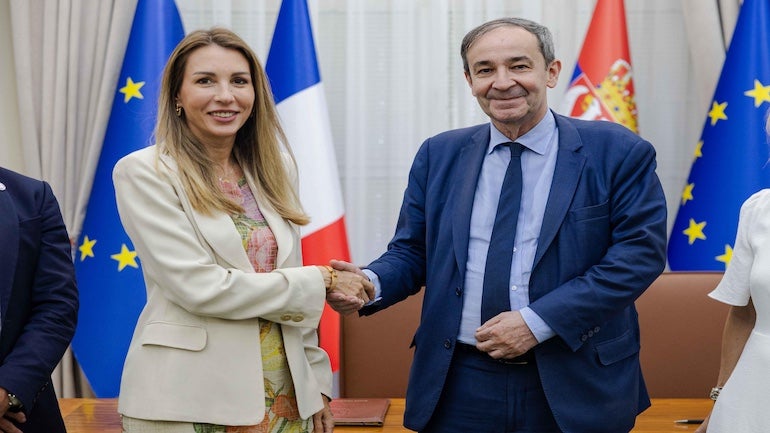
Serbia’s Minister of Mining & Energy Dubravka Đedović Handanović has signed a partnership agreement with Électricité de France (EDF) and the French Development Agency (AFD), which launches Phase 1 of Serbia’s civilian nuclear programme. AFD provided a €500,000 grant ($576,000) to support building professional and organisational capacities in Serbia aimed at improving the knowledge and experience of personnel involved in the nuclear programme.
Serbia’s nuclear programme has rapidly progressed from a 35-year moratorium on nuclear construction to an active institutional planning phase, operating in strict alignment with the International Atomic Energy Agency (IAEA) Milestones Approach. This framework mandates that any country introducing a civilian nuclear programme must evaluate and systematically build out 19 specific infrastructure issues across three progressive development phases. Serbia has now embarked on Phase 1.
In October 2024, the Ministry contracted EDF and French consultancy Egis to perform a Preliminary Technical Study on the Peaceful Use of Nuclear Energy. EDF delivered a 19-step framework in March 2025, in line with the IAEA Milestones Approach establishing critical milestones across three phases. It established that Serbia needs roughly €30m to fully navigate the pre-construction regulatory and administrative hurdles.
In November 2024, the National Assembly voted to lift the 1989 legislative ban that prohibited the construction of NPPs, processing facilities, or nuclear waste sites. The Serbian Energy Sector Development Strategy was formally amended to integrate 1,200 MWe of nuclear capacity into the grid in line with post-2040 decarbonisation goals.
The Nuclear Energy Programme Implementing Organisation (NEPIO) was set up in February 2026 and became fully operational in July. NEPIO is tasked to steer national policy, alongside SRBATOM, the Serbian Radiation and Nuclear Safety and Security Directorate (Direktorat za radijacionu i nuklearnu sigurnost i bezbednost Srbije).
In July, the Ministry held an extensive, four-day structural workshop alongside the IAEA to audit the legal, environmental, and supply-chain vulnerabilities of the grid. To complete Phase 1 of the Milestones Approach, Serbia has committed to completing 18 comprehensive studies. EDF will author three of these primary technical studies, while the remaining 14 are being opened to international tender.
“Our goal is that by the middle of next year, all studies will be completed that will enable an informed decision to be made on the further development of the nuclear programme, said Handanović. “In the years ahead, Serbia must be ready in the institutional, regulatory and professional sense for the choice of technology, and Serbia could get its first nuclear plant after 2040.”
She said: “EDF is the leading operator of nuclear power plants globally, with more than 50 nuclear reactors in France alone and is the world leader in the production of electricity from sources with low carbon dioxide emissions. It is very important for us that at this stage of our nuclear programme, in which we are laying the foundations for nuclear energy in our country, we will be able to use their knowledge, experience and resources, which will be of great use to the experts of the National Body for the Implementation of the Nuclear Energy Development Programme (NEPIO).”
She added that the most important part of this project relates to the development of a human resources. “Personnel represent the most valuable element in the development of the nuclear program in every country, and one of our most important tasks will be the creation of a base of engineers and other personnel who will be able to responsibly and professionally manage nuclear facilities in Serbia in the future,” she said.
AFD’s €500,000 grant represents its first participation in the field of nuclear programme development. With these funds, support will be provided in building professional and organisational capacities necessary for the preparation, development and management of Phase I and part of Phase II of the nuclear programme. The main activities include strengthening the competencies of institutions and professional teams, developing personnel capacities, developing project and management skills, improving safety culture, as well as acquiring technical knowledge necessary for making informed decisions, in accordance with the IAEA recommendations.


