
Maritime nuclear energy start-up Bluecore Energy has secured low-enriched uranium (LEU) to power its planned floating nuclear reactor systems. This comes less than three months after Bluecore Energy emerged from stealth, and just weeks after closing a $50m seed financing round led by Silverton Partners.
The company operates out of the Port of Long Beach, aiming to provide zero-emission offshore electricity via subsea cables to ports, data centres, and coastal industries. Bluecore is building a 10 MWe water-cooled small modular reactor (SMR) system based on established technology packed into thick steel pressure vessels and shielded by concrete. The closed-loop system requires refuelling only once every few years.
The LEU – uranium hexafluoride (UF6) enriched to 4.95% – was procured through global nuclear fuel market intermediary WMC. Unlike traditional financial trading firms, WMC, headquartered in Amsterdam, maintains operational hubs in Denver (USA), Zug (Switzerland), and Hong Kong to seamlessly navigate international regulatory and shipping corridors.
WMC moves, stores, and finances physical nuclear commodities across space and time. This includes trading unrefined uranium oxide (yellowcake), chemically processed uranium hexafluoride (UF6), and enriched uranium products.
WMC Group does not own or operate its own physical conversion or enrichment machinery. Instead, it employs book-transfer systems, tolling agreements, and logistically coordinates transactions across the few heavily licensed, multi-billion-dollar commercial facilities operating globally.
WMC secures raw uranium from global mining projects (such as their exclusive marketing partnership with NexGen’s Rook I project in Canada). WMC manages the transport of raw yellowcake to chemical conversion plants, where it is turned into UF6. These include the Honeywell Metropolis Works in Illinois (the US’s only conversion plant), Cameco’s Port Hope facility in Ontario (Canada’s only conversion facility), and Orano’s facilities in Malvési and Tricastin (France).
Once converted to gas, the material is sent to centrifuge enrichment plants including: Urenco USA’s National Enrichment Facility (NEF) in New Mexico; Urenco’s European plants in the UK (Capenhurst), Netherlands (Almelo) and Germany (Gronau); and Orano’s Georges Besse II in France (Tricastin).
Bluecore said the material “is currently held at a US nuclear fuel facility outside the state of California while Bluecore Energy advances its plans for future fuel fabrication, testing and validation”.
Bluecore Energy has not publicly named the exact facility where its newly purchased uranium is being held. However, industry logistics strongly point to Urenco USA (the National Enrichment Facility) located in Eunice, New Mexico. Because WMC operates heavily out of this facility by managing massive stockpiles of material for its clients via book-transfers, it is the standard logistical holding zone for commercial-grade enriched UF6 before it is shipped off to a fuel fabricator.
The stored UF₆ will eventually be converted into uranium dioxide (UO₂), fabricated into fuel pellets, and assembled into reactor fuel for validation and testing at a leading national nuclear laboratory. Bluecore Energy’s public regulatory filings and environmental reviews reveal that the company is partnering with the Idaho National Laboratory (INL) for its nuclear-specific testing.
Because Bluecore’s reactor uses conventional water-cooled technology, the process of transforming its newly acquired gas into solid fuel elements will follow a highly standardised path, likely executed via a commercial fabricator or in collaboration with facilities associated with INL.
Alongside securing its fuel supply chain, Bluecore Energy is advancing its engineering and maritime pathways in parallel. The company-initiated pre-application discussions with the Nuclear Regulatory Commission (NRC) and the US Coast Guard to align on safety and regulatory compliance for civil maritime nuclear technology. Bluecore has received an Approval in Principle from the American Bureau of Shipping (ABS) for its water-cooled, barge-mounted small modular reactor (SMR) design, establishing a clear technical roadmap for deployment.
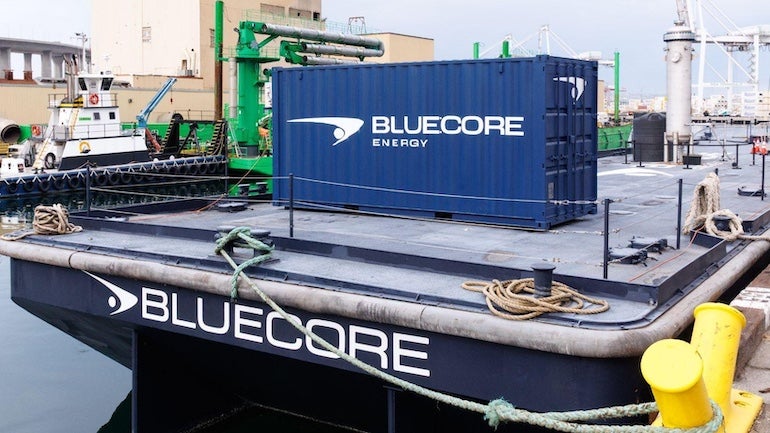
Bluecore has already leased its first dedicated port terminal and delivered a physical, non-fuelled prototype hull alongside an electrical test reactor pressure vessel to its Port of Long Beach headquarters to simulate hydrodynamic water-flow cooling.
While commercial grids and offshore data centres are a few years away from a live nuclear-connected hookup, the immediate milestones focus on moving through formal design certifications with the NRC and Coast Guard. Once fully certified, the barges can theoretically be towed into target locations and tied directly into coastal electrical infrastructure via subsea distribution cables within a matter of days.
“We’ve moved quickly since launching Bluecore Energy, but speed only matters if it is paired with rigor, said Bluecore Founder & CEO Kofi Asante. “We are putting the pieces in place across fuel, testing, engineering, safety, regulation and maritime classification at the same time. That is what it takes to turn this technology into a real system, and ultimately deliver reliable, zero-emission energy where it is needed most.”


