
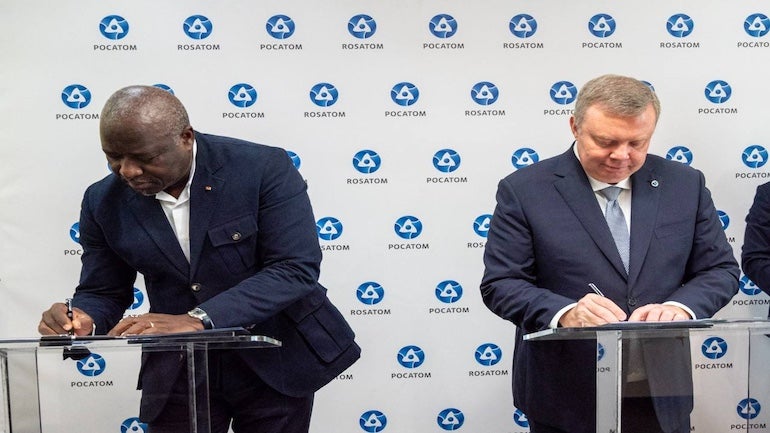
Rosatom and the Republic of Rwanda have signed a roadmap for the development of a small modular reactor (SMR) project following the first meeting of the Joint Coordination Committee for Cooperation in the Field of Atomic Energy (JCC) in Moscow. The meeting was chaired by Rosatom’s First Deputy General Director for Development and International Business, Kirill Komarov and Energy Advisor to the President of Rwanda and Chairman of the Rwanda Atomic Energy Board (RAEB) Lassina Zerbo.
The meeting reviewed the progress of cooperation in key areas including NPP construction, non-energy application of nuclear technologies, including the creation of a Centre for Nuclear Science and Technology (CNST), human resources development and the formation of national nuclear infrastructure. Issues of regulatory support for the programme were discussed separately.
“We are moving from framework agreements to joint work in specific areas: from training national personnel and forming nuclear infrastructure to projects for the implementation of small modular reactors,” said Kirill Komarov. “Rwanda is building its nuclear programme consistently and responsibly, and Rosatom is ready to be a reliable partner for the country at all stages along this path.”
Lassina Zerbo noted: “The roadmap approved today is based on bilateral cooperation in the field of peaceful uses of nuclear energy, which began in 2018. Our priority is to include nuclear energy in the country’s energy mix by the early 2030s to cover Rwanda’s growing energy demand. The implementation of the nuclear programme is primarily an investment in human capital, science and the long-term development of the country. The creation of the Joint Coordination Committee allows us to move on to substantive and regular work in all areas of our programme. We highly value the partnership with Russia and the contribution it makes to the training of Rwandan specialists and the formation of national nuclear infrastructure.”
Behind these developments is a long-standing nuclear relationship with Russia. A memorandum of understanding was signed in Moscow in June 2018 to establish basic cooperation guidelines for the peaceful use of atomic energy. The following December, a legally binding Inter-Governmental Agreement (IGA) signed in Moscow providing the formal framework to build a nuclear science centre and full-scale power plants. An Implementation Roadmap was signed between Rosatom and the Rwandan Embassy in Moscow in May 2019. This scheduled early personnel training and specific layout steps for the science centre.
A Finalised Construction Agreement was signed at the Russia-Africa Summit in Sochi later in 2019, explicitly binding both nations to building the CNST in Rwanda, featuring a 10 MW research reactor. This agreement was ratified and passed into law by Rwanda’s Chamber of Deputies in 2020. In July 2023 a Broadened Atomic Energy Cooperation Agreement was signed to more deeply integrate peaceful applications of atomic technologies.
In May, a Commercial Nuclear Power Plant Agreement was finalised with Rosatom to officially build Rwanda’s first commercial nuclear infrastructure. The document defines specific measures until the end of 2026 which relate to the start of the project to build CNST and also SMR technology with an operational date of 2030-32. Rwanda staff training in Russia is separately stated as key task. Rwandan students are already studying in Russia on various nuclear programmes.


