
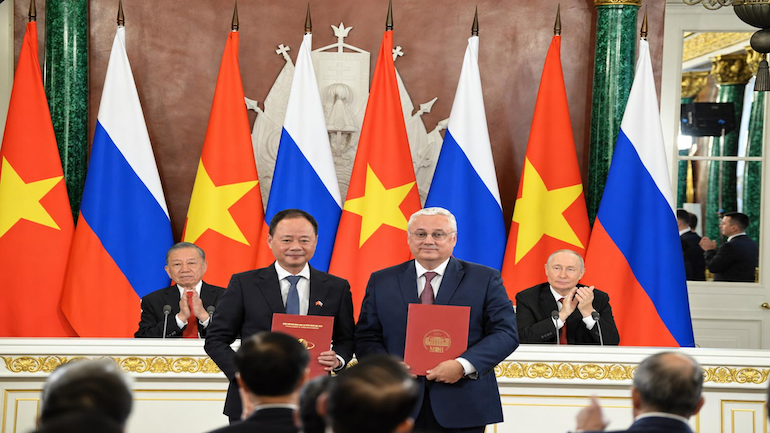
During the state visit of Vietnamese President To Lam to Russia, the National Research University (NRU) MEI (Moskovkovo Energeticheskovo Instituta – Moscow Energy Institute) and the Vietnam Academy of Science and Technology (VAST) signed a memorandum of understanding (MOU) to promote cooperation in research and training. The document was signed by NRU MEI Rector Nikolai Rogalev and VAST President Tran Hong Tai in the Kremlin. Russian President Vladimir Putin and President To attended the ceremony.
The MOU provides for joint scientific research in areas of mutual interest, the development of academic mobility, the exchange of teachers, researchers and students, as well as the organisation of seminars and other scientific events. Specific joint programmes and projects will be formalised in separate agreements. Promising areas include nuclear energy, low-power reactors, quantum technologies, hydrogen energy, new energy systems and modern materials.
One of the priorities of the joint work will be research in the field of low-power reactors. The parties are considering the possibility of creating a joint research laboratory to conduct theoretical and experimental research in the field of reactor technologies, thermophysics and low-carbon energy. It is expected that the work will include the development of calculation models, the creation of experimental installations and stands, and in the future – prototypes with the involvement of industrial partners.
Another promising area is quantum technology. MEI and VAST are discussing the possibility of creating a joint scientific laboratory. This will make it possible to unite the scientific teams of the two organisations, form joint research topics and provide training for specialists to implement new scientific and technical projects.
Cooperation between MEI and VAST is based on long-term scientific and educational ties between Russia and Vietnam. VAST President Tran Hong Tai is an MEI graduate and honorary doctor of the university.
“The signing of a memorandum of understanding between MEI and the VAST is not just another step in the development of our relations, but a real breakthrough into the future,” said Rector Nikolai Rogalev. “We are on the verge of creating truly breakthrough technologies. Joint research into low-power reactors, quantum technologies, hydrogen energy and new materials will open up new horizons for both countries. The planned creation of joint research laboratories will become the catalyst that will unite the best scientific minds of Russia and Vietnam.”
The five-year MOU, with the possibility of extension, defines the general directions of cooperation in the field of education and scientific research; The conditions for the implementation of specific projects, including their financial support, will be determined by separate agreements.
MEI has been cooperating with Vietnam for more than 70 years and co-ordinates the Russian-Vietnamese Consortium of Technical Universities. MEI envisages further development of the partnership with a consistent transition from personnel training and fundamental and applied research to the creation of engineering solutions, experimental development and their subsequent implementation.
On the eve of the ceremony, Rector Rogalev took part in the Russian-Vietnamese Scientific and Technological Forum Interaction in the Field of Strategic Technologies where he presented a paper on Prospects for Russian-Vietnamese cooperation in training in the field of strategic technologies. This listed practical areas of joint work with Vietnamese partners in nuclear energy, intelligent energy and engineering training, as well as proposals for the development of joint research and scientific infrastructure.
During the forum, Rosatom’s Director for Quantum Technologies Ekaterina Solntseva spoke about Russian-Vietnamese co-operation in the field. “The first is the joint development of a quantum development roadmap and the design of a quantum technology centre, which we know is planned to be created in Vietnam. Second is joint work on the implementation of this roadmap, including the creation of joint laboratories. Third, is personnel training. Together, these are significant and difficult tasks: in a short time, it is necessary, in fact, to create a new high-tech industry.”
Quantum technologies are advanced scientific tools that use the principles of quantum mechanics – the physics of tiny particles like atoms and electrons – to process information, measure things, and perform calculations in ways traditional computers cannot. Key areas include computing, measuring devices and communications. Applications include designing new medicines and vaccines, improving safety and efficiency in the nuclear energy sector and creating advanced materials with unique properties for technology and electronics.
Also, during President To’s visit, Rosatom’s Fuel Division TVEL and Vietnam’s national oil and gas corporation Petrovietnam have agreed to develop a project to create an Additive Manufacturing Centre in Vietnam. The agreement was signed by Rosatom’s Deputy General Director for International Activities Nikolai Spassky and Board Chairman of Petrovietnam, Le Ngoc Son.
The agreement defines the list and delivery deadlines for the equipment required to establish a fully functional 3D printing centre in Vietnam. In particular, it provides for the supply of 3D printers manufactured by the Fuel Division of Rosatom, which print metal products using selective laser melting and direct laser deposition technologies, as well as additional Russian equipment for heat treatment, turning operations, laboratory analysis, and so on
“The Additive Technologies Centre for Petrovietnam is not just about implementing 3D printing; it is a strategic tool for solving applied problems in the fuel and energy sector,” said Petrovietnam Deputy Director General Fan Tu Ziang. “The Centre will enable the rapid production of complex parts for drilling and pumping equipment, reduce production downtime through rapid prototyping, and also introduce modern additive technologies for the restoration and repair of equipment and large‑scale products.”
In addition, the agreement establishes the terms for organising metal powder production in Vietnam, including technical training and information exchange, as well as the joint development of quality standards, qualification procedures and product certification.
“In the future, we are ready to discuss localising the production of 3D printers in Vietnam. This work has already been done with partners in Belarus in 2025, where we moved from supplying 3D printers to jointly assembling them and supplying them to external customers,” said Ilya Kavelashvili, Director of the Additive Technologies business unit at TVEL.
Additive technologies make it possible to produce parts and components that are difficult to manufacture using traditional methods involving casting and mechanical processing. Three‑dimensional printing reduces the weight of products, optimizes the materials used, and shortens production time. Modern 3D printers allow for quick reconfiguration of printing parameters to manufacture products from various materials. 3D‑printed products are used in a wide range of fields, from nuclear and space technologies to medicine.


