
Argentina’s RA-10 Multipurpose Reactor has taken delivery of 27 drums containing six tonnes of reactor-grade heavy water for the reactor’s reflector tank in preparation for the final testing prior to start-up.
The RA-10, at the Ezeiza Atomic Centre in Buenos Aires, is a state-of-the-art 30 MWt open-pool research reactor developed by the National Atomic Energy Commission (CNEA – Comisión Nacional de Energía Atómica) currently undergoing pre-operational cold testing. The project was approved by the government and officially started by CNEA in 2010, receiving a construction licence from the regulator in 2014. The project completed its main civil construction works in early 2024 with nuclear technology firm INVAP serving as the main contractor.
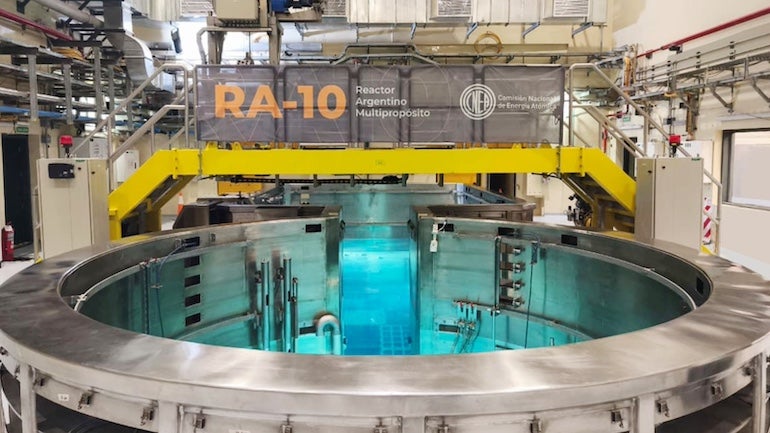
CNEA has launched functional validation testing of the reactor’s primary cooling system. The core has been configured with dummy, non-uranium fuel elements to simulate operational hydraulic conditions safely during the cold tests. A major infrastructure step was reached with the delivery of the heavy water for the reactor’s reflector tank, which provides the high thermal neutron flux necessary for its applications.
The RA-10 will replace the older 10 MWt RA-3 reactor. It is designed to make Argentina entirely self-sufficient in medical radioisotopes and capture up to 20% of global market demand. It will also expand therapeutic capabilities by enabling the local production of advanced isotopes like lutetium. The facility will produce up to 80 tonnes of doped silicon annually for electronic and industrial markets. Additionally, it will host the Argentine Neutron Beam Laboratory (LAHN) and a specialised laboratory to test and qualify advanced nuclear fuels locally rather than relying on facilities abroad.
The RA-10 serves as the reference architecture for the Brazilian Multipurpose Reactor (RMB), which INVAP is co-developing in partnership with Brazil to secure regional medical supplies.
While the RA-10 uses standard light water to cool and moderate its primary core, the heavy water (D2O) serves a distinct, critical purpose and will fill the specialised reflector tank that completely surrounds the core. The reflector tank is a cylindrical structure two metres in diameter by one metre high made of Zircaloy-4. It is hydraulically isolated from the systems that work with light water with the aim of avoiding cross contamination.
Heavy water has a uniquely low neutron absorption cross-section. Instead of absorbing neutrons generated by the fission core, it bounces them back. This reflection creates a highly dense thermal neutron flux. This concentrated stream of neutrons passes through the reactor’s auxiliary tubes to hit targets, enabling mass production of medical radioisotopes and medical therapies.
The heavy water for RA-10 was transferred from the Heavy Water Industrial Plant (PIAP – Planta Industrial de Agua Pesada) in Arroyito, Neuquén Province. PIAP is historically the world’s largest heavy water production facility, with an engineered production capacity of 200 tonnes a year. The facility was mothballed in 2017 due to spending cuts and is now the focus of a major $120m modernisation and export initiative to restart full-scale commercial operations.
The six tonnes of heavy water delivered to the RA-10 were sourced through a combination of existing stockpiles and localised maintenance, rather than active industrial manufacturing. Before PIAP was mothballed in 2017, it had a massive manufacturing footprint and, over its decades of active operation, the plant built up strategic product reserves and safeguarded inventories. The drums delivered to the Ezeiza Atomic Centre were drawn directly from these existing, securely stored domestic stockpiles
Even though the industrial synthesis lines (which combine natural gas and ammonia to extract deuterium) are offline, PIAP’s operators (ENSI and CNEA) maintain active, small-scale conditioning, laboratory, and quality control blocks on-site. Operators used these specific laboratory systems to check, filter, and process the stockpiled liquid. This successfully brought the six tonnes up to the strict 99.86% reactor-grade isotopic purity required for the RA-10 reflector tank.
Current public and private investments have established a clear path for PIAP back to production. CNEA in 2023–2024 initiated extensive technical assessments and localised maintenance to verify the physical integrity of the primary components. In May 2025 Candu Energy (a subsidiary of AtkinsRéalis) signed a memorandum of understanding with the CNEA. The deal provides engineering support to safely restart PIAP in exchange for long-term off-take rights to export heavy water for Canada’s Candu reactors.
In January 2026, CNEA launched the formal bidding processes for global and local engineering contractors to execute the facility’s overhaul. Full-scale industrial heavy water production is on track to resume by 2027. Because parts of the plant have been offline for roughly a decade, the revamp focuses heavily on replacing outdated infrastructure. This includes entirely replacing obsolete analogue telemetry and ageing mechanisation controls with modern digital automation systems. The monothermal ammonia-hydrogen isotopic exchange process used to extract deuterium from water is being overhauled. The facility is being adapted to satisfy international security guidelines.


