
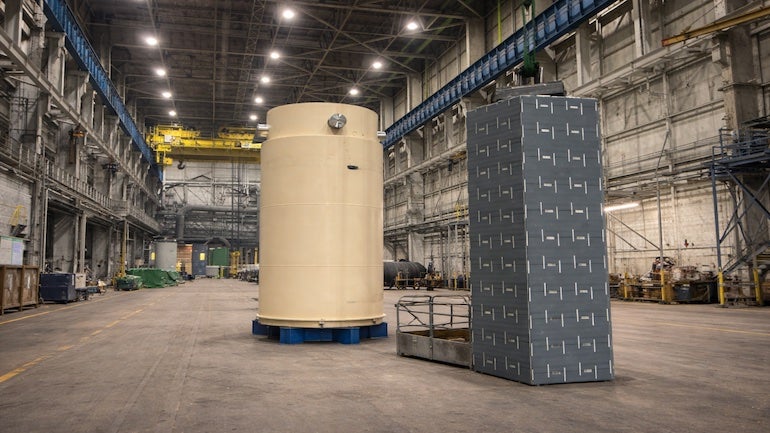
US-based Holtec International announced that an array of equipment for the management of used fuel had been delivered to India’s Kudankulam NPP in Tamil Nadu. The equipment co-engineered and manufactured by Holtec Asia and Holtec International, includes a number of high-density racks for storage of used nuclear fuel in deep borated water pools. Holtec said the racks contain “the industry’s most powerful neutron absorber called Metamic which is only produced in the United States”.
Kudankulam, operated by Nuclear Power Corporation of India Ltd (NPCIL), will comprise six units with VVER-1000 reactors. Work began following an intergovernmental agreement between India and Russia signed in 1988. Units 1&2 (Phase I) are already in operation and work is underway to build units 3-6 (Phases II and III). Units 1&2 began operation in 2016. The general framework agreement with Rosatom on the construction units 3&4 was signed in 2014 and, in 2017, the engineering division of Rosatom and NPCIL signed an agreement on the construction units 5&6. Work on units 5&6 began in 2021.
Holtec said other safety-significant equipment provided to NPCIL is the transport capable cask, HI-STAR 149, “which embodies the latest tolerance features developed at Holtec’s Corporate Engineering Center and is protected from unauthorised imitation by an array of patents”. The HI-STAR 149 provides flexibility for both on-site storage and off-site transport.
“We are pleased to provide technically superior systems, structures, and components to the owners of the operating Russian-origin nuclear plants who have been historically reliant on single-source offerings for goods and services from Russia’s state-owned OEM [original equipment manufacturer],” said Joy Russell, EVP & Chief Communications Officer of Holtec International.
She added: “This supply of used fuel management systems to NPCIL is in keeping with our track record to reverse-engineer and manufacture complex equipment for Russia-supplied nuclear plants, including prior work supporting legacy Russian reactor facilities such as the Chernobyl plant in Ukraine.”


