
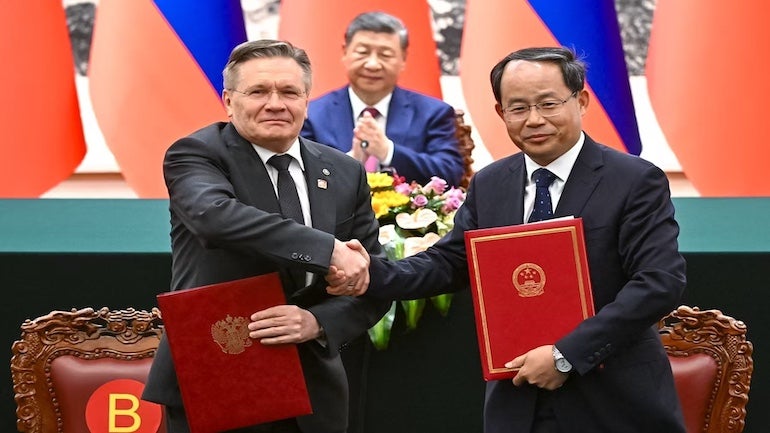
During Russian President Vladimir Putin’s recent state visit to Beijing, Russia and China signed over 40 agreements and cooperation documents – 22 formal documents signed during a special ceremony following bilateral talks between Putin and Chinese President Xi Jinping and 20 additional agreements and memorandums signed on the sidelines of the summit. Three of the memorandums related to nuclear energy.
Putin was accompanied by a high-profile official delegation of 39 key figures including senior government officials, regional governors, and corporate & state-owned industry CEOs including Rosatom Director General Alexey Likhachev, who signed the nuclear agreements.
A memorandum of understanding (MOU) signed with Director General (Chairman) of the China Atomic Energy Authority, Shan Zhongde related to cooperation in the development of human resources. The document provides for the establishment and strengthening of interaction on human resources, the exchange of experience and best practices training personnel for the nuclear industry, as well as cooperation between the youth and women’s industry communities of the two countries.
An MOU signed with China’s Science and Technology Minister Yin Hejun the People’s Republic of China envisaged cooperation in the field of controlled thermonuclear fusion. Russia and China are key participants in the International Thermonuclear Experimental Reactor (ITER) under construction at Cadarache in France.
Likhachev also signed and MOU with the President of the Chinese Academy of Sciences Hou Jianguo on cooperation in the fields of science and technology. This also included controlled thermonuclear fusion as well as nuclear medicine, accelerators and new photonic and quantum technologies.
Likhachev noted: “Our countries are united by a long history of strategic partnership not only in the construction of nuclear power plants, but also in the development of future technologies. Memorandums of long-term cooperation in fundamental areas of science and technology, primarily in controlled thermonuclear fusion, mean our readiness to move forward together, shoulder to shoulder, and provide leadership in these areas.”
The wide-ranging joint statement, issued by President Xi and President Putin following their talks, also referenced energy. “The parties, highly appreciating the significant results of Russian-Chinese energy cooperation, agreed to continue to strengthen their comprehensive partnership in the energy sector, support the two countries’ organisations in deepening mutually beneficial cooperation in the oil, gas, and coal sectors, the use of peaceful nuclear energy and renewable energy, including ‘green’ certificates, ensure the safety and stability of the operation of cross-border energy infrastructure, facilitate the unimpeded transportation of energy resources, promote a deeper dialogue between energy-producing and energy-consuming countries, jointly maintain the stability of global energy markets, and improve the level of energy security based on the principles of energy justice.”
It further noted that the parties intend to continue implementing the Tianwan and Xudabao NPP construction projects, “ensure the timely completion of construction work and commissioning of the facilities, and, on this basis, deepen cooperation in the peaceful use of nuclear energy, consistently promote cooperation in the areas of nuclear fusion, fast neutron reactors, and the closed nuclear fuel cycle, and develop cooperation in the form of package agreements in the area of the initial stage of the nuclear fuel cycle and the joint construction of new nuclear power plants based on the principles of mutual benefit and a balance of interests”.
With respect to joint activities in space, which include the construction of a nuclear plant on the moon, the joint statement said the parties “agreed to continue implementing large-scale space projects that meet the shared interests of Russia and China and are included in their national space programmes, actively promote cooperation, and systematically increase the level of interaction in key areas of space activities, including the International Lunar Research Station, lunar exploration, and deep space exploration”.
Six of the eight units at China’s Tianwan NPP in Jiangsu province use Russian reactors. Tianwan 1&2 with VVER-1000 reactors were handed over by Rosatom to China and put into warranty operation in 2007. Units 3&4 were put into warranty operation in 2018.
Also in 2018, an intergovernmental protocol and a framework contract was signed with Rosatom for the construction of Tianwan 7&8 and Xudabao 3&4 in Liaoning province with VVER-1200 reactors. Construction of Tianwan unit 7 began in May 2021 and unit 8 in February 2022. They are scheduled to begin commercial operation in 2026 and 2027. Construction of Xudabao 3&4 began in July 2021 and May 2022 for commissioning in 2027 and 2028. Tianwan 5&6 and Xudabao 1&2 use Chinese reactors.
Rosatom is also cooperating with China on fast reactors, and work is underway on fourth-generation reactors and the application of nuclear technologies in space. Transportation between Russia and China via the Northern Sea Route is also increasing.


