
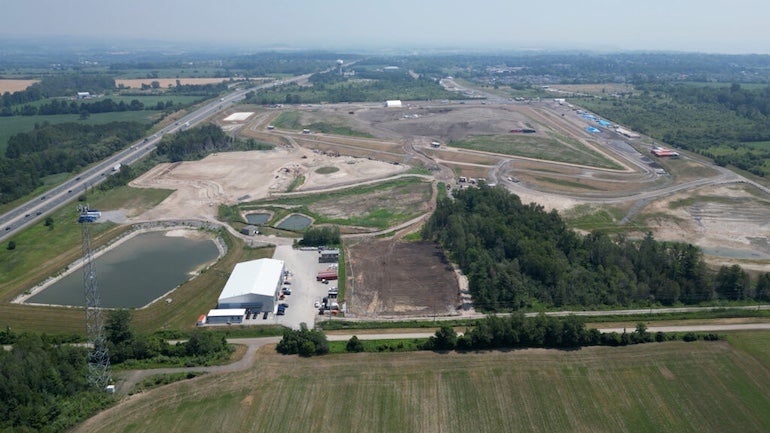
Atomic Energy of Canada Limited (AECL) and the Municipality of Port Hope in Ontario have reached a long-term agreement to safely manage eligible historic low-level radioactive waste (LLW) in Port Hope for up to 100 years after the Port Hope Long-Term Waste Management Facility (LTWMF) closed. The facility is managed by Canadian Nuclear Laboratories (CNL).
The agreement extends the current 20-year post-closure period. Once the Port Hope Area Initiative (PHAI) project is complete, a designated access point will remain open at the Port Hope LTWMF with disposal capacity to ensure the facility can accept any LLW discovered during future renovations, repairs, or infrastructure projects.
The PHAI involves the cleanup of approximately 1.2m cubic metres of legacy LLW from sites in Port Hope, construction of a near surface storage facility (engineered containment mound), and long-term monitoring and maintenance of the LTWMF.
The LLW in Port Hope is the result of historic radium and uranium refining operations that began in the 1930s. In 1930, Eldorado Gold Mines Ltd discovered rich, radioactive pitchblende ore at Great Bear Lake in the Northwest Territories. The company transported this raw ore thousands of kilometres south through a shipping network known as Canada’s “Atomic Highway” to be processed in Port Hope.
The refinery in Port Hope went through several distinct production phases, each generating high volumes of waste. From 1933 to the 1940s, Eldorado refined the ore to extract radium, used at the time for cancer treatments and luminous medical/industrial instruments.
The Government of Canada nationalised Eldorado in 1944, transforming it into a federal Crown corporation named Eldorado Nuclear Limited. Production shifted toward uranium processing to supply the WWII Manhattan Project and subsequent Cold War weapons production. The focus later shifted toward processing uranium for civilian NPPs.
During the early decades of operation, the long-term environmental and health risks of radioactive materials were not understood or regulated. Consequently, toxic process byproducts containing radium-226, uranium, and heavy metals such as arsenic were handled carelessly: Millions of cubic metres of loose process residues, tailings, and contaminated soils were given away or used as standard fill material for construction, grading, and landscaping.
Large amounts of refinery waste were routinely dumped into the local municipal landfill, public beaches, and ravines. Industrial activity directly contaminated the sediment at the bottom of the Port Hope Harbour. Because this waste was mixed directly into the local soil and used to build up residential properties nearly a century ago, digging can still unearth pockets of it. This is currently managed by CNL under the Historic Waste Program.
In 2001, the federal government and local municipalities established PHAI to find a permanent solution for the legacy waste. In 2016, major preparation and construction works on the highly engineered above-ground storage mound began at the site of the former Welcome Waste Management Facility. In 2017 the LTWMF opened its first engineered cell to accept waste shipments from local remediation sites.
Large-scale excavation of contaminated soil from residential properties, public spaces, and the local harbour was fully scaled up. The facility is not a permanent storage, but an engineered cell system designed to be sealed in 2032 once all active community cleanup targets are met.
As PHAI progressed, it became clear that it is not always practical or beneficial to remove all of the eligible waste from every location. Under the new arrangement, property owners have more choice and flexibility. If they choose to leave eligible LLW undisturbed under existing features such as mature trees or landscaping, they can address the radiological material later, if needed.
Canada will continue to cover both the transportation and long-term management of eligible LLW. Property owners will still be responsible for excavation and restoration costs.
The LTWMF will continue to accept the same eligible materials currently managed through the PHAI, including both radiological contaminants and certain associated non-radiological contaminants addressed under the project.
The facility will only accept material contaminated with radium, thorium, or uranium (radiologically contaminated material), while other material (such as arsenic) will need to be managed through provincial systems.
The new agreement provides a clear, regulated pathway for managing historic waste well into the future, removing concerns about what would happen once the project is complete. Homeowners who choose not to participate today can be assured that there will still be a safe option available in the future if conditions change.
Participation in PHAI is voluntary, and homeowners who participate continue to receive comprehensive remediation and restoration at no cost, with waste safely transported and managed by Canada through AECL and its contractor CNL.


