
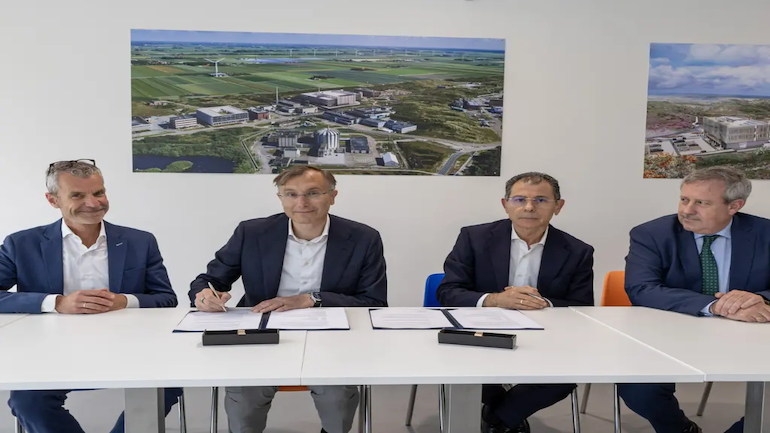
NRG Pallas and FCC Construcción have signed an agreement which ensures the procurement, fabrication, and seamless implementation of specialised hot cells for the state-of-the-art Pallas reactor in Petten, Netherlands. Hot cells are heavily shielded nuclear radiation containment chambers that allow technicians to safely handle, process, and inspect highly radioactive materials using remote manipulators.
The Pallas reactor is designed to replace the ageing High Flux Reactor (HFR), which currently meets a significant portion of European and global demand for medical radioisotopes. Once operational, the new facility will support cancer diagnoses and cardiovascular therapies for more than 30,000 patients every day.
For the Pallas reactor, hot cells are long-lead components. Securing their production early prevents upstream structural delays, as they must be integrated directly into the civil architecture of the primary reactor building. The execution of this phase relies on a combined matrix of design, construction, and operational expertise.
NRG Pallas acts as the client, financier, and ultimate future facility operator. FCC Construcción: Serves as the primary general contractor managing the overall civil infrastructure execution. Asturfeito joins the consortium as the highly specialised industrial supplier directly tasked with manufacturing the hot cell units. ICHOS acts as the project’s nuclear design representative, ensuring technical plans adhere strictly to safety guidelines.
What makes the hot cells for Pallas unique is their integrated design. The full process, from reactor pool to dispatch, takes place within one building. This reduces the need for transport between different facilities, limits intermediate handling steps and contributes to safety, efficiency and reliability in the supply chain for medical isotopes. The design also allows for high-volume processing, while remaining flexible will be enough to support customer needs, research applications and future market developments.
“The Hot Cells are technically complex and crucial to the overall functioning of the reactor,” said NRG Pallas CEO Maurits Wolleswinkel. Their integrated design requires close coordination between engineering, construction, operations and specialist suppliers. This agreement gives us a strong basis for the next phase: manufacturing, installation and commissioning.”
Jose Martinez, Construction Director of Pallas Project noted: “We are proud to contribute our specialist expertise to the Pallas reactor. The Hot Cells require a high level of precision, safety and technical performance. Together with NRG Pallas, ICHOS and Asturfeito we will deliver a solution that supports reliable production and safe handling of irradiated materials.”
ICHOS and Asturfeito provide the highly technical nuclear engineering backbone for the Pallas reactor project. While ICHOS acts as the ultimate architectural and nuclear mind behind the reactor’s blueprint, Asturfeito serves as the specialised industrial manufacturer responsible for fabricating the heavy physical systems.
ICHOS is a specialised consortium established specifically to design, implement, and commission the Pallas reactor. ICHOS BV is based in the Netherlands but is fully owned by INVAP, the Argentinian state-owned nuclear and aerospace technology company. INVAP (via ICHOS) was awarded the European design tender for the reactor due to its extensive history of successfully designing and building multi-purpose research reactors globally.
ICHOS, contracted since January 2018, is the design representative. They authored the core architectural plans for the facility, coordinate international technical collaborations from their design base in Alkmaar, and guide the project through strict nuclear safety and licensing frameworks. To ensure zero gaps in project continuity, NRG Pallas holds a “Keep Well Agreement” with ICHOS. This legally guarantees that INVAP will continuously channel its full technical resources, engineers, and decades of operational expertise into the Petten project.
Asturfeito is a highly specialised Spanish heavy-engineering company tasked with the physical manufacturing and testing of the reactor’s long-lead equipment. Asturfeito builds bespoke, high-integrity mechanical assemblies for the world’s most demanding scientific projects, including international particle accelerators and advanced nuclear fusion programmes.
Asturfeito, subcontracted directly by the general builder FCC Construcción, is the specialist supplier for the hot cells. It specialises in heavy components built to strict nuclear safety culture standards. For Pallas, they will fabricate hot cell equipment; remote handling systems; nuclear-grade pressure vessels, airtight ventilation dampers, and massive shield doors/hatches. Before any equipment ships to Petten, Asturfeito constructs full-scale mechanical mock-ups and test systems at their own facilities to ensure the remote handling gear works flawlessly under rigorous safety conditions.
The delivery and integration of the hot cells are tied to a strict, multi-year construction schedule designed to prevent disruptions to the global medical isotope supply. The Pallas reactor project remains on track to achieve full commercial operation in 2032.
Phase 1 – site preparation & foundation is completed (2022-mid-2025). This included demolition of old infrastructure, clearing of underground cables, and pipeline rerouting. Workers also finalised the massive foundation excavation pit (50 by 50 metres and 17.5 metres deep) required to support the heavy nuclear infrastructure.
Phase 2 – nuclear island civil works is underway (2025-2026). The Dutch Ministry of Health officially launched the main construction phase. Pouring is underway for the first three underground floors of the reactor building (the nuclear island”). Simultaneously, specialised divers are conducting underwater civil works in a separate pit for the secondary cooling system building.
Phase 3 – Equipment Integration & Structure is scheduled for 2027-2030. As the civil structure rises, the hot cells supplied by FCC and Asturfeito will be structurally integrated. Because hot cells require heavy concrete and lead shielding, they must be positioned before the building’s upper walls and roofs are sealed. The target window for the physical completion of the primary reactor building structures is 2030.
Phase 4 – commissioning & commercial operation is scheduled for 2031-2032. This includes system testing, safety reviews, and pre-operational cold-commissioning phases begin. The facility officially begins commercial operation in 2032. This aligns with the planned phasing out of the ageing High Flux Reactor (HFR), ensuring no gap in patient care.


