
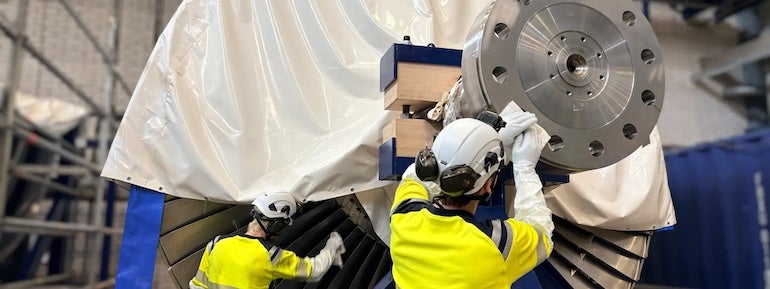
A major turbine island modernisation project is underway at Finland’s Loviisa NPP. The project will be implemented in phases during annual outages between 2026 and 2028. The modernisation project will increase the facility’s electrical output by approximately 38 MWe by 2028 and raise its lifetime electricity generation by around 7 TWh. This phased initiative is part of an overarching €1bn ($1.15bn) lifetime extension investment programme to secure stable, fossil-free energy until 2050. The project is being led by Fortum’s own experts in cooperation with selected partners.
The Loviisa plant comprises two Soviet-designed VVER-440 reactors and currently provides more than 10% of Finland’s electricity. Loviisa unit 1 began commercial operation in 1977 and unit 2 in 1981. Preparations for the turbine modernisation include rotor cleaning and inspection work. The modernisation consists of three foundational projects targeting the plant’s conventional (non-nuclear) island.
The low-pressure turbines are being refurbished by Doosan Škoda Power (Czech Republic) and directly drives the plant’s 38 MWe electrical capacity boost without requiring the nuclear reactors to generate extra thermal heat. The project replaces all eight low-pressure turbine inner casings and internal flow components across both power units. To minimise raw material waste and lower project costs, the large, structurally sound outer casings and existing steam valves are being retained, repaired, and structurally integrated with new internal flow assemblies that optimise steam aerodynamics. This raises the plant’s projected lifelong generation from 170 TWh to 177 TWh over the course of its extended operating licence. Equipment deliveries and physical retrofits began directly alongside the scheduled August 2026 annual outages.
Turbine Automation is being renewed by Finnish technology provider Valmet. The turbine protection and control systems are undergoing a total technological shift to replace obsolete, third-party legacy systems that have reached the end of their operational lifecycle. Valmet is installing its proprietary Valmet DNA Turbine Automation system across four separate steam turbine lines. The project replaces more than 16,000 physical interface signals, routing them through a single, modern decentralised digital control network. New user interfaces give operators in both main control rooms expanded real-time data, high-fidelity monitoring, and digital diagnostics over the generator auxiliary systems. Valmet delivered an identical, fully upgraded digital training simulator hardware and software package in April 2026 to let control room operators master the new automation before the real systems go live. System testing and handover will take place first on the Loviisa 2 reactor in October 2026, followed by the Loviisa 1 reactor in October 2028.
The main seawater pumps are being replaced by Austria’s Andritz. The main cooling infrastructure is being fully revitalised to stabilise the secondary thermal cycle of the conventional island. These industrial pumps circulate cold Baltic seawater directly into the plant’s large condensers. This steam condensation process cools the steam exiting the low-pressure turbines back into water so it can be safely pumped back through the power generation loop. Each of Loviisa’s two power units relies on a redundant array of four main seawater pumps (eight pumps total across the entire facility). The original Soviet-era pumps and electric drive motors have reached the end of their technical lifespan. Andritz is installing custom vertical line shaft or split-case cooling water pumps that feature hydraulic impeller blade adjustments and advanced anti-corrosion wear coatings to withstand the harsh brackish marine environment.
The upgrades will be integrated into annual outages, minimising impacts on production while ensuring efficient use of resources. The 2026 outages are split into two distinct, sequential phases to guarantee that one reactor unit remains active and producing electricity while the other is undergoing service. For unit 2, which is undergoing a comprehensive eight-year major overhaul, the outage is from 2 August to 21 September Both units will then be temporarily online or transitioning to balance power grid loads for several days. Unit 1, which is undergoing a standard, shorter maintenance window focused heavily on refuelling, will be offline from 26 September to 18 October. To undertake this work, the plant will bring in 1,000 external contractor workers from about 100 specialised engineering firms.
The logistics of transporting the newly upgraded low-pressure turbine components to the Loviisa power plant require careful coordination. While the entire set of parts to be replaced weighs roughly 2,000 tonnes, the heavy-lift operation is broken down into specific modular components. The logistical execution relies on careful management.
The initial challenge is transporting the heavy machinery safely from the factory floor to the island facility. The turbine inner casings and new flow components are manufactured at the Doosan Škoda Power facility in Pilsen, Czech Republic travel via specialised heavy-load multi-axle trailers over Czech and German highways to a strategic northern German port (such as Hamburg or Rostock). The modules are transferred onto heavy-lift cargo ships to cross the Baltic Sea, sailing directly to the dedicated industrial quay at the Loviisa plant site on the Hästholmen island.
Because the upgrades are tied to the plant’s scheduled annual maintenance outages, there is no buffer time for delivery delay. The components must arrive, clear quality assurance, and be staged on-site before the shutdown sequence begins. To prevent congested dock space on the island, components are systematically managed at a secondary staging port onshore. They are transferred to the island only when the turbine hall is physically prepped to receive them.
Once the parts arrive at the turbine hall, the logistics shift from transport to precision positioning. The heavy-lift team utilises the turbine hall’s main overhead gantry cranes to lift and lower the new inner assemblies. Because Fortum is retaining and repairing the original, massive outer casings to save costs, engineers must seamlessly fit the brand-new Western-designed internals into the Soviet-era outer structures. This requires micro-level alignment to prevent microscopic imbalances that could induce dangerous turbine vibrations.
Moving new parts in means old parts must move out, triggering a secondary logistics loop. The eight original, worn-out low-pressure inner casings must be carefully unbolted, cut down into manageable sections, and lifted out of the turbine hall. Since these components operate entirely on the “conventional island” (the non-nuclear side), they are non-radioactive. However, clearing out thousands of tonnes of legacy industrial steel requires a dedicated fleet of transport vehicles to haul the metal off the island to domestic recycling facilities.


