
US-based advanced fuel technology company Lightbridge has accelerated plans to build a dedicated facility at Idaho National Laboratory (INL) to manufacture lead test assemblies (LTAs) of Lightbridge Fuel for testing in US commercial power reactors. This follows its selection in August for the Department of Energy’s (DOE’s) Nuclear Energy Launch Pad INL programme.
The selection provides an accelerated pathway toward DOE authorisation for Lightbridge to design, build, and operate LTAs represent the final fuel qualification stage between reactor testing and commercial fuel sales.
“This is the most important step we have taken toward putting Lightbridge Fuel into commercial reactors, and it changes how investors should understand our timeline,” said Lightbridge Chairman and CEO Seth Grae. “A DOE-authorised facility will let us manufacture full-scale Lightbridge Fuel assemblies that nuclear utilities will run in their plants, and can produce them years sooner than a conventional facility licensing path would allow. We have been working with a major engineering, procurement, and construction (EPC) firm in preparation for the start of construction of the Special High-assay low-enriched uranium (HALEU) Extrusion Demonstration (SHED) facility as soon as next year.”
Launch Pad is a DOE initiative supporting the Trump administration’s goal of nuclear energy expansion through streamlined pathways for developers to demonstrate and accelerate commercial deployment. Facilities developed under the program are privately financed. Lightbridge continues to develop detailed cost estimates for SHED, and based on preliminary estimates, the anticipated cost to construct, operate, and decommission SHED can be funded from the Company’s current cash and financial resources.
“Operating under DOE authorization will allow us to begin building and demonstrating our manufacturing process on an accelerated schedule,” said Dr Andrey Mushakov, Executive Vice President and Chief Operating Officer of Lightbridge. “We will prove out our equipment, processes, and quality systems at production scale, and carry that knowledge directly into our future commercial-scale manufacturing facility. Each step de-risks the next.”
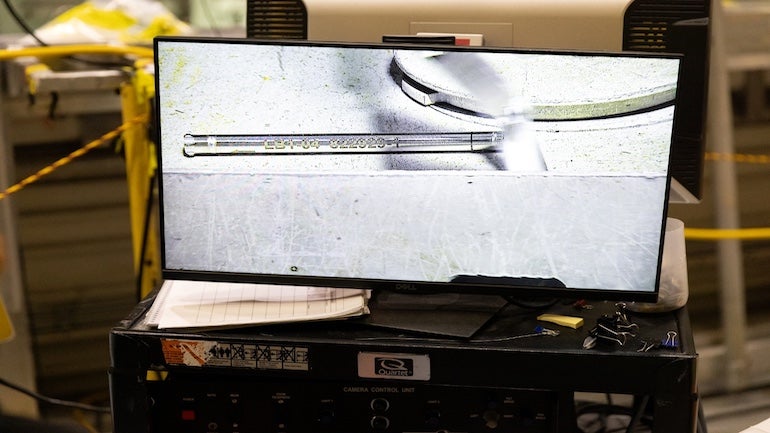
Lightbridge is currently irradiating fuel material samples in the Advanced Test Reactor at INL, with post-irradiation examination for the initial batch of irradiated samples discharged in May 2026 expected to begin later this year. The SHED facility would manufacture the company’s first LTAs for insertion in commercial reactors and is intended to serve as a precursor to commercial-scale fuel fabrication.
In parallel, the company is working with a major EPC firm on evaluating potential sites and conducting a conceptual design for the Lightbridge Expandable Fuel Facility (LEFF), a larger, commercial-scale fuel fabrication facility designed to be licensed by the Nuclear Regulatory Commission and to begin production initially at a throughput of a few batch reloads a year and later expand it to many batch reloads per year, with the potential for additional facilities, including regional facilities serving international markets.
Lightbridge is developing a proprietary next-generation nuclear fuel technology for existing light-water and pressurised heavy-water reactors as well as fuel for new small modular reactors. DOE’s Gateway for Accelerated Innovation in Nuclear (GAIN) programme has twice awarded Lightbridge to support its fuel development over the past few years. An extensive worldwide patent portfolio backs Lightbridge’s technology.
Lightbridge Fuel is designed to increase the power output of an existing reactor by up to 10% with no change to the plant’s steam generators, and by up to 20% for plants that move to a high-capacity steam generator. New-build reactors equipped with higher-capacity steam generators could see an increase of roughly one-third, while enhancing safety margins and reducing the levelized cost of electricity.
Over the next several quarters, Lightbridge expects to provide more detail, including the results of post-irradiation examination of the fuel samples produced with INL, progress on the SHED design and site work, site selection for LEFF, and the cost, timeline, and economic assumptions that analysts need to model both facilities.
Lightbridge traces its origins back to 1992, when it was incorporated in Delaware. In 2001, it changed its name to Thorium Power Inc (TPI). During this phase, it focused heavily on developing thorium-based fuel designs aimed at reducing nuclear proliferation risks, particularly for international markets such as Russia.
In 2009, the company rebranded as Lightbridge Corporation. With this shift, it pivoted away from thorium to focus entirely on its proprietary metallic uranium-zirconium (U-Zr) alloy fuel for commercial water-cooled reactors. Lightbridge operates primarily under a licensing and royalty model. It invents, patents, and validates the technology, intending to license the final designs to commercial fuel manufacturers rather than operating long-term commercial-scale assembly lines itself.


