
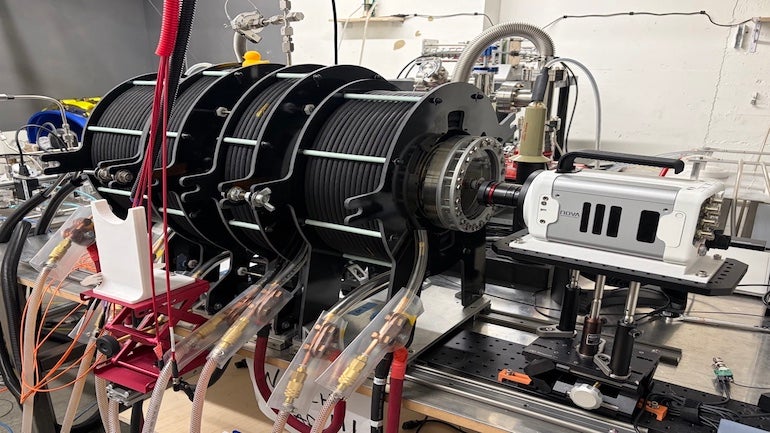
San Francisco-based start-up Marathon Fusion has achieved a notable breakthrough by demonstrating the simultaneous separation and enrichment of hydrogen and lithium isotopes using its proprietary plasma centrifuge technology. This accomplishment addresses two critical, historically distinct bottlenecks in the commercial nuclear fusion fuel cycle using a single, unified hardware architecture.
Traditionally, processing unburnt tritium exhaust and enriching lithium raw materials required entirely different facilities and chemical methods. Proving that a single electromagnetic plasma method can handle both tasks significantly simplifies the engineering footprint of a plant.
In a commercial deuterium-tritium (D-T) fusion reactor, managing the fuel cycle is complex. Marathon Fusion’s approach tackles both the input and output demands. During fusion plant operation most of the tritium (a rare and expensive hydrogen isotope) exits in the exhaust without fusing. Marathon’s plasma centrifuge uses crossed electric and magnetic forces to drive a supersonic rotation of charged particles. This creates “differential pumping” to selectively filter and recycle tritium from the exhaust, reducing required tritium inventories and flow rates by a factor of 10 or more.
The US Department of Energy’s (DOE’s) Fusion Science and Technology Roadmap published in June identified tritium processing as a core challenge, noting: “Progress in this area is critical for enabling sustained DT operation… and demonstrating the viability of fusion as a large-scale energy source.”
To keep running, fusion plants must breed their own tritium by bombarding a “blanket” of lithium with neutrons. However, this requires heavily enriched lithium-6, a supply chain currently dominated by foreign sources and viewed as a high-risk bottleneck for the industry. The same plasma centrifuge enriches lithium-6 to secure a domestic supply of tritium-breeding raw materials.
“Marathon’s results on isotope separation are impressive and important for the fusion industry. By enabling selective tritium pumping, their technology can improve fusion power plant performance while dramatically reducing the required tritium inventory,” said Dennis Whyte, an MIT Professor of Nuclear Science & Engineering whose research quantified the impact of selective pumping in the fusion fuel cycle. “Their approach could also enable improved lithium isotope separation, which is a key process in improving tritium production efficiency in fusion power plants. Lithium isotope separation is both a near term opportunity for Marathon, as well as one that grows to massive scale as fusion energy deploys.”
Per F Peterson, Distinguished Professor of Nuclear Engineering at UC Berkeley and advisor to Marathon Fusion explained that lithium isotope separation also has wider applications. “Nuclear engineers have searched for an ideal coolant to move massive amounts of heat at low pressure and high temperature. The answer, from a pure heat capacity perspective, is the molten salt called FLiBe. This molten mixture of lithium and beryllium fluorides packs atoms together almost as densely as in solid graphite. In liquids, each atom stores nearly equal heat, so FLiBe has the highest volumetric heat capacity of any nuclear coolant, along with tremendous neutron stopping power.”
He added: “The catch is that the lithium in FLiBe must be isotopically enriched in lithium-6 for fusion, or lithium-7 for fission. Today the world makes less than a tonne of enriched lithium each year, with a mercury-based process now used only in Russia and China. The terawatt-scale deployment that our world needs will require hundreds of thousands of tonnes of enriched lithium to be in service, produced with clean lithium enrichment technology.”
With support from DOE’s $15m ARPA-E VISION OPEN programme launched in March, Marathon is now shifting focus toward building its first commercial pilot facility to scale this technology for gigawatt-level fusion deployment. Marathon, which received a $3.63m award, is one of just three private fusion companies supported by this programme. The grant is structured to support the team until March 2029. It focuses on enabling “differential pumping” to clean impurities out of unburnt plasma while simultaneously separating lithium isotopes for fuel-breeding blankets.
Marathon Fusion’s total financial pool sits around $18m. ARPA-E’s early milestone-based validation acted as a major catalyst, enabling the company to unlock critical private capital from major firms such as Breakthrough Energy Fellows, 1517 Fund, and Anglo American.
Marathon’s experimental results have tracked closely with their computational models, validating the underlying theory, and enabling predictive modelling to inform the design of upcoming systems. Following the success of its plasma centrifuge milestone, Marathon Fusion is transitioning from lab-scale proof-of-concept testing to commercial scaling. The company is raising capital to construct its first commercial pilot facility, which it plans to deploy by 2028, with an eye toward achieving full-scale commercial production by 2029.
The upcoming pilot facility is designed to move beyond scientific validation and demonstrate a high-throughput supply chain capable of servicing the broader fusion market. Upon scaling the pilot technology into its first full-scale commercial facility by 2029, the company aims to produce tens of tonnes of enriched lithium-6 per year – enough raw material to satisfy the tritium-breeding blankets of a new gigawatt-scale fusion plant every two years. The system is also being engineered to recover, purify, and repurpose approximately 560 kilograms of tritium annually.
Marathon positions itself as an ecosystem supplier, manufacturing the high-throughput processing systems needed to handle reactor exhaust and fuel supplies. It is not building a pilot fusion reactor to generate electricity. Instead, it is building a commercial manufacturing plant – a pilot fuel-processing and isotope-separation factory. This facility will house rows of proprietary plasma centrifuges and metal foil pumps.
Its job is to produce raw materials – enriching raw lithium into Lithium-6 to sell directly to fusion companies for their tritium-breeding blankets. It will test components to prove its machinery can handle the intense, high-throughput flow rates of a simulated gigawatt-scale reactor exhaust before shipping the hardware to customers. In this way, marathon aims to generate revenue by selling crucial materials to the rest of the industry before its partners finish building their fusion power plants. Marathon Fusion, founded in 2023, The company was co-founded by Kyle Schiller (CEO) and Adam Rutkowski (CTO). Schiller is a former Science Policy Fellow at Schmidt Futures under Tom Kalil. He previously ran the Fusion Entrepreneurship Workshop and built machine learning/analytics infrastructure at Airbnb and Zenysis. Rutkowski is a former Propulsion Engineer at SpaceX and a Plasma Physics PhD candidate at Princeton University.


