
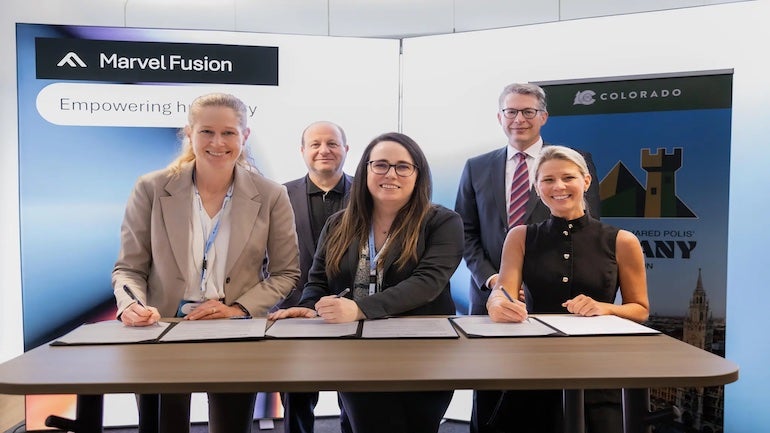
Munich-based start-up Marvel Fusion has signed a letter of intent (LOI) with the State of Colorado and Siemens Energy to strengthen transatlantic collaboration and accelerate the development and commercialisation of laser-driven fusion energy.
The LOI establishes a transatlantic partnership framework focused on the following four key areas of collaboration:
- Joint research and development: conducting collaborative programmes and sharing access to world-class laser and fusion research infrastructure;
- Ecosystem connectivity: strengthening structural ties between Colorado’s RISE Hub (at Colorado State University) and Bavaria’s VEGA Hub ecosystem;
- Industrial and supply chain partnerships: building transatlantic industrial networks to source, scale, and deliver laser-based fusion power technologies; and
- Talent development: launching joint educational and workforce initiatives to train the next generation of specialised fusion energy professionals.
The partners will establish a joint working group to define priority projects, with delegation visits, expert workshops, and initial cooperation activities planned over the next 12 months. The signing ceremony took place at the Marvel Fusion headquarters in the presence of Jared Polis, Governor of Colorado, and Markus Blume, Bavarian State Minister for Science and Arts. The LOI builds on a broader Bavaria–Colorado agreement to strengthen transatlantic cooperation in science, research, and innovation.
This agreement bridges two major hubs for global energy research: Bavaria, Germany – home to Marvel Fusion’s headquarters and a robust industrial ecosystem anchored by Siemens Energy; and Colorado, USA, where the state-of-the-art $150–160m Advanced Technology Lasers for Applications and Science (ATLAS) laser facility is slated to host Marvel Fusion’s technology demonstrator.
The ATLAS facility is currently under construction on Colorado State University’s (CSU) Foothills Campus in Fort Collins. Marvel established a public-private partnership with CSU in August 2023. ATLAS, slated for substantial completion in December 2026, serves as the primary technical demonstrator for Marvel Fusion’s laser-driven inertial confinement fusion technology. Component testing and first-of-their-kind high-repetition fusion demonstration runs at CSU are planned for 2027–2031 with 2032 targeted for completion for Marvel Fusion’s first fully integrated commercial laser fusion reactor prototype. Commercial roll-out is planned for 2036.
The facility will house three ultra-high intensity, ultrashort-pulse laser systems delivering a combined 7 petawatts (PW) of power (more than 5,000 times the entire electrical generation capacity of the US) firing simultaneously. The blast lasts for approximately 100 quadrillionths of a second. The lasers concentrate this massive power onto a fuel target roughly the width of a human hair, creating extreme pressures and temperatures to induce fusion.
Unlike historic “single-shot” laser facilities, ATLAS is specifically engineered for high repetition rates, making it optimised to test a process scalable for industrial energy grid delivery. This two-storey, 77,626-square-foot facility features a complex design that includes 590 tonnes of structural steel. Extreme laser precision requires an ultra-stable environment, and the building incorporates over 7,350 cubic yards of reinforced concrete.
The laser and target bays feature five-foot-thick concrete walls alongside a three-foot-thick concrete foundation slab to guarantee structural isolation and radiation safety. Beyond energy research, the interior layout supports high-energy x-ray and gamma-ray diagnostics for advanced plasma physics, national security, and semiconductor EUV lithography testing.
While Marvel Fusion focuses on the physics of laser-target ignition, Siemens Energy (slated to transition to the unified brand name Omterra by late 2026) is designing the balance-of-plant systems, bridging the gap between “scientific net energy gain” and a grid-connected commercial power plant.
Because laser fusion operates as a series of rapid, pulsating thermal explosions, the infrastructure requirements are highly specialised. The heat generated by target fusions must be transferred out via a coolant system to drive a turbine. Siemens Energy is deploying its utility-scale steam turbine and generator portfolios. These systems are being optimised to manage the thermal cycles typical of laser-driven inertial fusion.
Firing 7-petawatt lasers at rapid intervals demands immense electrical energy injection before releasing a larger surge back into the system. Siemens Energy utilises its High-Voltage Direct Current (HVDC) systems and Flexible AC Transmission Systems (FACTS) to integrate this volatile power cycle safely into public grids without inducing widespread brownouts.
The plant blueprint requires Battery Energy Storage Solutions (BESS) to balance the load, maintain grid frequency control, and guarantee consistent 99.99%+ plant uptime. To keep the plant entirely green, Siemens Energy is integrating special high-voltage switchgear that will ensure the transmission system emits no greenhouse gases. End-to-end plant tracking uses line digitalisation and automated diagnostics to continuously monitor weather-driven grid risks, line loading, and turbine degradation.
Marvel Fusion has secured nearly €400m ($430m) in total public and private funding, which relies on a bipartite funding strategy, blending traditional venture capital equity with large-scale, public-private institutional infrastructure investments.
Marvel Fusion’s venture equity capital is structured across three core rounds, bringing its total private venture backing to over €170m. In parallel with equity rounds, the company has received capital injections from public research networks in the EU, Germany and the US.
In March 2025, Marvel Fusion formally locked in a €17.5m blended finance package from the European Innovation Council (EIC) Fund, as an extension of its Series B round. The following November, company advanced into the EIC STEP Scale Up programme, making it eligible to unlock up to €30m in direct hardware scaling investments from the EU.
Germany’s Federal Agency for Disruptive Innovation (SPRIND) committed a major institutional grant in September 2024, contributing directly to Marvel Fusion’s initial €70m Series B closing pool. In November 2025, the German government funded Marvel Fusion’s FusioTile Consortium Project, a dedicated grant initiative aimed at accelerating European industrial laser optics manufacturing innovation. The German Federal Government in July 2026 backed the launch of the Laser Fusion Hub, a multi-regional, state-funded initiative led jointly by Marvel Fusion and Focused Energy.
In the US, Marvel’s 2023 public-private partnership with CSU enabled them to jointly draw from regional institutional infrastructure pools. In December 2023, the Department of Energy (DOE) approved Marvel’s inclusion in a multi-institution Inertial Fusion Energy (IFE) Hub, opening up access to the initial $16m in federal ecosystem grants used to establish the RISE Hub at CSU. In September 2025, Marvel was awarded a DOE INFUSE (Innovation Network for Fusion Energy) grant to fund direct laser focusing simulation work.
Heike Freund, COO of Marvel Fusion, said the lates LOI “builds on the strong foundation we have established through our collaboration with Colorado State University, culminating in the development of a unique technology validation platform. By bringing together the State of Colorado, Siemens Energy, and the innovation ecosystems of Colorado and Bavaria, we are creating a powerful transatlantic partnership to accelerate the commercialization of fusion energy.”


