
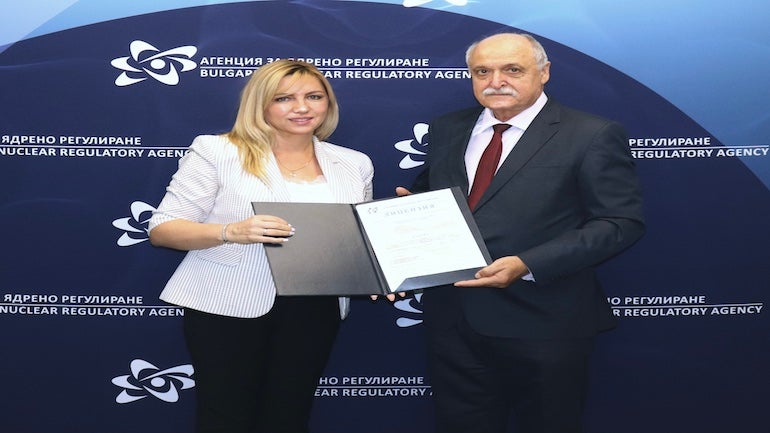
The Bulgarian Nuclear Regulatory Agency (AYaR – Agentsia za Yadreno Regulirane) has formally handed over a new 10-year decommissioning licence to the State Enterprise Radioactive Waste (DP RAO – Drzhavno Predpriyatne RadioAktivni Otpadtsi) for decommissioning work at Kozloduy NPP units 3&4.
The new licence brings together and replaces the previous individual licences for the two units. It defines the safety requirements during decommissioning and gives the right to DP RAO to carry out deactivation and dismantling of structures, systems and components, as well as management of materials and radioactive waste from decommissioning processes.
The activities will be carried out in full compliance with the updated decommissioning plan for units 3&4. To reach the end state defined in the Spent Nuclear Fuel and Radioactive Waste Management Strategy, as well as the goals set in the Decommissioning Plan, DP RAO should dismantle all technological equipment in the engine room, reactor compartment and the auxiliary housing, which will subsequently be deactivated and transported off the industrial site.
All buildings and adjacent territories will be deactivated until the specified criteria for exemption from regulation according to the requirements of the Safe Use of Nuclear Energy Act (ZBIYaE – Zakon za Bezopasno Izpolzvane na Yadrenata Energia) and its implementing regulations. DP RAO continues to manage the decommissioning infrastructure projects financed by the Kozloduy International Fund through the European Bank for Reconstruction & Development (EBRD).
This approval follows operational launch in April of Bulgaria’s first national repository for low- and intermediate-level radioactive waste, located near the Kozloduy NPP site. The repository will house the waste generated from dismantling these older units. The repository was primarily funded by a grant of approximately €76m ($89m) from the Kozloduy International Decommissioning Support Fund (KIDSF) administered by the EBRD on behalf of the EC and other international contributors. The project also received national co-financing totalling approximately BGN34m ($20m) from the Bulgarian government.
The aim is to decommission units 1-4 by 2030, aiming for a “brown field end state”. In addition to the repository, this is supported by the construction of the Dry Spent Nuclear Fuel Storage Facility, which began operation in January 2016 and can store used fuel for more than 50 years. The Plasma Melting Facility, commissioned in 2018, reduces the volume of and treats radioactive waste.
Kozloduy units 1-4 were closed some 20 years ago as a strict condition for Bulgaria’s 2007 accession into the European Union, following safety classifications assigned by the European Commission (EC). However, these Soviet-designed VVER-440/V-230 pressurised water reactors, built with notable technical design modifications. Though officially classified by the EC as older, non-upgradable V-230 models, both reactors featured a heavily modernised, improved design that bridged the safety gap toward the much more advanced V-213 generation.
Bulgaria continues to maintain its energy grid through units 5&6 and is currently making moves to expand the Kozloduy site with two advanced Westinghouse AP1000 reactors, projected to come online in the mid-2030s. There are also various proposals for the construction of small modular reactors.


