
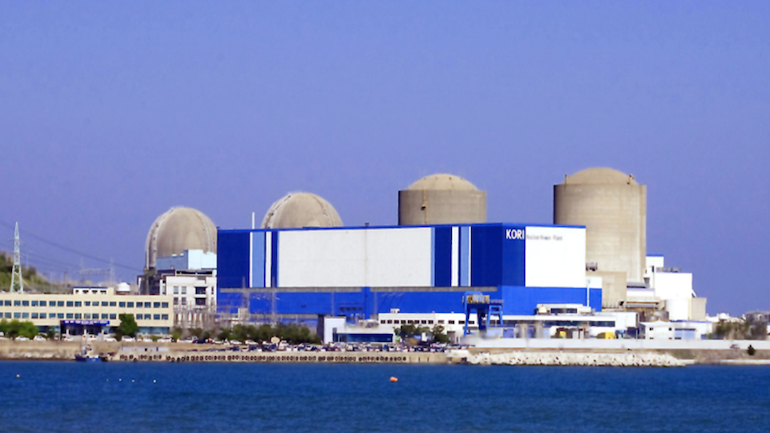
The Korea Hydro & Nuclear Power (KHNP) has selected North Gyeongsang Province’s Yeongdeok County as the site for two large-scale nuclear reactors with a maximum output of 1,400 MWe each, and Busan’s Gijang County as the site for a small modular reactor (SMR) with an output of 700 MWe.
The new plants will be built under the 11th Basic Plan for Long-term Electricity Supply and Demand (power plan), prepared in November 2025. The plan forecasts mid- to long-term electricity demand over the 15 years from 2024 to 2038 and sets a supply roadmap for facilities such as nuclear and renewables to match that demand.
The bidding process for the reactor sites closed at the end of March. Yeongdeok County and Ulju County in Ulsan both submitted proposals for large NPPs, while Gijang and Gyeongju applied to host an SMR.
KHNP’s site evaluation committee explained that the decision was taken based on a points system. Site suitability, environmental impact, construction feasibility, and acceptance from the community each accounted for 25 points. Yeongdeok scored a total of 91.01 points and Gijang scored 87.11. Ulju and Gyeongju received 82.63 points and 84.56, respectively.
Rather than expanding an existing nuclear complex such as Kori (between Busan and Ulsan), Wolsong (Gyeongju), Hanbit (Yeonggwang) or Hanul (Uljin), the project will establish new nuclear power sites in Yeongdeok. This is the first time in 14 years that a new region has been selected as an NPP site for a nuclear reactor. “One of the main arguments against building additional reactors was that it would be difficult to secure a new site,” said Moon Joo-hyun, a professor of energy engineering at Dankook University. “This decision shows that local acceptance of nuclear power has improved compared to the past.”
Yeongdeok’s selection raises the possibility of reviving a previous NPP project after almost a decade. The county had been selected in 2011 to host two 1,500 MWe nuclear reactors, Cheonji 1&2, under the Lee Myung-bak administration. The process had begun to secure the land property, but the project was cancelled during former President Moon Jae-in administration’s nuclear phaseout policy.
Gijang, the site selected for the SMR, has an established nuclear power infrastructure. It already operates Kori NPP units 2-4 and Shin-Kori units 1&2. The new SMR site is also owned by KHNP within the Kori Nuclear Power Headquarters. The lack of need to purchase additional land or relocate residents appears to have worked to its advantage. The site is adjacent to the sea, which is also favourable for SMR cooling.
In the wake of KHNP’s decision, the government aims to complete the designation of the planned power development zone by early 2027, secure approval for the project implementation plan and construction permits in 2029, and break ground in 2031. The SMR is targeted to complete construction in 2035, while the large-scale nuclear reactors aim to be completed in 2037 or 2038.
Once a site is finalised for plant construction, funds are directed to the local government under the Act on Support for Areas around Power Plants and the “regional resources facilities tax” in the Local Tax Act. First, a one-time special grant of more than KRW100bn ($66m) is paid to promote development and co-prosperity in areas near the plant. The special grant equals 2% of total construction costs, consisting of 1.5% of construction costs plus an additional charge of 0.5% for voluntary hosting.
Local governments can also receive grants based on electricity generation. A local government that hosts a nuclear plant receives a “basic grant” of KRW0.25 per kWh every year starting after groundbreaking. Under the same law, KHNP also pays 0.25 won per kWh every year to the local government from groundbreaking as “business operator support funds”.
Gijang County, which will host the SMR, is also set to receive significant grants. Assuming an SMR design life of 80 years and a capacity factor of 80%, hosting a 700 MWe SMR would bring in about KRW1.2bn a year in basic grants and business operator support funds, and about KWR102bn over 85 years including the five-year construction period.
In February, Korea’s National Assembly passed the Special Act on the Promotion and Support of SMR. The Ministry of Science and ICT plans to invest KRW1200bn by 2030 in core technology designs for three domestically developed SMR types. A consortium led by KHNP and the Korea Atomic Energy Research Institute is developing the Innovative Small Modular Reactor (i-SMR) – an integrated pressurised water reactor type nuclear power plant with an electrical output of 170 MW for both domestic use and export.
Nuclear power is increasingly seen as critical for securing stable baseload electricity as AI-driven power demand accelerates. According to preliminary projections set for the 12th electricity supply plan, electricity consumption could reach as much as 694.1 terawatt-hours by 2040, significantly exceeding earlier forecasts made in last year’s report by the KHNP.
“Countries around the world are competing to expand nuclear power to provide the stable and affordable electricity needed for AI and other industries,” said Chung Bum-jin, a professor of nuclear engineering at Kyung Hee University. “Korea must continue building new reactors domestically to maintain its competitiveness in the global nuclear export market.”
The Korean Nuclear Society has proposed that the government include an additional two to four large-scale reactors and two SMRs in the 12th Basic Plan for Long-term Electricity Supply and Demand (2026–2040) due to be finalised later this year. Korea’s 26 operable reactors currently provide around a third of its electricity, with four more reactors are under construction.


