
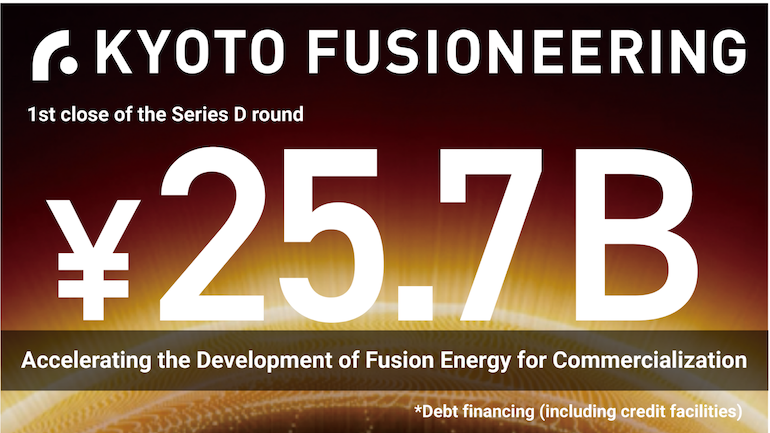
Japan’s Kyoto Fusioneering (KF) has announced the first close of its Series D funding round, securing JPY16.72bn ($105m) in new equity along with access to JPY 9.0bn in credit and loan facilities, for JPY 25.72bn in total. The funds will accelerate KF’s UNITY programme, a staged de-risking effort spanning Japan, Canada, and the US, and expand the company’s supply capacity and international operations.
KF explained that it is not concerned with the fusion reaction itself. But with everything surrounding the reaction to make fusion a commercial power source. This includes the systems that heat the fuel, absorb the energy the reaction throws off, convert that energy into useful forms, and generate and recycle the fuel. While most of the fusion industry is working on the reaction, KF focuses on the plant that must be built around it, regardless of fusion approach.
KF’s Unity (Unique Integrated Testing Facility) programme tackles the blanket and fuel cycle challenge through separate-effects testing. Each distinct class of physics is isolated in a purpose-built facility before they are brought together.
Unity-1, operating in Kyoto, Japan, resolves the non-nuclear behaviour of a liquid-metal breeding blanket: thermal-hydraulics, magnetohydrodynamic effects, hydrogen isotope extraction, materials compatibility, high-temperature heat extraction, and power generation. Unity-2, under development in Ontario through Fusion Fuel Cycles, a joint venture with Canadian Nuclear Laboratories, will demonstrate the world’s first continuous, end-to-end D-T fuel cycle in power-plant-relevant conditions. Unity-3 adds the critical fusion-nuclear dimension – the neutronics, tritium production validation, and transmutation effects that can only be measured in a real fusion-neutron environment.
Each facility retires a different category of risk. Together they validate the blanket and fuel cycle systems and supply the data and components needed before full-scale integration. Once all three are running, KF will be the first company in the world to have tested systems essential for commercial fusion power. This round will go primarily toward accelerating that work.
KF is an industry enabler validating the infrastructure every fusion plant needs. Fusion programmes around the world already run on KF’s gyrotrons – the high-power microwave tubes that help heat fusion fuel to the temperatures at which it reacts, well over a hundred million degrees.
Building on foundational technology developed by Japanese research institutions, KF has pushed gyrotron performance to a world-leading level and paired it with the supply-chain management and precision final assembly needed to deliver products tailored to each project’s specifications. This has won KF a steady stream of orders from public and private fusion programmes worldwide.
As demand grows, KF will use this funding to build mass-production capacity and a supply system that can respond quickly – putting the industrial base in place before fusion plants start being built, rather than after.
New investors in this latest funding round include: IMM Japan Korea-Japan Fusion Fund Investment Limited Partnership (General Partner: IMM Investment Japan Co Ltd); Site Ground Capital Ltd; GX Acceleration Agency (Organisation for the Promotion of Transition to a Decarbonised Growth-Oriented Economic Structure); Development Bank of Japan; East Japan Railway Company (JR East); Minerva Growth Partners and two additional new investors.
Existing Equity Investors (Follow-on Investment) include: SMBC Venture Capital Co Ltd; Kyoto Capital Partners Co Ltd; JIC Venture Growth Investments Co Ltd; Daiwa Corporate Investment Co Ltd; DBJ Capital Co Ltd; MUFG Bank Ltd.
Debt Financing/Credit Facility Providers include Sumitomo Mitsui Banking Corporation; The Kyoto Bank Ltd; Sumitomo Mitsui Trust Bank Ltd; Mizuho Bank Ltd; and one other.
KF Representative Director & CEO Satoshi Konishi noted: “We are deeply grateful – not just for the scale of this round, but for the range of investors who joined it. We see it as confidence in KF, and as a sign that fusion energy is moving from research into industrialisation. We also take it as recognition of our evolution into a company that, regardless of reactor concept, provides, in an integrated manner, the technologies essential to fusion power demonstration projects worldwide.”


