
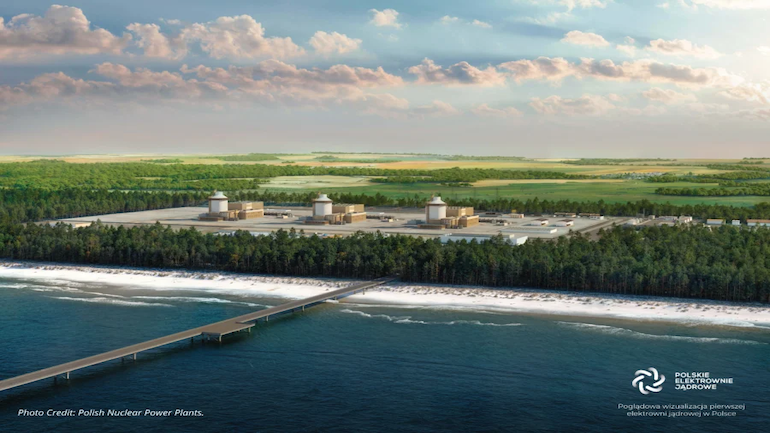
Agreement has been reached on the main commercial and legal terms between Polskie Elektrownie Jądrowe (PEJ) and the Westinghouse-Bechtel consortium establishing the core framework for the upcoming Engineering, Procurement & Construction (EPC) contract for Poland’s first NPP.
The plant will feature three Westinghouse AP1000 reactors with a combined capacity of 3,750 MWe at the Lubiatowo-Kopalino site in the Choczewo commune in the northern Pomerania province. The first nuclear concrete pour is targeted for 2028, and the first electricity is expected to flow to the Polish grid by 2036.
PEJ handed the project site over to Bechtel in August. A second stage of preparatory earthworks, including site grading, drainage upgrades, and temporary road construction, is underway. A construction permit application was submitted to Poland’s State Atomic Energy Agency (PAA – Państwowa Agencja Atomistyki) in March. By law, the PAA has 24 months to review this documentation.
However, PEJ also needs Regional Construction Permit from the Pomerania regional governor which it cannot legally receive until PAA first approves the nuclear licence. Consequently, PEJ is preparing the paperwork now and plans to officially submit the construction permit application in 2027.
The terms agreed between PEJ and the US consortium represent a baseline framework, paving the way for detailed negotiations regarding remaining contract details. Both PEJ and the consortium have stated their determination to finalise and conclude the full EPC contract by the end of 2026.
“This agreement reflects the momentum we’ve built with PEJ,” said Dena Volovar, President of Bechtel’s Nuclear, Security & Environmental business. “Bechtel has designed, built, or supported 150 nuclear power plants over 80 years…. Using modern execution tools to drive efficient delivery, we’re bringing that experience to Poland, and we’re building local capability as we go. By the time this plant is running, Polish companies and Polish workers will be part of a nuclear industry that can compete for decades.”
The project has already driven significant domestic involvement, awarding roughly $250m in contracts to Polish companies including Budimex, Doraco, Unihouse, MSA Security, and Barg MB (Gdańsk) to carry out work at the project site. More contracts with Polish subcontractors are expected to be signed soon. In addition, training partnerships have been established with three local universities to build a long-term nuclear workforce.
The total investment cost for Poland’s first NPP is estimated at €42-46bn ($47.8-52.4bn). To fund one this major infrastructure project, Poland has adopted a 30% public equity and 70% debt financing structure. The Polish government is covering approximately 30% of the project’s capital expenditure through direct state support. The state is providing a capital injection of roughly PLN 60bn ($15bn) directly to (PEJ. In early 2026, the first tranche of PLN4.6 billion in treasury bonds was transferred to fund ongoing design and internal infrastructure work.
The European Commission has approved Poland’s state aid package, which includes a 40-year two-way Contract for Difference. This guarantees revenue stability by compensating PEJ if market electricity prices fall below a fixed strike price, heavily mitigating long-term financial risk.
The remaining 70% of the budget is being sourced through external debt, backed entirely by 100% Polish State Treasury guarantees. The Export-Import Bank of the United States (EXIM) serves as a principal lender. In January 2026, PEJ and US EXIM signed a direct-loan agreement under EXIM’s Engineering Multiplier Program (EMP). This marks the first-ever direct financing agreement between the EXIM and a Polish entity, specifically funding the export of advanced technical and engineering services from Westinghouse and Bechtel.
International Export Credit Agencies (ECAs) are expected to cover 60-70% of the total debt. Alongside US backing, the project has drawn initial support from Canadian financial institutions. The remaining portion of the debt will come from commercial markets, which showed intense initial interest with early market soundings being 5-6 times oversubscribed.


