
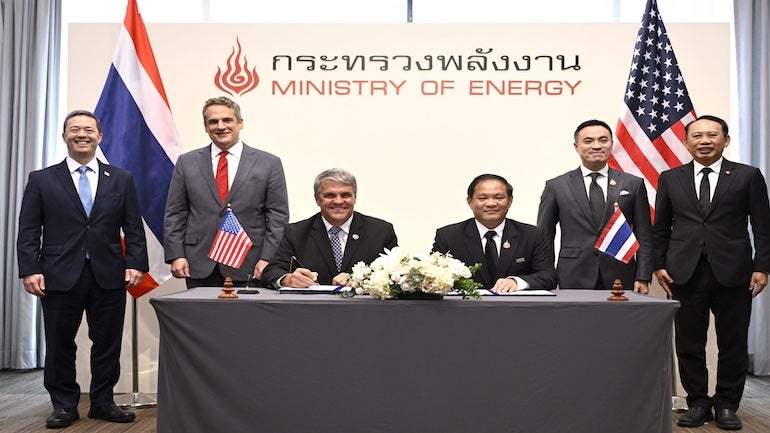
The US Trade & Development Agency (USTDA) is promoting US civil nuclear energy technology to support Thailand as it explores development of its first-ever nuclear power project. USTDA signed an agreement with the Electricity Generating Authority of Thailand (EGAT) for a feasibility study to provide technical analysis of US small modular reactor (SMR) technologies that would generate about 600 MWe.
EGAT will use the USTDA-funded technical analysis to evaluate potential plant locations, estimated project costs, and the completely new regulatory frameworks required to implement civil nuclear infrastructure in Thailand. The study is designed to remain neutral while evaluating advanced reactor designs from seven major US companies: GE-Hitachi, Holtec, Kairos Power, NuScale, TerraPower, Westinghouse, and X-Energy.
This partnership builds upon the bilateral US-Thailand 123 Agreement on peaceful civil nuclear cooperation, which legally entered into force in July 2025, paving the way for the transfer of US technical data and reactor technologies. This collaboration aligns with Thailand’s updated Power Development Plan (PDP), which targets the deployment of its first SMR units by 2037 to counter diminishing domestic natural gas reserves and meet its long-term carbon neutrality goals
While the initial 2037 deployment will supply about 1% of the country’s total electricity mix, the long-term target scales up to 9,000 MWe of total SMR capacity by 2050. Current strategies focus on building two initial units (one in the Northeast/North and one in the Southern region). EGAT intends to prioritise existing power plant sites to use established grid infrastructure and reduce investment barriers. The integration of SMRs is paired with a push to increase the share of renewable energy in total generation to 51% by 2037 (up from 36% under previous plans), and eventually to 73% by 2050.
“For the United States, this partnership advances our commitment to American innovation and leadership in advanced civil nuclear energy. It is part of America’s nuclear renaissance – an era of renewed innovation and investment that is creating new opportunities to deploy advanced technologies at home and around the world,” said USTDA Deputy Director Thomas R Hardy. “It reflects a broader foreign policy priority: working with trusted partners to expand access to reliable energy technologies while strengthening energy security across the Indo-Pacific.”
The USTDA-funded feasibility study mandatorily evaluates a technology-neutral list of seven leading American civil nuclear developers. Each offers a different technological footprint:
- GE-Hitachi’s BWRX-300 is a 300 MWe boiling water reactor (BWR) using passive safety systems. The design is relatively advanced in global licensing and commercial tracking.
- NuScale Power’s VOYGR light water reactor comprises fully factory-fabricated 77 MWe modules designed to be grouped into multi-module plants. It is the first SMR design to receive US Nuclear Regulatory Commission (NRC) certification.
- Westinghouse’s AP300 pressurised water reactor is a 300 MWe scaled-down iteration of the large-scale AP1000 technology, minimising regulatory hurdles.
- TerraPower’s Natrium sodium-cooled fast reactor uses liquid sodium as a coolant paired with a molten salt energy storage system to easily adjust output to compensate for unstable renewables.
- X-Energy’s Xe-100 high-temperature gas reactor is a pebble-bed, helium-cooled reactor using TRI-structural ISOtropic (TRISO) fuel pebbles that cannot melt down, suitable for clean industrial heat and power.
- Kairos Power’s fluoride salt-cooled high-temperature (KP-FHR) reactor uses TRISO fuel combined with a low-pressure liquid fluoride salt coolant for robust passive safety at exceptionally high temperatures.
- Holtec International’s SMR-300 pressurised water reactor is a 300 MWe walk-away safe, natural-circulation reactor that requires no pumps or moving parts to cool the core in an emergency.
This multi-vendor assessment gives Thailand a comprehensive blueprint of modern SMR capabilities ranging from traditional water-cooled units to next-generation molten salt and gas designs, while ensuring maximum transparency as they draft their safety frameworks. However, none of them as yet has an operating reference plant in the USA. They are all in the construction and licensing phase.
Dr Narin Phoawanich, EGAT’s Governor, said: “This grant represents an important foundation for Thailand to evaluate the potential role of SMR technology in strengthening energy security and supporting a cleaner energy future. We highly value the opportunity to learn from American innovation, expertise and experience while advancing cooperation between our two countries.”
The USTDA describes itself as “the US government’s first mover on critical infrastructure development in emerging markets, advancing the shared strategic priorities of the United States and our overseas partners while creating opportunities to deploy trusted US solutions”. USTDA “funds the upfront technical work that accelerates the development of infrastructure projects, helping them attract the financing they need for implementation and procurement of US goods and services”.
However, Thailand is keeping its options open and has also signed cooperation agreements with China and South Korea. The Thai government and EGAT have explicitly stated they have not selected a final supplier or reactor design. Thailand looking to secure the best financial, regulatory, and technological deals.
EGAT signed a cooperation agreement with China National Nuclear Corporation (CNNC) Overseas in August 2024 involving direct technical exchanges regarding SMR technology and how it can be deployed on the Thai grid. China’s primary pitch is its Linglong One (ACP100) reactor, a 125 MWe commercial SMR design. China’s Advantage: Unlike the US designs, China is already commercially operating or finalising construction on its SMR units (such as the HTR-PM and Linglong One). This offers Thailand a real-world blueprint to study. Furthermore, Chinese state-owned enterprises often attach highly competitive state-backed financing and waste management options.
In June 2025, EGAT signed a memorandum of understanding with Korea Hydro & Nuclear Power (KHNP). This partnership is focused on conducting joint reviews of SMR options, sharing technical data, and training Thai personnel through site visits to South Korean nuclear facilities. South Korea positions itself as a strategic “third option” for Southeast Asian nations that want top-tier nuclear technology but prefer to remain neutral and avoid becoming geopolitically dependent on either the US or China.
In addition, Thai power producer Global Power Synergy has been engaged in a joint feasibility study with Denmark’s Saltfoss Energy (formerly Seaborg) since April 2024. They are evaluating advanced, floating compact molten salt reactors (CMSR) built onto power barges. This technology is being co-developed and manufactured through a South Korean consortium involving Samsung Heavy Industries and KHNP, which could provide Thailand with an ocean-docked nuclear solution to bypass complex mainland siting laws. However this is still in the early construction phase.


