
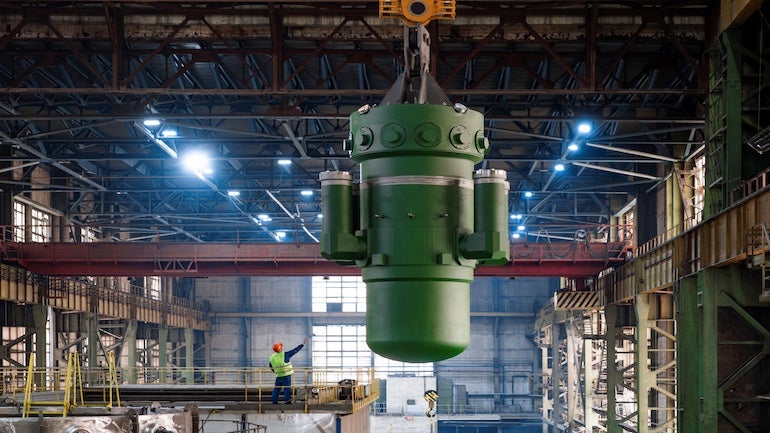
Russia’s ZiO-Podolsk (part of Rosatom’s Mechanical Engineering Division), has manufactured the second RITM-200S reactor unit for the lead floating power unit PEB-106 (Plavuchevo EnergoBloka -106) intended to supply power to a large copper cluster in Chukotka. The reactor already passed hydraulic tests, which confirmed its reliability, and a trial assembly, which proved that all components and elements fitted according to technical specifications.
Each PEB-106 houses two RITM-200S reactors each generating 58 MWe (totalling 106 MWe per barge). The first reactor for the lead vessel was manufactured in May. Following its completion, it was transported by rail to the Baltic Shipyard in St Petersburg, allowing the project to advance to the installation phase inside the vessel’s hull.
This lead unit is part of a planned series of four floating platforms built to supply power to the Baimsky copper mining cluster in the remote Chukotka region, with the first unit scheduled for commissioning in 2028.
“2026 was a landmark year for ZiO-Podolsk machine builders: for the first time, we produced a set of RITMs for a nuclear floating power unit, which will provide power to an industrial cluster in the Russian North,” said ZiO-Podolsk Director Anton Lebedev. “This is an important step in the development of small nuclear energy throughout the world. Also this year, the plant set a record: in less than a year, four installations of the RITM family were manufactured, and five more are in production.”
The RITM-200 was originally designed to power the nuclear icebreaker fleet. Its design was 1.5 times more compact and significantly more powerful than previous generations of ship reactors. The design has since been adapted for use on floating NPPs and also for ground-based low-power reactors.
Several Rosatom enterprises are involved. OKBM Afrikantov is the chief designer and complete supplier of the reactor plant. AEM-Spetsstal in St Petersburg produces metallurgical blanks for future reactors. The reactor plant body is manufactured at ZioPodolsk where final tests and trial assembly also takes place. A total of 16 RITMs have been manufactured, eight of which ar already operating as part of the nuclear icebreaker fleet. A further 12 are at different stages of production.
While both the RITM-200 and RITM-200S share the same compact, Generation III+ integral pressurised water reactor (PWR) design, the RITM-200S was optimised explicitly for stationary power generation on a floating barge, whereas the standard RITM-200 was engineered for the dynamic propulsion needs of Project 22220 nuclear icebreakers.
Unlike icebreaker reactors, which experience frequent power spikes and drops as the ship rams through thick Arctic ice, the RITM-200S operates as a baseload utility plant. It maintains a steady, higher thermal performance (198 MWt) to maximise steam turbine efficiency for onshore consumers via high-voltage cables.
To power the Baimsky copper and gold mining cluster, Rosatom is deploying four upgraded floating NPPs to Cape Nagloynyn. Due to domestic shipyard backlogs, the structural steel hulls for the initial units were outsourced to a shipyard in China before being towed to St Petersburg for final nuclear integration.
The current rollout schedule follows a staggered deployment path aimed at full cluster activation by 2031. Unit 1 is scheduled to begin supplying power to the region by 2028. Units 2&3 (the core fleet) are currently in various stages of forging at ZiO-Podolsk and are scheduled for staggered delivery and commissioning between 2028 and 2030. Unit 4 (the reserve plant) is a dedicated backup unit.
Because the Baimsky mining cluster requires uninterrupted, year-round power, Unit 4 is scheduled for completion by 2031. It will supply power to the grid whenever one of the three primary units needs to shut down for its five-year scheduled maintenance and refuelling cycle.
Mooring a 19,000-tonne floating nuclear power plant in Cape Nagloynyn, where winter ice packs can freeze solid and Arctic tides constantly shift the sea level, requires a highly specialised engineering system. Traditional anchor chains or nylon ropes would snap under the pressure of shifting ice or pull the vessel off-course. Rosatom therefore has developed a hybrid marine infrastructure engineered specifically for extreme polar conditions.
To keep the PEB-106 securely positioned, it is held by heavy-duty rigid mooring devices. Rather than swinging freely on an anchor line, the barge is attached to massive onshore or seabed-anchored steel columns via articulated mechanical arms. These act as vertical sliders. They permit the barge to rise and fall seamlessly with heavy Arctic ebbs and flows. While the barge can move vertically, the arms restrict horizontal drift. This stability ensures that the 50 high-voltage power cables running from the barge to the shore grid never stretch, twist, or snap.
The barge is not left exposed to the open ocean. Rosatom constructs a hydro-technical protective pier and breakwater system around the station’s permanent mooring berth. The outer breakwater is a reinforced, rock-and-concrete structure designed to absorb the kinetic energy of drifting ice floes pushing against the coast. It deflects massive sheets of moving ice away from the hull.
By enclosing the barge within a protective harbour, engineers isolate the vessel from powerful waves and the dynamic forces of moving sea ice packs. Even inside a protected pier, the sea will freeze solid around the barge during the Arctic winter. To prevent the ice from exerting crushing static pressure, the plants are equipped with countermeasures.
Waste heat generated by the RITM-200S reactors can be redirected to warm the ballast tanks and outer hull sections slightly, preventing ice from bonding to the steel plating. Subsea pipelines surrounding the barge release a continuous curtain of compressed air bubbles. This drives warmer water from the seafloor up to the surface, mitigating thick ice formation immediately adjacent to the vessel. the PEB-106 operates safely as a stationary utility plant through this combination of flexible vertical mooring, protective barriers, and active ice management.


