
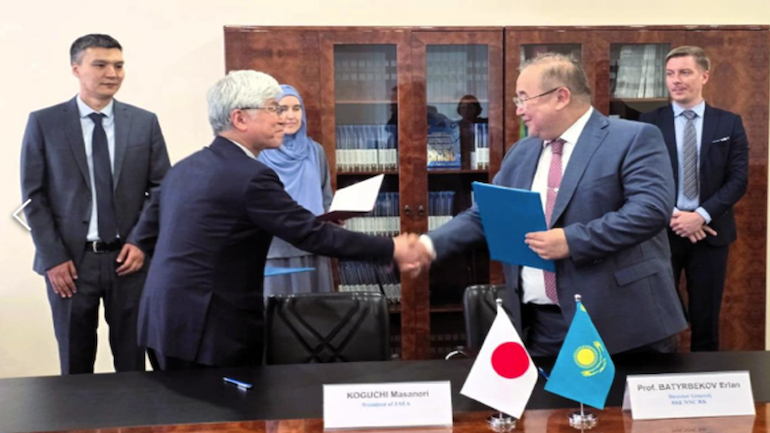
A meeting in Almaty between the Director General of Kazakhstan’s National Nuclear Centre (NNC), Erlan Batyrbekov, and the President of the Japan Atomic Energy Agency (JAEA), Masanori Koguchi, discussed joint achievements and prospects for further research on fast reactor safety.
The meeting advanced their 20-year bilateral cooperation in the EAGLE (Experimental Assessment of Gladly-Initiated Local Accidents) programme with the launch of the EAGLE-4 project, which extends the partnership to 2031.
The EAGLE programme explores severe accident scenarios for sodium-cooled fast neutron reactors, specifically evaluating molten core behaviour and its interaction with sodium coolants. Over the last two decades, the collaboration has resulted in: 200 preparatory and methodological tests; 11 large-scale in-pile experiments performed at Kazakhstan’s unique IGR research reactor; and more than 65 out-of-pile tests completed on the specialised EAGLE test bench.
The experimental programmes EAGLE, EAGLE-2 and EAGLE-3 were successfully completed, and, with assistance from Marubeni Utility Service, computational and analytical work was carried out to prepare the next stage of the EAGLE programme.
The meeting resulted in the signing of a new Memorandum of Cooperation and the Phase-1 implementation agreement for the EAGLE-4 project. This will focus on safety testing to justify the architectural design of Japan’s upcoming Generation IV demonstration fast reactor, the Japan Sodium-Cooled Fast Reactor (JSFR), which serves as the cornerstone of the country’s long-term nuclear independence strategy.
The planned roadmap includes testing advanced fuel assemblies optimised for Japanese Gen-IV reactor models; executing a fresh matrix of in-pile and out-of-pile experiments; and conducting small-scale validation tests across multiple NNC specialised facilities. This will provide the primary scientific data required for international safety licensing and risk mitigation.
The JSFR design was heavily informed by Japan’s two previous landmark sodium-cooled fast reactors. Joyo (1977 – present), Japan’s first experimental fast reactor, located in Ōarai continues to serve as an essential irradiation test facility for advanced materials. Monju (1994-2016), a larger prototype fast breeder reactor built to generate electricity, suffered a severe secondary loop sodium leak and fire in 1995 halting operations for years. Following a long series of technical setbacks and changing post-Fukushima regulations, the Japanese government officially decided to decommission Monju in 2016.
Following the decommissioning of Monju, Japan shifted away from traditional “breeder” reactors (which maximize plutonium production) toward advanced fast reactors focused on safety, economic viability, and reducing high-level nuclear waste.
Unlike Monju’s complex “loop-type” layout, the JSFR design adopted a consolidated “pool-type” configuration. Keeping all radioactive sodium within a single, heavily reinforced reactor vessel radically minimises the risk of external piping leaks. The heat transport systems were streamlined from traditional multi-loop designs down to an efficient two-loop system, slashing construction volume, steel requirements, and capital costs. A demonstration fast reactor is planned to operate by 2050.


