
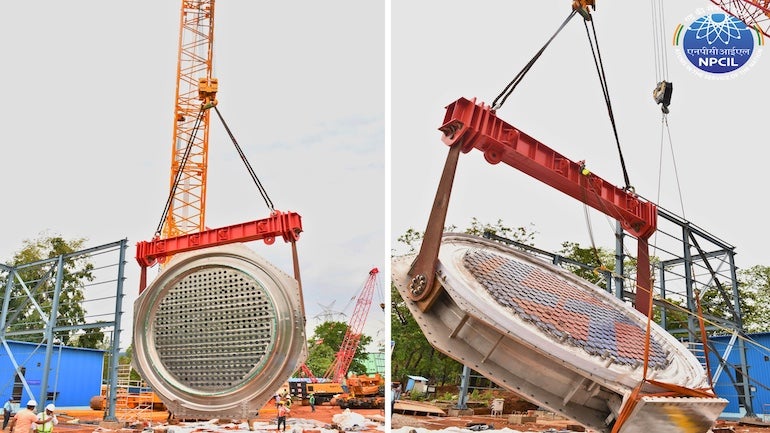
Nuclear Power Corporation of India Limited (NPCIL) reported progress at the Kaiga nuclear power project (units 5&6) in Karnataka with delivery of a key component of the reactor core, the first end shield for unit 5. The component was manufactured by Larsen & Toubro (L&T) at its Hazira facility. The unloading operation was carried out using a 500-tonne crane, a 70-tonne crane and a 10-tonne chain pulley block.
Kaiga 5&6 are two of 10 indigenously designed 700 MWe pressurised heavy water reactors (PHWRs) approved for serial construction by the Union Government in 2017. Currently, Kaiga houses four 220 MWe PHWRs that were connected to the grid between 2000 and 2011. NPCIL expects to construct the two PHWRs by 2031. Excavation works began in May 2022 and the Atomic Energy Regulatory Board (AERB) approved first concrete for the units in March.
Megha Engineering & Infrastructures Limited (MEIL) is executing the Engineering, Procurement, and Construction (EPC) contract for Kaiga 5&6. This marks a historic shift in India’s nuclear energy sector, as it is the first time a private sector company has been awarded an entire nuclear power plant construction project.
The end shield weighs 107 tonnes and measures approximately 9.3 metres in height and width, with a thickness of 0.920 metres. It provides structural support to coolant channel assemblies, enables on-power refuelling and forms an integral part of the calandria vault enclosure.
The calandria is a large, low-pressure cylindrical stainless-steel tank that holds the heavy water moderator. This horizontal, thin-walled cylindrical structure contains the moderator liquid at relatively low temperatures (around 65°C) and pressures. Hundreds of thin-walled tubes that span horizontally from one end of the cylinder to the other. Inside these calandria tubes sit the high-pressure pressure tubes (coolant channels), which hold the uranium fuel bundles and the high-temperature heavy water coolant.
The calandria and the end shields work together to form the main reactor vessel assembly. Each calandria requires two end shields – one bolted and welded to each side of the horizontal cylinder. Because neutrons and gamma radiation leak out of the ends of the reactor core, these components act as the primary radiation barriers.
Each end shield is a complex, double-walled circular steel structure. The space between the walls is packed with carbon steel balls and filled with water to absorb escaping radiation. The outer face of the end shield contains specialised openings that line up exactly with the coolant channels. This allows automated fuelling machines to lock onto the reactor and change fuel bundles while the reactor is running. The end shields bear the massive structural load of the horizontal coolant channels and the fuel inside them.
Scaling up Indian PHWRs from the older 540 MWe design to the current 700 MWe fleet standard required significant re-engineering of these two components. The calandria must now support 392 fuel channels instead of 306. The end shield plates were made thicker to sustain the higher structural loads and provide better radiation attenuation. Hundreds of holes must be bored into the end shields with sub-millimetre precision. Misalignment by even a fraction of a millimetre would prevent the robotic fuelling machines from docking properly.


