
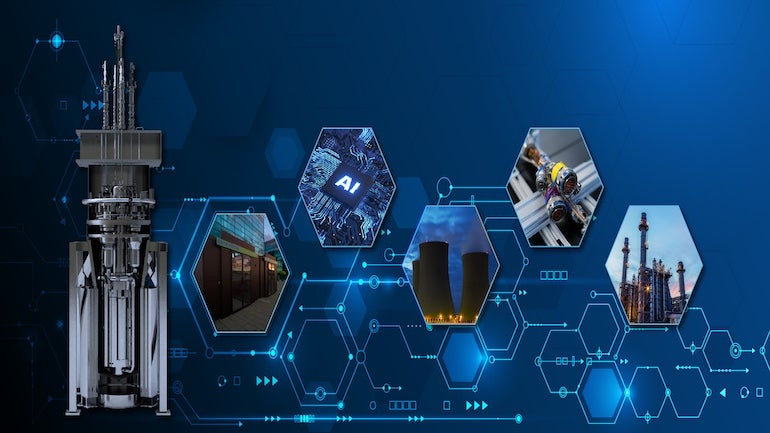
The US Idaho National Laboratory (INL) has announced initial selections for the Microreactor Application Research Validation & Evaluation (MARVEL) end user experiments. The five competitively selected teams will demonstrate several test cases, including desalination of remote operations and advanced sensors. The experiments will also be among the first to demonstrate the viability of powering data centres.
MARVEL is a sodium-potassium-cooled microreactor that is being developed by the Department of Energy (DOE) at INL’s Transient Reactor Test Facility. It will generate 85 kWt or up to 20 kWe and will provide a platform where the private sector can gain access to an operational microreactor to demonstrate innovative new use cases for the technology. MARVEL is intended to test microreactor applications, develop regulatory processes, and explore various electrical and nonelectric uses. It will be connected to INL’s first nuclear microgrid and is expected to be operational by late 2027.
The MARVEL project kicked off in 2020, and after four years of planning, design, and supporting experiments, the fabrication of its components began in spring of 2024. “With access to MARVEL, companies can explore how microreactors will potentially help us win the global AI race, solve water challenges and so much more,” said John Jackson, National Technical Director for the DOE Office of Nuclear Energy’s Microreactor Program. “The MARVEL testbed exemplifies how nuclear energy can open the door to a stronger, safer and more prosperous future for our country.”
The selected companies as the first potential end users for MARVEL will work with DOE and national laboratory staff members to create implementation plans for their proposed projects. They include:
- Amazon Web Services, which proposes coupling the MARVEL reactor with a modular data centre. This is a new service that makes it simple and cost-effective for defence and government agencies to build data centres anywhere in the world by enabling the creation of a self-sustaining, rapidly deployable system that can operate independently of traditional power infrastructure.
- DCX USA and Arizona State University, which propose using MARVEL to demonstrate the feasibility of a microreactor to power a data centre for artificial intelligence to yield valuable data on how to provide a stable, continuous power supply capable of handling the unique demands of AI processing.
- General Electric Vernova, which proposes using MARVEL to demonstrate remote and autonomous reactor operations and to establish controls standards for broader application of the technology with commercial reactors.
- Radiation Detection Technologies, which proposes using MARVEL to test advanced high-performance sensor technologies that could help monitor the performance of advanced reactors.
- Shepherd Power, NOV and ConocoPhillips, which propose leveraging MARVEL for a pilot-scale desalination project using nuclear-generated process heat to demonstrate the viability of advanced nuclear energy for addressing produced water challenges in oil and gas operations.
The selectees will coordinate with national laboratory experts to determine the feasibility of their proposed application using MARVEL. This may lead to the opportunity to use MARVEL for demonstration. Final agreements for proposed projects are anticipated to be announced in 2026.


