
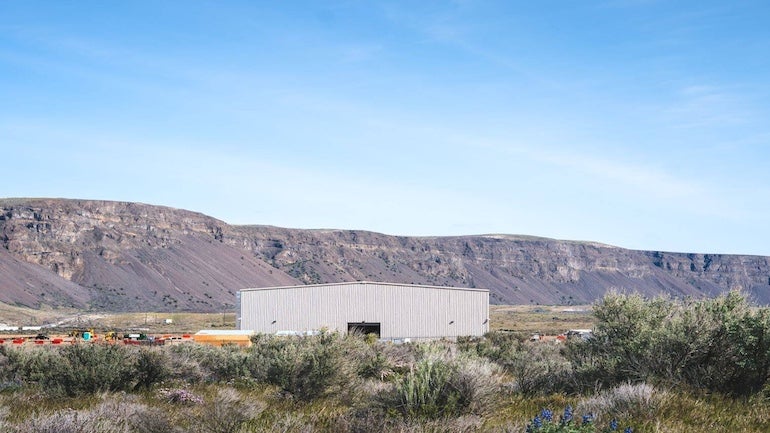
The Washington State Department of Health (DOH) has issued a Radioactive Materials Licence (RML) and Radioactive Air Emissions Licence (RAEL) to fusion company Helion Energy for its Orion facility in Malaga, Washington. Unlike prior research or experimental permits issued to other firms, these are commercial operating approvals.
In 2023, the US Nuclear Regulatory Commission (NRC) ruled that fusion technology should be regulated like particle accelerators and medical equipment rather than traditional, complex fission reactors. Because Washington is an “Agreement State” with NRC, its state DOH holds the authority to issue these permits. This distinction, codified by Congress in the bipartisan ADVANCE Act of 2024, reflects fusion’s fundamentally different safety profile Washington’s pathway was strengthened by bipartisan state legislation in 2024 and 2025 (House Bills 1924 and 1018) that clarified fusion’s role in clean energy policy and provided permitting certainty for fusion power plants.
“We are extremely proud to be granted these licenses from the Washington DOH, making us the first company in the world with the regulatory approvals in place for fusion power plant operations,” said David Kirtley, CEO of Helion Energy. “We have a long history of working with the DOH to license our previous fusion activities. Today’s announcement represents the rigor of that work and opens the door for practical, commercial, safe fusion power.”
“We’re grateful to partner with a world-class company like Helion. Leading radioactive regulatory oversight for the fusion industry in Washington state is an honor and is essential to protecting public health while advancing clean energy,” said Jill Wood, director of the Department of Health’s Office of Radiation.
Assembly and office structures have been completed at the Malaga site. Armed with these licences, Helion has approved construction of its generator building, with earthwork actively underway.
Helion is finalising a transmission interconnection agreement with the Chelan County Public Utility District to deliver power directly to the local grid. It is also pursuing its ambitious timeline to fulfil a 2023 power purchase agreement, which requires delivering 50 MWe of fusion power to Microsoft data centres.
In June, Helion raised $465m in a Series G funding round. The round valued the company at a $15.5bn post-money valuation, nearly tripling its previous valuation. Th funding brought Helion’s total capital raised to date to $1.5bn.
Unlike traditional tokamak designs, Helion focuses on Field-Reversed Configuration (FRC) and Magneto-Inertial Fusion (MIF) that shoots pulses of plasma together and directly recovers electrical energy using magnetic forces instead of traditional steam turbines.
Helion’s approach of rapid iteration and testing has enabled the company to make some progress toward a commercial fusion machine. Its 7th-generation prototype, Polaris, is intended to demonstrate the first electricity produced from fusion. With its previous prototype, Trenta, Helion was the first private company to achieve a fuel temperature of 100m degrees Celsius, which is generally considered the required operating temperature for a commercial fusion power plant. Polaris became the first privately funded fusion machine to operate with deuterium-tritium fuel and reached internal record plasma temperatures exceeding 150m degrees C.
In July 2025, Helion announced plans to build its eighth prototype, Orion, a 50 MW fusion plant at property owned by the public utility district operators of Rock Island Dam near Malaga, in Chelan County, Washington. The company said the plant is intended to be operational by 2028, supplying power to nearby Microsoft data centres.
Helion’s timeline to deliver grid electricity by 2028 is generally viewed as highly improbable, given its track record. Kirtley said in 2014 that Helion could get a fusion reactor up and running in three years. In 2023, he said that the company would be able to generate fusion power and “go after commercially installed power generation” by 2024.
Dr John Slough, the chief visionary behind Helion’s core technology and a co-founder of the company, left Helion in May 2018 citing fundamental scientific and ethical disagreements regarding the company’s engineering direction. Slough has publicly targeted the technical viability of Helion’s scaling timeline. He argued that Helion’s executive leadership was glossing over the historically intractable problem of plasma confinement. In plasma physics, keeping an FRC stable as temperatures and pressures scale up is extraordinarily difficult.
He implicitly questioned the ethics of making aggressive commercial grid promises to investors before proving the underlying confinement physics works. Slough subsequently published alternative fusion reactor blueprints that completely abandon Helion’s roadmap, opting instead for a compact staged magnetic-compression reactor utilising standard fuel and a lithium-bearing blanket.


