
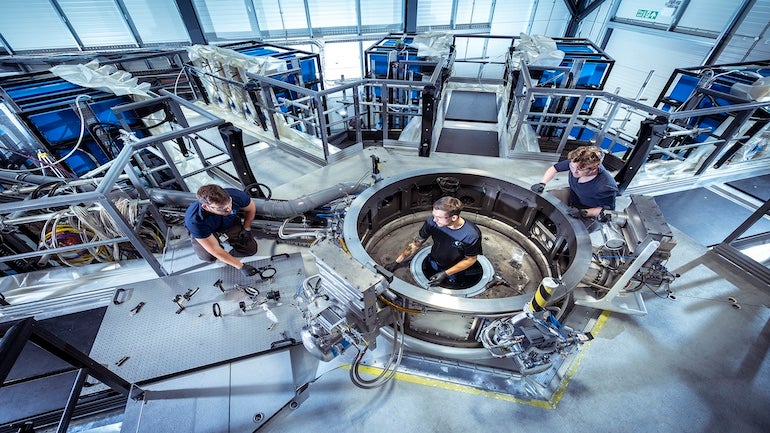
Oxford-based fusion developer First Light Fusion announced a major milestone by successfully demonstrating the core fuel compression principle behind its proprietary FLARE architecture. The experiments, conducted on the company’s in-house M3 pulsed power facility, validated that fuel can be compressed to a high density using a simpler, lower-power driver by transferring the burden of pulse control directly into the target.
Unlike conventional inertial confinement fusion, which attempts to compress and heat fuel simultaneously, FLARE (Fusion via Low-power Assembly and Rapid Excitation) splits the process into two independent stages: compression – assembling the fusion fuel to a high density; and ignition – delivering a separate, rapid burst of energy to trigger fusion (fast ignition).
The successful M3 experiments prove the viability of the first stage (compression) and address cost, which is the primary barrier to commercial fusion. The technology involves complex, multi-shell fuel targets that turn a single electrical impulse into timed shockwaves, controlling the compression internally and preventing premature heating.
By shifting functionality from the machine to the target, the peak power requirements of the compression driver are drastically reduced. First Light Fusion estimates that its compression driver costs could be an order of magnitude lower than comparable inertial fusion concepts. Lower power, simpler pulsed systems result in less mechanical stress, leading to longer component lifetimes, reduced downtime, and lower maintenance costs.
According to CEO Mark Thomas, validating controlled compression on M3 materially reduces technical risk. This milestone clears the path for First Light Fusion to progress toward fully integrated FLARE experiments and, ultimately, a high-gain commercial fusion demonstration. “This experiment validates a central principle of FLARE: that we can simplify the machine by putting more functionality into the target,” he said. “Demonstrating controlled compression on M3 is an important step in reducing risk on our path towards commercially viable fusion energy.”
The platform demonstration is a major technical milestone achieved following the company’s £25m ($33m) fundraise earlier this year. The experiments were not designed to demonstrate ignition or fusion gain, but to isolate and test this core compression principle. The next phase will build on this validated compression platform, moving towards fusion relevant fuel conditions and then integrated experiments combining compression with the rapid heating needed to trigger fusion.
First Light Fusion’s entire approach is inspired by a tiny, loud sea creature: the pistol shrimp, which does not use its oversized claw to pinch prey. Instead, it snaps its claw shut so fast that it shoots out a high-speed jet of water. This moves so quickly that the water pressure behind it drops instantly creating a tiny bubble of vapour. As the surrounding water pressure crushes that bubble, it collapses violently generating a massive shockwave, a flash of light and temperatures reaching over 4,700°C. This shockwave stuns or kills its prey.
First Light Fusion takes this exact mechanism of a collapsing cavity and scales it up to try and recreate the conditions inside a star. Instead of a claw, they use a giant railgun or an electrical pulsed-power driver to shoot a projectile at hyper-velocity (around 6.5 kilometres per second) into a specially designed, 3D-printed block called a target. Inside that target is a series of precisely engineered internal cavities and multiple layers (shells) of material.
When the projectile hits the target, it creates a massive shockwave. As this shockwave travels through the target’s internal cavities, the geometry forces it to focus, concentrate, and speed up like the collapsing bubble of the pistol shrimp.
At the very centre of the target is a tiny capsule of fusion fuel (deuterium and tritium). By the time the amplified shockwave reaches this fuel capsule, the pressure is immense enough to instantly crush the fuel to a high density, setting it up for a fusion reaction.
Most fusion projects use incredibly complex, multibillion-pound machines (giant lasers or massive magnets) to carefully shape and compress the fuel. First Light’s philosophy is to build a much simpler, cheaper machine, and let the complex internal physics of the 3D-printed target do the heavy lifting of shaping and amplifying the energy.


