
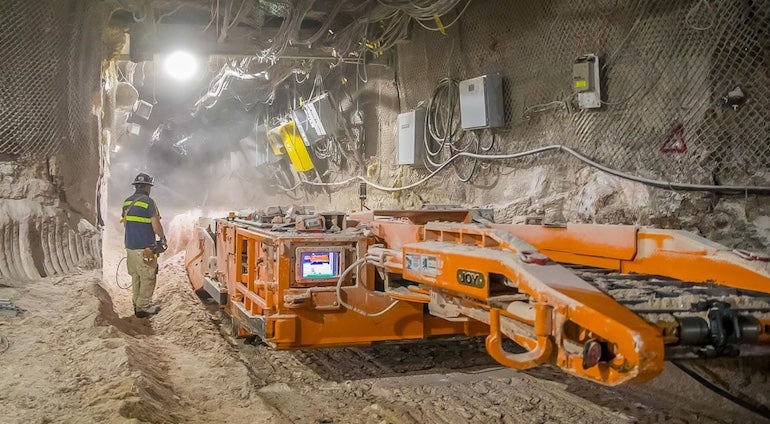
In an August 2026 amendment to its original 1998 Record of Decision (ROD), the US Department of Energy (DOE) extended the operational lifespan of the Waste Isolation Pilot Plant (WIPP) near Carlsbad, New Mexico, pushing its closing horizon to approximately 2083.
The plan calls for the excavation and use of seven new underground disposal panels (numbered 13 to 19) in the prehistoric salt beds to accommodate ongoing waste storage. While the physical footprint and operational timeline are expanding, the total statutory volume limit of transuranic waste allowed at the repository remains unchanged under the ROD.
Because the facility’s lifespan is being extended by five decades, DOE expects a 143% increase in the total volume of disposable defence-related waste generated nationally over the longer period. The expansion will require corresponding upgrades to the facility’s surface structures to support the development and ventilation of the new underground panels.
The WIPP site is a mined repository that has been excavated 2,100 feet below the surface in a prehistoric salt deposit. In 1998, after analysing potential environmental impacts, DOE decided to dispose of as much as 175,600 cubic metres of defence-generated transuranic (TRU) waste at WIPP, treated and packaged to meet environmental standards for the site. Disposal operations at WIPP were slated to continue until 2033.
WIPP is designed to accept TRU waste generated by past, present, and future defence-related operations, including nuclear weapons development and manufacturing; plutonium recovery, stabilisation, and management; research and development; environmental restoration, decontamination, and decommissioning; waste management at DOE labs and other government facilities; and testing at other institutions under contract to the DOE.
DOE intends to excavate and use seven additional underground disposal panels (numbered 13–19) for continued disposal of defence-generated TRU waste at WIPP. The excavation and use of these new panels, in addition to panels 11–12, will occur until approximately 2083. (The addition of panels 11 and 12 was approved by the Environmental Protection Agency last year.)
Despite the addition of new disposal panels, DOE has made no changes to the maximum total volume of TRU waste that can be accepted at WIPP. The new disposal panels are necessary at WIPP, according to the DOE, because some of the original panels have become unusable as a result of deteriorating ground conditions, radiological contamination, and concerns for worker safety.
The DOE stated in its amended ROD that it intends to implement a number of site infrastructure changes associated with the additional planned disposal panels, such as construction of surface structures and facilities to support the new panel development. These structures could include a new salt pile and pond, solar arrays, and upgraded hoisting capabilities (such as shafts, ventilation, and haulage).
DOE said it evaluated several factors that could be impacted by the new underground panels and surface facility modifications. These factors include visual resources, geology and soils, water resources, air quality, biological resources, cultural and paleontological resources, socioeconomic issues, transportation, and human health.
In total, 173 acres would be disturbed due to the additional panels and facility modifications at WIPP, but evaluation of geology and soils indicated that new excavation and construction “would not affect notable changes compared to the impacts analysed in 1997.” Other impacts, such as those to air quality, would be temporary. In other instances, the DOE stated that it would develop prevention and protection measures, such as preventing stormwater pollution and mitigating biological or cultural impacts. Additionally, the DOE calculated that the risk of death due to cancer was about “1,000 times less than the impacts” the agency listed in 1997.
As the DOE prepared its amended ROD for WIPP, it was also engaged in ongoing interactions with WIPP’s host state. In February, the New Mexico Environment Department (NMED) issued a large fine against DOE, claiming that it has failed to prioritise the disposal of legacy nuclear waste from Los Alamos National Laboratory at WIPP. And in April, NMED proposed revisions to WIPP’s operating permit to prioritise the disposal of waste generated within New Mexico.


