
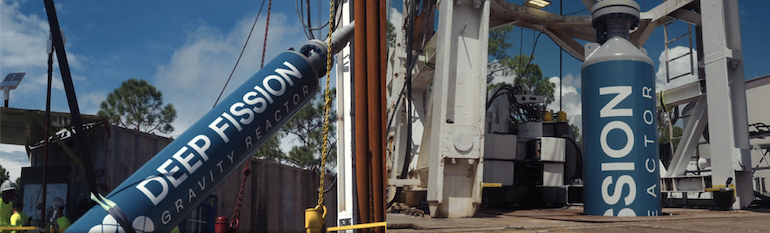
California-based start-up Deep Fission has demonstrated installation and retrieval of a full-size prototype reactor canister from a borehole using standard commercial drilling equipment. The company, which plans to place small modular pressurised water reactors in boreholes one mile underground, took delivery of the prototype reactor canister at the Great Plains Industrial Park in Parsons, Kansas in July.
A standard commercial crew lowered a 20-foot, full-size, non-nuclear replica canister 100 feet deep into a 34-inch-wide borehole and successfully retrieved it to the surface. No equipment had to be invented, custom-built, or specifically modified for nuclear service. The business model relies entirely on combining the existing commercial drilling supply chain with proven pressurised water reactor physics.
The Deep Fission Gravity Nuclear Reactor pairs standard pressurised water reactor (PWR) physics with deep-borehole drilling and geothermal heat exchange. By placing the technology a mile underground, the design bypasses the need for massive surface containment facilities.
Deep Fission’s design focuses on scalability, relying entirely on existing supply chains. Power output is 15 MWe per individual borehole reactor. Modular clusters ranging from 1-9 boreholes will yield 15-135 MWe per site. Each reactor uses four standard fuel assemblies using readily available low-enriched uranium (LEU). The mile-long vertical water column into which it is inserted generates 160 atmospheres of hydrostatic pressure naturally. This matches the internal core pressure, virtually eliminating traditional loss-of-coolant accidents.
A closed-loop system sends thermal energy up to a surface heat exchanger using geothermal principles to spin a traditional turbine generator. The target construction timeline is six months per reactor. Deep Fission uses a phased commercial pilot project format intentionally designed to transition directly into grid operation.
“The most important thing about this demonstration is what we did not have to do,” said Liz Muller, CEO and Co-Founder of Deep Fission. “We did not have to develop new technology. We used a rig and rigging that is commercially available in the field today, and our reactor uses pressurised water technology that has been operating in the nuclear industry for decades. Our innovation is in how we put proven pieces together, not in inventing something that has never been built. That is the difference between a science project and something you can deploy.”
Construction began on the primary test facility at the Great Plains Industrial Park in Parsons, Kansas ibn December 2025. The Department of Energy (DOE) approved the Nuclear Safety Design Agreement (NSDA) under the DOE Reactor Pilot Program. This formalised the safety framework needed to fast-track commercial demonstration.
The team is currently drilling a 6,000-foot data acquisition well to harvest critical local geological, hydrological, and thermal profiles. Following initial testing, the pilot plant is hoping to obtain a full licence from the Nuclear Regulatory Commission (NRC). This will allow it to pivot directly into delivering baseload power to utilities, industrial manufacturers, and data centres.


