
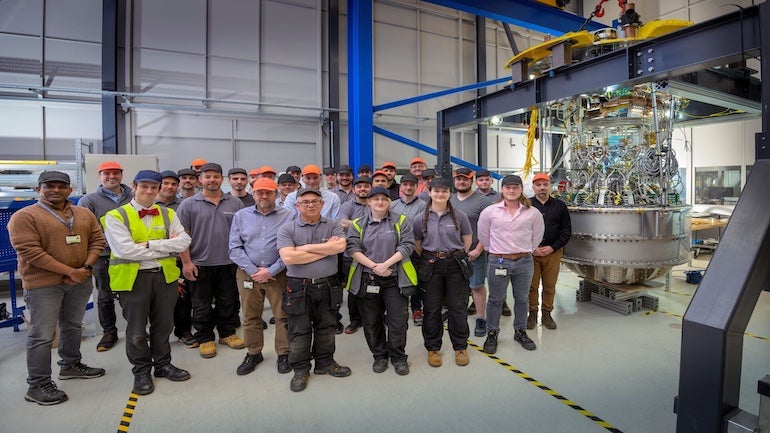
Tokamak Energy has completed a 14-month campaign on its fusion magnet system Demo4, validating the company’s ability to design, build, integrate and operate complete high-temperature superconducting (HTS) systems.
Demo4 demonstrated magnetic field strengths and angles, current densities, operational temperatures and mechanical loads together in a single, fully integrated device validating the magnets as well as the cryogenics, energisation systems, instrumentation and controls needed to run a balanced set of interacting magnets.
The system comprises 44 HTS coils arranged in a spherical tokamak configuration, 14 toroidal field (TF) limbs, each made up of two partially insulated HTS coils, and two poloidal field (PF) coils, each built from eight fully insulated HTS coils. It is cooled by a pressurised helium cooling system operating at up to 20 bar, and its behaviour was tracked by more than 600 sensors monitoring voltage, field, temperature and stress.
Demo4 reached a peak magnetic field of 13.7 Tesla, ran toroidal field coils at 5,600 Amps, and cycled the system across a wide operating range from 77 Kelvin down to 17 K, while withstanding transverse mechanical stresses of 150 MPa – almost 1,500 times atmospheric pressure.
The magnet system operated for roughly 10,000 hours in various states of energisation, including extended periods at high field. Testing also included multiple forced discharges up to 12.5 T and high current, designed to stress-test the system’s resilience under fault conditions.
Liam Brennan, Director of TE Magnetics, Tokamak Energy’s HTS business division, said: “HTS magnet design is key to the performance and affordability of a fusion power plant. Demo4 proves our integrated magnet system can perform under demanding fusion-relevant configurations.”
The learning gained from the campaign is now being applied in the company’s work with UK Fusion Energy, supporting the development of the HTS magnet system for STEP Fusion. The campaign is also shaping Tokamak Energy’s next generation of HTS magnet systems, including refined manufacturing and jointing methods, improved instrumentation, and a better understanding of operating margins.


