
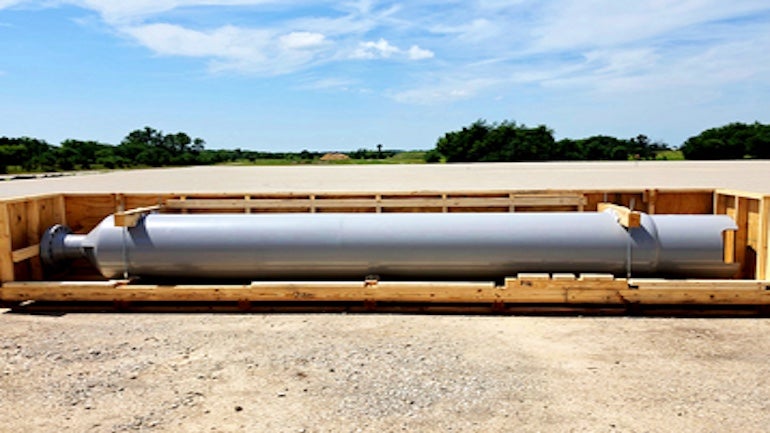
California-based start-up Deep Fission, which plans to place small modular pressurised water reactors in boreholes one mile underground, has taken delivery of its prototype reactor canister at the Great Plains Industrial Park in Parsons, Kansas. Deep Fission broke ground in December 2025 at the Kansas site, for its pilot project and plans to build a full-scale commercial plant there following the test reactor demonstration.
Delivery of the canister marks a key milestone in Deep Fission’s Proof-of-Concept Well programme and its Gravity Nuclear Reactor development. “This milestone reflects disciplined execution across fabrication, testing, and delivery, and strengthens the foundation for scaled deployment of our Gravity Nuclear Reactor system,” said Mike Brasel, Chief Operating Officer of Deep Fission.
Deep Fission said the factory-built prototype canister completed fabrication, hydrostatic testing, and delivery to Kansas without mentioning where it was manufactures. The official press releases and US Securities and Exchange Commission (SEC) filings from Deep Fission do not publicly name the specific third-party manufacturing vendor or the city where the prototype canister was fabricated.
However, the documentation says it was produced in an off-site, specialised “qualified facility” capable of handling the high-pressure welding and hydrostatic testing required for pressurised water reactor (PWR) components, rather than being assembled on-site in Kansas. According to Deep Fission’s announcements, the prototype was constructed using readily available, standard commercial-grade components to prove that the reactor’s outer structure does not rely on exotic or hard-to-source materials.
“The arrival of our prototype reactor canister at the Kansas site is a clear step forward in moving from design to deployed infrastructure,” said Mark Pérès, Chief Nuclear Officer of Deep Fission. “Successfully manufacturing, testing, and delivering this hardware demonstrates performance of our design and supply chain capabilities. Upcoming testing using this hardware will validate our approach and provide valuable learnings as we assemble, install and test key systems under non-nuclear conditions in our large diameter borehole.”
The Proof-of-Concept Well is Deep Fission’s nearly full-scale validation programme, designed to demonstrate a larger-diameter borehole and end-to-end installation workflow using commercial-grade, non-nuclear components prior to fuel loading. The programme is intended to validate each stage of underground deployment under real-world conditions while confirming engineering assumptions at scale and supporting the company’s broader commercialisation timeline.
The Gravity Reactor is based on established pressurised water reactor technology adapted for subsurface deployment, using pressure from a mile-long water column atop and surrounding the reactor in the borehole, to support operating pressure and cooling. In this design, thermal energy is transferred through a closed-loop system from the reactor canister to a heat exchanger, then rises to the surface in a secondary closed-loop for conversion into electricity, like a geothermal system.
Following arrival at the Parsons site, the non-nuclear prototype reactor canister will be prepared for testing as Deep Fission continues preparation for its large diameter drilling programme. The factory-built prototype canister will be used to test mechanics and fluid dynamics without any radioactive fuel.
In March, Deep Fission begun drilling its first data acquisition well in Parsons, Kansas – the first of three planned wells in the initial phase of site characterisation and engineering validation. It will be drilled to a depth of approximately 6,000 feet and will have a diameter of roughly eight inches.
The data acquisition well will make it possible to gather critical geological, hydrological, and thermal data to inform final engineering design, safety analysis, and regulatory planning. The drilling campaign and subsequent testing programme will support a series of technical evaluations aimed at accelerating progress to commercial deployment.
The Company is advancing permitting with the Kansas Department of Health and Environment (KDHE) for the 30-inch-wide non-nuclear borehole, which is expected to serve as the next major proof-of-concept milestone. Data collected from the preliminary 6,000-foot test well will be combined with large-hole tests to ensure the rock layers meet strict safety profiles before real nuclear deployment.
The Company is also progressing development of its full-scale nuclear demonstration borehole and advancing design of its primary heat exchanger. These parallel efforts support a phased strategy to accelerate iterative validation of the most unique aspects of Deep Fission’s commercial deployment model.
In August 2025, Deep Fission was one of 10 companies selected by the US Department of Energy (DOE) to receive support under its Reactor Pilot Program. This was authorised under the May 2025 Executive Order 14301, which allows reactor testing and deployment on sites outside of national laboratories.
Deep Fission was founded in 2023 by father-daughter team Elizabeth and Richard Muller, who also co-founded Deep Isolation in 2016 to develop the concept of placing canisters of radioactive waste hundreds of metres underground via a borehole.


