
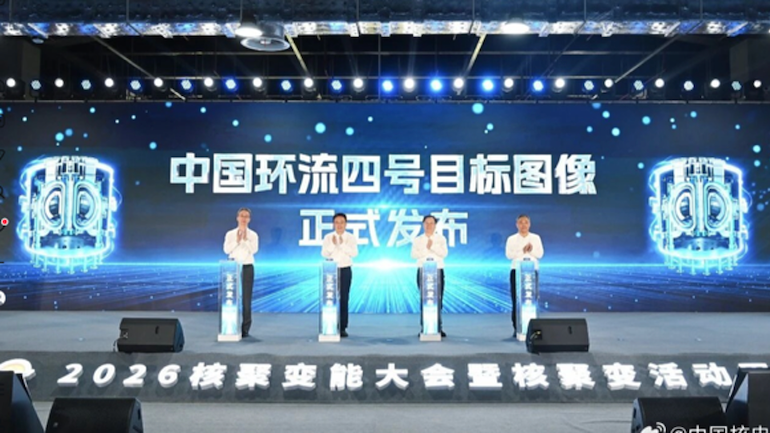
At the Fusion Energy Conference & Fusion Week 2026 in Shanghai, the target image of China’s HL-4 (Huanliu-4) tokamak was officially released during the opening ceremony. As the world’s first high-temperature superconducting high-field steady-state burning experimental platform, HL-4 is designed to achieve steady-state operation as its core objective.
Leveraging Shanghai’s comprehensive strengths in high-temperature superconductivity, digitalisation, and AI supercomputing, the device is set to accelerate rapid iteration in fusion technology. Serving as a core platform for China’s fusion energy transition toward engineering and commercial applications, the development of HL-4 will further consolidate China’s international standing in the fusion field and lay essential technical groundwork for future fusion reactor construction.
The HL-4 facility, being constructed in Shanghai, will use 25-tesla high-temperature superconducting (HTS) magnets. These magnets vastly increase the magnetic field strength while significantly shrinking the required footprint and iteration cycle of the tokamak.
Huanliu translates to “circulation” or “toroidal flow” – a direct reference to the donut-shaped magnetic field used in a tokamak to twist and trap plasma. HL-1 – HL-4 were all designed by the Southwestern Institute of Physics (SWIP) in Chengdu.
HL-1, built in the late 1970s and completed in 1984, was the first large-scale, independently built tokamak in China. It did not produce massive amounts of power or use advanced superconductors, but taught Chinese engineers how to construct a vacuum chamber, handle basic magnetic coils, and safely control plasma. It was later upgraded to the HL-1M to test enhanced plasma heating technologies.
HL-2A began operations in 2002 and was significantly upgraded to the HL-2M around 2020. The HL-2 series transitioned the Chinese programme into advanced plasma physics. HL-2A was crucial for studying “H-mode” (high-confinement mode) – the ultra-efficient plasma state required for power plants. The upgraded HL-2M featured a unique, flexible magnetic structure designed to handle extreme heat loads, serving as a testbed for technologies used in ITER (the International Thermonuclear Experimental Reactor).
HL-3 (originally named the HL-2M upgrade) is China’s largest operational conventional (copper-coil) tokamak. In 2023, it made headlines by generating a plasma current of over 1m amperes (1 MA) in high-confinement mode. It mimics the core physics of a true burning reactor, but because it uses copper magnets, it cannot run indefinitely without overheating.
HL-4 takes the plasma physics learned from HL-3 and marries it to HTS magnets. This completely eliminates the overheating limitations of the copper coils, taking China from short physics pulses to continuous, industrial power engineering. The target design aims for a minimum fusion energy gain of Q = 5, with an eventual power output of 100–200 MWe. Q = 5 is the metric used by physicists to describe the efficiency of a nuclear fusion reactor. It means the system generates five times more power from fusion reactions than the power injected to heat the plasma.
Commissioning is targeted in 2027 for the initial Shanghai facility with completion of the first 25T HTS high-field magnet research, development, and testing line set for 2028. Full prototype magnet development and completion of the facility, aligning with China’s broader push to demonstrate fusion power generation is expected by the end of the decade
China’s HL-4 tokamak uses a real-time data-driven digital twin framework powered by high-speed AI supercomputing to predict and correct chaotic plasma movements faster than human operators can react. The system creates a live, high-fidelity computer replica of the superheated plasma inside the tokamak chamber. Thousands of sensors on the physical HL-4 device feed real-time magnetics, temperature, and density readings into the virtual model via high-speed edge computing.
Instead of waiting for instabilities to happen, the AI uses physics-informed neural networks to forecast plasma shape and current changes hundreds of milliseconds before a disruption occurs. Intelligent reinforcement learning agents instantly adjust the HTS magnetic fields and heating inputs to suppress turbulence and keep the core stable
China’s fusion roadmap splits into three distinct lines of research: the academic vanguard (EAST – Experimental Advanced Superconducting Tokamak), the immediate national demonstration bridge (BEST – Burning Plasma Experimental Superconducting Tokamak), and the commercial-scale industrial framework (HL4).
EAST, located at the Institute of Plasma Physics (ASIPP) in Hefei, explores extreme plasma durations. It proved able to hold a 100m degree Celsius plasma stable for long stretches, but it relies on older, bulkier Low-Temperature Superconducting (LTS) technology.
BEST, also built in Hefei, acts as the immediate intermediate bridge to the national power grid. In mid-2026, it successfully tested the world’s largest 582-tonne superconducting toroidal field magnet. BEST focuses on the brute force physics of burning a deuterium-tritium fuel mix to generate China’s first fusion-derived electricity.
While EAST and BEST focus on state-driven milestones using traditional giant magnets, Shanghai’s HL-4 relies entirely on 25T HTS magnets. HTS tape can handle massive magnetic pressures while operating at slightly warmer cryogenic temperatures, meaning the HL-4 reactor can be drastically smaller, cheaper, and faster to iterate than BEST, establishing the blueprint for cost-effective commercial fusion plants.
To manufacture the complex 25-Tesla HTS magnets required for HL-4, China has mobilised its premier high-tech industrial cluster in the Yangtze River Delta (YRD). This region houses a tightly knit innovation consortium led by state enterprises, academic institutions, and specialised private suppliers. These include:
- China Fusion Energy Co Ltd (Consortium Leader), which orchestrates the commercialisation pipeline, anchoring the manufacturing supply chain between private component makers and national labs.
- Shanghai Superconductor Technology Co Ltd (SST) – a global heavyweight in manufacturing second-generation 2G-HTS wire tapes providing the highly uniform, high-current-density superconducting tapes required to wrap the 25T high-field magnets.
- Energy China (CEEC) & Shanghai Electric Group – major industrial equipment conglomerates handles the precision cryogenic vacuum chambers, advanced structural reinforcement blocks, and heavy thermal insulation jackets capable of handling immense magnetic stress.
- The Shanghai Institute of Superconductivity, which partners directly with factories to oversee multi-sensor quench detection systems and millisecond-level automated shut-offs to ensure magnet safety during high-field tests.


