
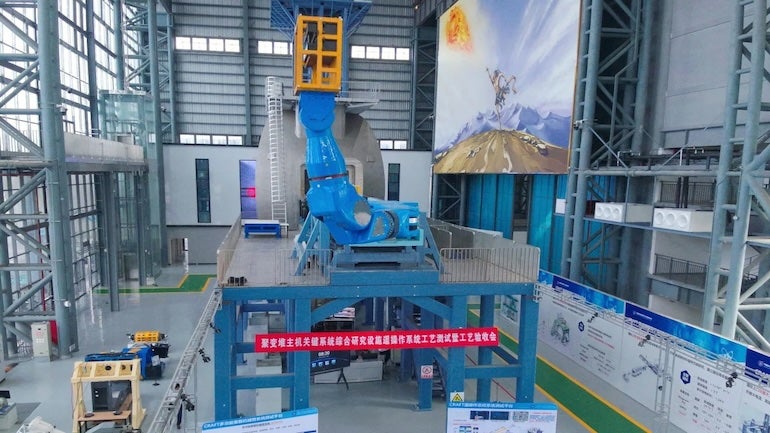
China has built and tested a giant robot to perform maintenance work on future fusion reactors. The remote handling test platform, which consists of three arms, has passed expert evaluation and acceptance, according to a report by the state-owned Science and Technology Daily.
The evaluation showed that the giant main arm of the robotic system could handle a payload of 60 tonnes with exceptional precision, achieving accurate positioning and vertical lifting to within 4mm. This far exceeds payload of the world’s largest and most complex robot systems currently deployed for hazardous tasks in the nuclear power industry. For example, Japan’s Mitsubishi Heavy Industries has developed a 7-metre-long robotic arm for maintaining and inspecting nuclear reactor vessels, with a maximum arm tip load of 2 tonnes.
The two smaller arms of the Chinese system also offer exceptional flexibility and precision, consistently returning to a precise position with an accuracy of ±0.01mm.
The robot is a key subsystem of the Comprehensive Research Facility for Fusion Technology (CRAFT), nicknamed Kuafu after a mythical Chinese figure who tried to capture the sun. CRAFT is a platform on which engineers can develop and test the key components of fusion reactors. The facility was built under the supervision of the Institute of Plasma Physics, a Chinese Academy of Sciences affiliate in Hefei, Anhui province.
During the operation of a fusion reactor, core components such as the cladding – protective layers designed to withstand extreme heat, pressure and radiation from the fusion plasma – are susceptible to damage. Maintenance can only be performed remotely by robots able to operate under the stress of high heat, strong magnetic fields and neutron irradiation.
Despite rapid advances in industrial robotics, current models are not designed to withstand such harsh environments while also carrying heavy loads with ultra-high precision. Pan Hongtao, an Institute of Plasma Physics researcher who oversaw the development, said his team had developed a machine capable of meeting these highly challenging requirements by overcoming technological hurdles relating to materials, robotic structure, sensor ability, control and reliability.
The technologies mastered in developing the robot are expected to contribute to the operation of next-generation nuclear fusion devices, both domestically and overseas. These include the Burning Plasma Experimental Superconducting Tokamak in Hefei, which is expected to be completed in 2027, and the International Thermonuclear Experimental Reactor (ITER) under construction in France. ITER’s remote-handling system manages payloads of up to 45 tonnes.
Pan said related technologies could also be extended to other applications, including nuclear plant maintenance, aerospace, heavy machinery operations and emergency rescue. CRAFT is expected to be completed by the end of the year. According to its developer, more than 300 scientists and engineers are working on the project, which will incorporate ITER technologies as well as innovations still under development.


