
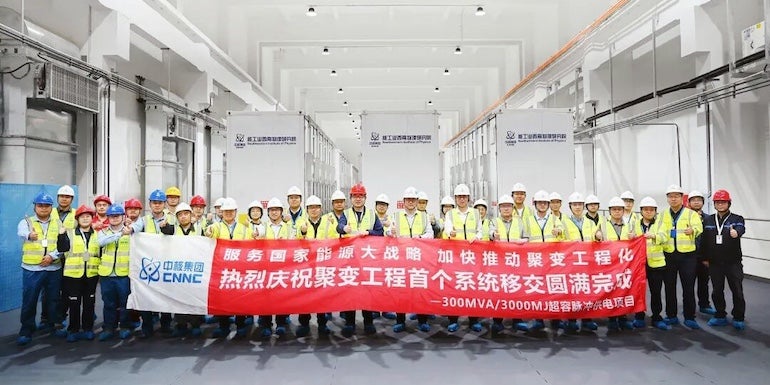
China National Nuclear Corporation (CNNC) has commissioned a breakthrough supercapacitor-based pulsed power supply system to modernise the operation of the Huanliu-3 (HL-3) tokamak. “This system represents a significant evolution from traditional pulse step modulation (PSM) and flywheel generator configurations, addressing critical constraints in the high-energy operation of nuclear fusion devices.
The commissioning of the 300 MVA / 3000 MJ supercapacitor-based energy storage system (SCESS) is a landmark operational pivot for the HL-3 installation marking the transition from individual subsystem installation to comprehensive system-wide adjustment.
The introduction of the supercapacitor-based pulsed power supply enhances the HL-3 experimental reactor across several key vectors. Modernising a tokamak requires rapid, massive bursts of energy to run magnetic confinement coils and auxiliary heating. Drawing this directly from the localised electricity grid can trigger instability. Supercapacitor arrays allow energy to be safely stored over minutes and discharged in intense, multi-megawatt bursts, lowering the required grid footprint.
The system is explicitly tailored to enable rapid, fast-switching power for high-power Neutral Beam Injection systems. By integrating soft-switching DC-DC resonant converters with the supercapacitor units, the facility can modulate heating power injections exceeding 5 MW into the plasma with minimised switching losses.
Achieving stable magnetic confinement demands millisecond-level dynamic responses from the power supplies running the toroidal and poloidal field magnets. The fast charge-discharge and high power density properties of supercapacitors support microsecond/millisecond-level current ramps to mitigate chaotic plasma movements.
This milestone fits directly into China’s broader nuclear fusion roadmap handled by the Southwestern Institute of Physics (SWIP) in Chengdu. As China’s largest conventional copper-coil tokamak, the HL-3 has already achieved a major “dual hundred-million-degree” milestone, heating plasma ions to 120m degrees Celsius and electrons to 160m degrees Celsius. Upgrading its power system optimises its operation within high-confinement mode (H-mode).
While the HL-3 relies on copper magnets that limit the duration of physics pulses before overheating, its localised power supply and structural findings are serving as the foundation for the newly unveiled HL-4 tokamak. Being constructed in Shanghai, the HL-4 will leverage High-Temperature Superconducting (HTS) magnets to move away from short pulsed bursts into continuous, steady-state burning operations.
The HL-3 transition was attended by Zhang Libo, SWIP Director and Chen Qingchuan, Deputy Director. Zhang Libo noted that the transition of the first system was the result of the joint hard work of all organisations involved in the construction, and also made it possible to accumulate experience and create conditions for the subsequent comprehensive adjustment of the systems.
During the project, SWIP coordinated interactions with organisations such as CNNC’s Seventh Design Institute, CNNC Huaxing, CNNC Consulting, China Electric Equipment Group Co Ltd and Xuji Electric, combining the stages of system development, design, manufacturing, installation and commissioning. During more than 10 months of continuous construction, the supercapacitor pulsed power supply system underwent reconstruction, installation of equipment and static adjustment of subsystems.
During construction, the engineering team, faced with difficult working conditions and the intersection of many specialties, used mock-up modelling in combination with three-dimensional Building Information Modelling to pre-play the progress of construction. This made it possible to identify and eliminate spatial conflicts, contradictions in the sequence of work, intersections of pipelines and communications in advance, as well as inconsistencies in the distribution of resources and strengthen control of technical and safety risks at their source. At the same time, the project relied on a digital control system, providing risk prevention and a closed cycle of improvements throughout construction.


