
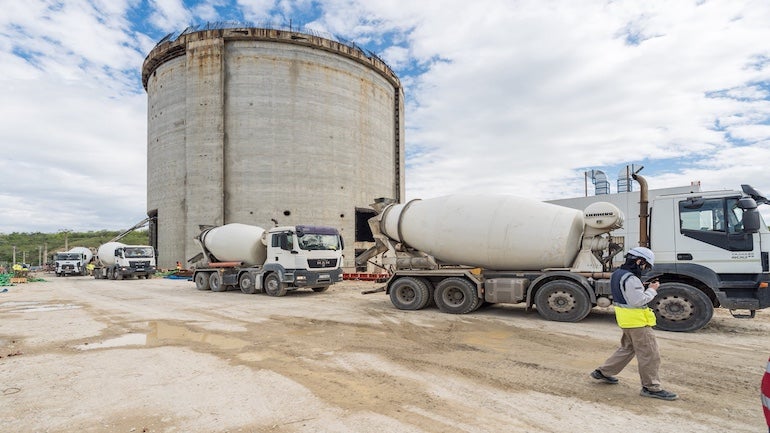
Romanian nuclear utility SN Nuclearelectrica (SNN) has completed the first continuous concrete pour for the permanent foundation of the Radioactive Waste Storage Facility (DIDR-U5), which is being built as part of refurbishment project at unit 1 of the Cernavodă NPP. Approximately 3,470 cubic metres of concrete was used for the foundation, equivalent to about 380 concrete mixer trucks, with the operation carried out under the required strict safety, quality, and operational coordination standards.
In September 2025, Nuclearelectrica obtained a construction permit for from the Commission for the Control of Nuclear Activities (CNCAN) the construction permit for DIDR-U5. After 30 years of operation, unit 1 is being refurbished to enable it to operate for another 30 years.
The Cernavodă site houses two Candu 6 pressurised heavy water reactors (units 1&2) on a site originally constructed for five. Construction of three more units began but was stopped in 1990 when unit 3 was 52% complete and unit 4 was 30% complete. Romania is now planning to complete units 3&4 and is also looking to the possible deployment of small modular reactors (SMRs).
In December 2024, SNN signed the engineering, procurement and construction (EPC) contract for the estimated €1.9bn ($ 2.2bn) refurbishment project with a consortium of Korea Hydro & Nuclear Power, AtkinsRéalis’s Candu Energy, Canadian Commercial Corporation and Ansaldo Nucleare. In September 2025, SNN and a banking syndicate led by JP Morgan signed two financing agreements totalling €620m for the refurbishment of Cernavodă unit 1 and the Cernavodă NPP 3&4 expansion project.
The two 720 MWe operating units (1&2) provide about 20% of Romania’s power. They began operation in 1996 and 2007 with a 30-year design life. A further 30 years of operation is possible following refurbishment. Work to extend unit 1 began in 2017 and is currently in the second of three phases, expected to be completed in 2026. This involves preparatory measures. The third phase, scheduled for 2027 to 2029 will see the unit shutdown for refurbishment.
In April, the European Commission (EC) opened an in-depth investigation to assess whether Romania’s plans to grant public support for the refurbishment and lifetime extension of unit 1 of the Cernavodă NPP is in line with EU State aid rules.
“With significant developments in recent years at the EU policy level, nuclear energy plays an important role in the EU’s energy mix, contributing to security of supply and decarbonisation goals,” said Nuclearelectrica General Manager Cosmin Ghita. “The installed nuclear capacity in the EU is projected to reach 109 GWe by 2050 (base case scenario), resulting from the extension of the operational life of existing reactors and the construction of new high-capacity reactors.”
He added: “Romania currently possesses all the advantages needed for developing the nuclear industry – experience, know-how, specialists, infrastructure, an integrated nuclear fuel chain, and long-standing international partnerships in the development of the Romanian nuclear programme, as well as the trust of international banking institutions. All of these collectively represent essential capabilities for expanding the Romanian nuclear programme through the refurbishment of unit 1, followed by the project for units 3&4 and the project for SMRs.”


