Canadian-US global investment firm Brookfield and US start-up The Nuclear Company (TNC) have announced a partnership to form a new company, as yet unnamed, to promote development of Westinghouse nuclear reactor technology. The new project development company will offer execution capabilities for the deployment of nuclear projects based exclusively on Westinghouse reactor technology, including AP1000 and AP300.
It will also offer end-to-end project management, licensing support, and oversight of engineering, procurement, construction and commissioning activity. The parties expect to progress toward definitive documentation in the coming months, subject to customary approvals and conditions.
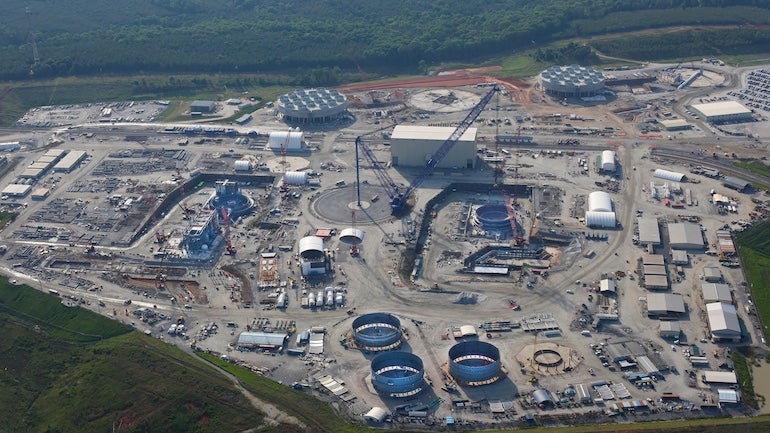
Brookfield has selected the new company as the project manager for its ongoing efforts to potentially develop the two partially constructed AP1000 units at the VC Summer NPP near Jenkinsville (South Carolina), now renamed the Fairfield County SC nuclear project. TNC described the project as “one of the most execution-ready nuclear development opportunities in America. Santee Cooper, South Carolina’s state-owned utility company, supports the company’s role on the project”.
However, this is not a universally-held view. According to Bloomberg: “VC Summer is considered a low point for the US nuclear industry. South Carolina utility Santee Cooper and the plant’s former co-owner, Scana Corp, halted construction on two AP1000 reactors in 2017 after costs climbed above $20bn and Westinghouse, a contractor on the project, filed for bankruptcy. It was one of two US efforts to build the Westinghouse AP1000 reactors; the other, at the Vogtle plant in Georgia, was completed in 2024, seven years behind schedule and more than $20bn over budget.”
In October 2025, Santee Cooper, South Carolina’s state-owned electric and water utility, signed a memorandum of understanding with Brookfield Asset Management to finish the two AP1000 reactors at C Summer. If Santee Cooper and Brookfield can strike a final deal to finish the project, the utility will be paid $2.7bn. Santee Cooper could also own up to 25% of the two new nuclear reactors once operational, including a quarter of the energy generated. It could take up to two years to complete a final investment deal between the utility and Brookfield.
Referring to the new company, TNC Chief Nuclear Officer Joe Klecha noted: “Our team was built on the field of Vogtle and on some of the most complex energy projects in the world. We know what it takes to deliver nuclear. What’s been missing is a model that brings together the people, the capabilities, and the capital to do it at speed and scale. That’s what this partnership creates.”
The new company will support due diligence activity for project and oversee the delivery should it move forward to Final Investment Decision. Development of the project remains subject to further evaluation, regulatory approvals, and the execution of definitive agreements.
“This joint venture reflects Brookfield’s disciplined approach to large-scale infrastructure investment and focus on partnering with experienced operators,” said Wyatt Hartley, Managing Partner at Brookfield. “By combining our global infrastructure development capabilities with nuclear project delivery expertise, we believe this platform has the potential to accelerate the American nuclear resurgence, building on the momentum of the Westinghouse partnership with the US Government.”
Brookfield acquired Westinghouse from Toshiba in 2018 following its 2017 bankruptcy. In 2023, Cameco joined Brookfield as a co-owner of Westinghouse. In 2025, Westinghouse, Brookfield, and Cameco entered into a strategic partnership with the US government to accelerate the deployment of at least $80 bn of AP1000 and AP300 reactors across the USA. TNC, launched in 2024, says it aims to modernise nuclear construction through a “design-once, build-many” approach, backed by a proprietary AI-driven platform that transforms reactor construction into a data-driven, predictable process.
The proposal to restart the cancelled VC Summer nuclear reactor construction project faces many challenges, according to an August 2025 detailed report from Savannah River Site (SRS) Watch. The 24-page report outlines major stumbling blocks to revival of the project. The report, Economic, Technical and Regulatory Challenges Confound Restart of the Terminated V.C. Summer Nuclear Reactor Construction Project in South Carolina, presented obstacles to the restart proposal.
SRS Watch Director Tom Clements pointed out that ratepayers are still paying 5.22% of the bill for the terminated project and that “the restart effort could once again saddle customers with additional massive costs if VC Summer 2.0 proceeds”. He noted that the earlier project owners, Dominion Energy, which owned 55% of the project and owns the VC Summer site where a single operating reactor is now located, and the South Carolina Public Service Authority (Santee Cooper), originally owning 45% of the project, have no interest in pursuing project restart.
Major components such as the AP1000 reactor vessels and steam generators have been sitting exposed to the weather and degrading in the environment for more than eight years. The Nuclear Regulatory Commission (NRC) licence has expired. The pedigree of the quality of construction, such as rebar and concrete placement and quality, would have to be reestablished. The fact that the project is about 40% complete and the reactors never operated means licensing must begin from scratch. “If NRC regulations are weakened in response to executive orders by the Trump Administration, such weakening could lead to unsafe construction and operation if the project were to somehow to go forward,” the report said.
It is unclear how much equipment remains to be resold. “The stored equipment may now be obsolete, may no longer have NRC pedigree or may not function as anticipated during the time of original construction. Some of the equipment could have been in storage for 10 years or more. Under strict NRC oversight, every inventoried component would likely have to have its origin re-established and be retested and recertified and may have to be replaced, which would be costly and perhaps not feasible,” the report noted.
The report said Westinghouse plans for new AP1000s are unclear. While Westinghouse is pushing its AP1000 reactor, it remains unclear if Westinghouse can establish necessary nuclear quality supply chains for the AP1000 anywhere, including related to the restart of the VC Summer project. During the failed construction, supply chains failed, dealing a decisive financial and technical blow to the project.
The cost and schedule of new Westinghouse AP1000s is unclear. Westinghouse CEO Dan Sumner claimed in June 2025 that the company could begin to deploy 10 new AP1000s in the US by 2030 at a cost of at least $7.5bn each. The sites are unknown and interested utilities and investors are unknown. The number of units reflects an Executive Order from the White House. “Given the failure of the US AP1000 projects, this could well be Westinghouse rhetoric designed to please gullible politicians who are excited about new nuclear reactor construction or to entice unknowing utilities and investors. And the price tag of $7.5bn has no demonstrated basis in existing facts about the AP1000 cost.”
According to the report, federal rhetoric supporting nuclear power is not enough. Secretary of Energy Chris Wright has often said that the Trump administration will “unleash” US energy dominance, including with new nuclear power. “The subtext is that taxpayers and ratepayers will be thrashed by the ‘unleashing’, which could essentially be a repeat of the first failed round of AP1000 construction.”
The report concludes: “Restart doesn’t look to offer sustainable, efficient or affordable energy for South Carolina so must be viewed with caution. Likewise, the response to restart hurdles could also be instructive to other utilities or countries that, in a sea of concepts for imaginary “small modular reactors” – none of which exist in the US – might consider pursuing the AP1000 reactor, for which Westinghouse is making an endless sales pitch for a product that has faced massive cost overruns and unresolved problems in the US.”