
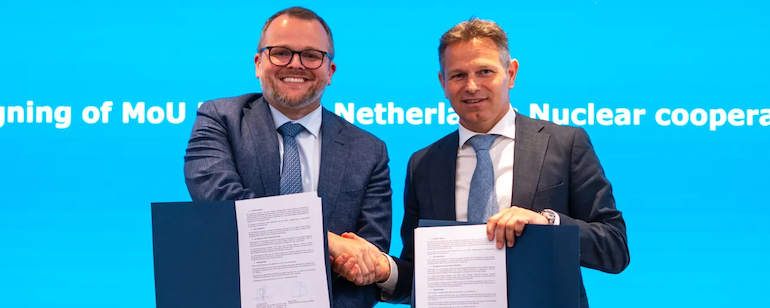
The Netherlands and Belgium have announced the strengthening of their cooperation in the field of nuclear energy. This collaboration aims to contribute to a better exchange of knowledge and a stronger supply chain, strengthening the nuclear ecosystem. It also underlines the importance of nuclear in the energy transition and the energy independence of both countries.
Belgian Energy Minister Mathieu Bihet, and the Netherlands Secretary of State for Climate & Green Growth, Jo-Annes de Bat, endorsed these projects in a memorandum of understanding (MOU) signed during the 4th Belgium-Netherlands Nuclear Conference (BeNeNuc26) held in Brussels.
Under the MOU, the Netherlands and Belgium will collaborate in the development of a wider research base (R&D) as well as in the strengthening of knowledge exchanges through periodic meetings. The Netherlands will benefit from the industrial expertise of Belgium due to its greater number of operational NPPs. Netherlands will share the knowledge acquired in the context of the construction of new NPPs and developments related to small modular reactors (SMRs). This applies in particular to site studies, authorisations, procedures and components.
Belgium has seven nuclear power reactors – three at Tihange near Liege and four at Doel near Antwerp. All seven are pressurised water reactors (PWRs) operated by Electrabel, part of Engie. Apart from Doel 1&2, which are 430 MWe plants, the others have a capacity of approximately 1000 MWe.
Under the 2003 phase-out law, which was repealed in 2025, Doel 1 was to be taken out of service in 2015 but was allowed to operate until 2025 under amended legislation. Doel 3 was closed in 2022 and Tihange 2 in 2023. Tihange 1 closed in September 2025 and Doel 2 the following December. Doel 4 and Tihange 3 were scheduled to close in November 2025 but the conflict in Ukraine and subsequent sanctions on Russian oil and gas resulted both being allowed to operate for 10 more years.
Netherlands has one operating NPP at Borssele, 515 MWe PWR that was commissioned in 1973. In December 2021, the new coalition government of the Netherlands decided to prioritise nuclear energy as part of its climate and energy policies. Two new 1000-1650 MWe projects are to be completed by about 2035 to provide 9-13% of electricity production with the Borssele site viewed as the most suitable location for the new reactors. The government is also taking steps to prepare the Netherlands for the possible deployment of SMRs.
Under the agreement, the two countries also plan to organise joint innovation missions, allowing companies and organisations to exchange expertise across borders. Shared training programmes for future nuclear workers are also being considered, as both countries expect thousands of workers will be needed for future reactor projects. In addition, Belgium and the Netherlands want to work together on long-term solutions for the management, storage and disposal of radioactive waste.
“Future European nuclear projects will require solid value chains, high-level skills and close cooperation between states, research centres and industrialists,” said Belgian Energy Minister Mathieu Bihet. “Belgium and the Netherlands have recognised expertise and intend today to pool their strengths to contribute to the development of a more robust, more innovative and more independent European nuclear ecosystem.”
Dutch State Secretary for Climate & Green Growth Jo-Annes De Bat noted: “The Netherlands is currently at a pivotal moment, with projects aimed at strengthening its energy independence thanks to a greater share of nuclear energy in its energy mix. In a rapidly evolving sector that requires a high density of knowledge, cooperation with neighbouring countries is essential. Together with Belgium, we can give the necessary impetus to our common ambitions. In this way, we are strengthening the sector and also contributing to a broader European dynamic.”


