
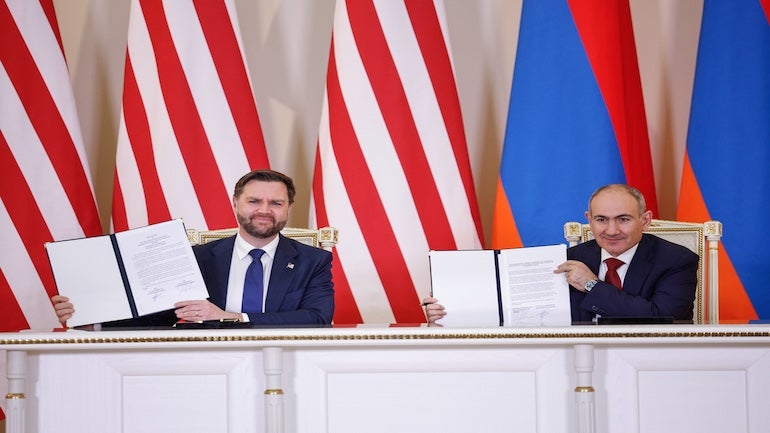
Following a meeting in Yerevan Armenian Prime Minister Nikol Pashinyan and US Vice President JD Vance signed a joint statement on the completion of negotiations on the Agreement on Cooperation between the Government of the Republic of Armenia and the Government of the United States of America in the Field of Peaceful Use of Nuclear Energy, known as a 123 Agreement.
The agreement, which will provide the legal framework for export of nuclear material, equipment and components from the US to Armenia is named after Section 123 of the US Atomic Energy Act, which requires the conclusion of a peaceful cooperation agreement before significant transfers of nuclear material or equipment from the US can begin.
“Once this gets underway, it will pave the way for the American and Armenian companies to strike deals on civil nuclear projects. That means up to $5bn in initial US exports plus an additional $4bn in long term support through fuel and maintenance contracts.” Vance said.
He added: “This is a classic win-win for both Armenia and the United States of America. This means stronger energy security for my own country and I also think it means stronger energy security for Armenia, and it also will create a lot of new jobs back home in the United States. It means small modular reactors, American technologies will be coming to this country. Again, this is one of the few countries where we feel confident enough to invest at this level, to send this kind of technology.”
Pashinyan said: “This agreement will open a new chapter in the deepening energy partnership between Armenia and the United States, and will contribute to the diversification of Armenia’s energy resources by implementing safe and innovative technologies. I also expressed my gratitude for the long-standing support provided to Armenia by the United States in the field of nuclear security and expressed willingness to further develop sectoral cooperation in areas of greatest importance to both countries.”
Earlier in February Armenia’s Minister of Territorial Administration & Infrastructure, David Khudatyan said the Armenian authorities had decided that its new nuclear power plant will be of a small modular reactor (SMR), but that the final choice of technology is still to be decided. “We continue to study proposals, including with partners from Russia, the USA, China, South Korea and France. The final decision on choosing a model will be made in 2026–2027,” he told a press conference. He said there was no need for haste in making this decision, noting that, after choosing a model, a partner country will be determined. He added that technologies for modular nuclear power plants have not yet become widespread and require additional research, which is currently ongoing.
The currently operating Armenian NPP (ANPP) at Metsamor was built in the 1970s with two Soviet-supplied VVER-440-V230 units but was closed following a devastating earthquake in 1988. However, unit 2 was recommissioned with Russian help in 1995 following severe energy shortages. In March 2014, the Armenian government decided to extend the plant’s service life to 2026. Most of the overhaul (until 2019) was funded by an interstate loan from Russia.
In December 2024, following a meeting of the Armenian-Russian intergovernmental commission it was decided to extend the life of the plant until 2036. The Armenian government allocated $65m for the implementation of the programme, which is being undertaken by Russian company Rusatom Service.
Construction of a new nuclear plant has long been part of Armenia’s overall plan, although finance has proved to be an obstacle. In 2024, Pashinyan said it was planning to build a new NPP within 8-10 years, and a preliminary feasibility study for the construction of a new 1200 MWe unit was under consideration. At that time, Gera Sevikyan, Advisor to the ANPP Director General told ArmInfo that a fundamental decision had been made to build a new unit using the Russian TOI reactor with a capacity of 1,200 MWe.
Rosatom continues to offer support to Armenia’s nuclear programme. Three days before Vance’s visit, Rosatom Director General Alexei Likhachev held talks with the Speaker of the Armenian National Assembly, Alen Simonyan. Likhachev gave a briefing on the progress of work to extend the life of the ANPP and also discussed in detail the construction of new nuclear power units. Rosatom subsequently said it is offering Armenia comprehensive cooperation in the field of nuclear energy including the construction of large, medium, and small-capacity NPPs and related projects, including non-nuclear ones.


