
The Armenian authorities have decided that its new nuclear power plant will be of a small modular reactor (SMR), but the final choice of technology is still to be decided, according to Armenia’s Minister of Territorial Administration & Infrastructure, David Khudatyan.
“It was decided that the new nuclear power plant should be modular. We continue to study proposals, including with partners from Russia, the USA, China, South Korea and France. The final decision on choosing a model will be made in 2026–2027,” he told a press conference.
He said there was no need for haste in making this decision, noting that, after choosing a model, a partner country will be determined. He added that technologies for modular nuclear power plants have not yet become widespread and require additional research, which is currently ongoing.
Construction of a new nuclear plant has long been part of Armenia’s overall plan, although finance has proved to be an obstacle. In 2024, Prime Minister Nikol Pashinyan said it was planning to build a new NPP within 8-10 years, and a preliminary feasibility study for the construction of a new 1200 MWe unit was under consideration.
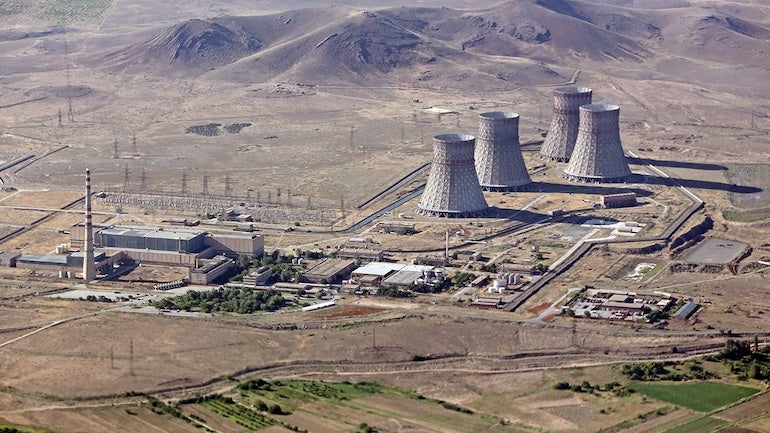
The currently operating Armenian NPP (ANPP) at Metsamor was built in the 1970s with two Soviet-supplied VVER-440-V230 units but was closed following a devastating earthquake in 1988. However, unit 2 was recommissioned with Russian help in 1995 following severe energy shortages. In March 2014, the Armenian government decided to extend the plant’s service life to 2026. Most of the overhaul (until 2019) was funded by an interstate loan from Russia.
In December 2024, following a meeting of the Armenian-Russian intergovernmental commission it was decided to extend the life of the plant until 2036. The Armenian government allocated $65m for the implementation of the programme, which is being undertaken by Russian company Rusatom Service.
This year, ANPP will be shut down for approximately five months from April for a major scheduled maintenance, Khudatyan said, noting that power supplies would not face problems given the availability of other generating capacity that is currently underutilised, specifically solar power plants which accounted for approximately 15% of all electricity generated in 2025.
“Implementation of the programme for the first NPP life extension until 2026 is continuing while the second programme provides for extending the life for another 10 years.” He added that the necessary contracts had been concluded, and that work is being carried out in accordance with the approved calendar schedule. “We are confident that the programme will be successfully implemented, and the NPP will remain connected to the Armenian energy system in the next 10 years.”


